21 min read
This report analyzes the IPv4 transfer market for August 2026, based on completed IPv4Center marketplace transactions and official RIR transfer records.
Executive Summary
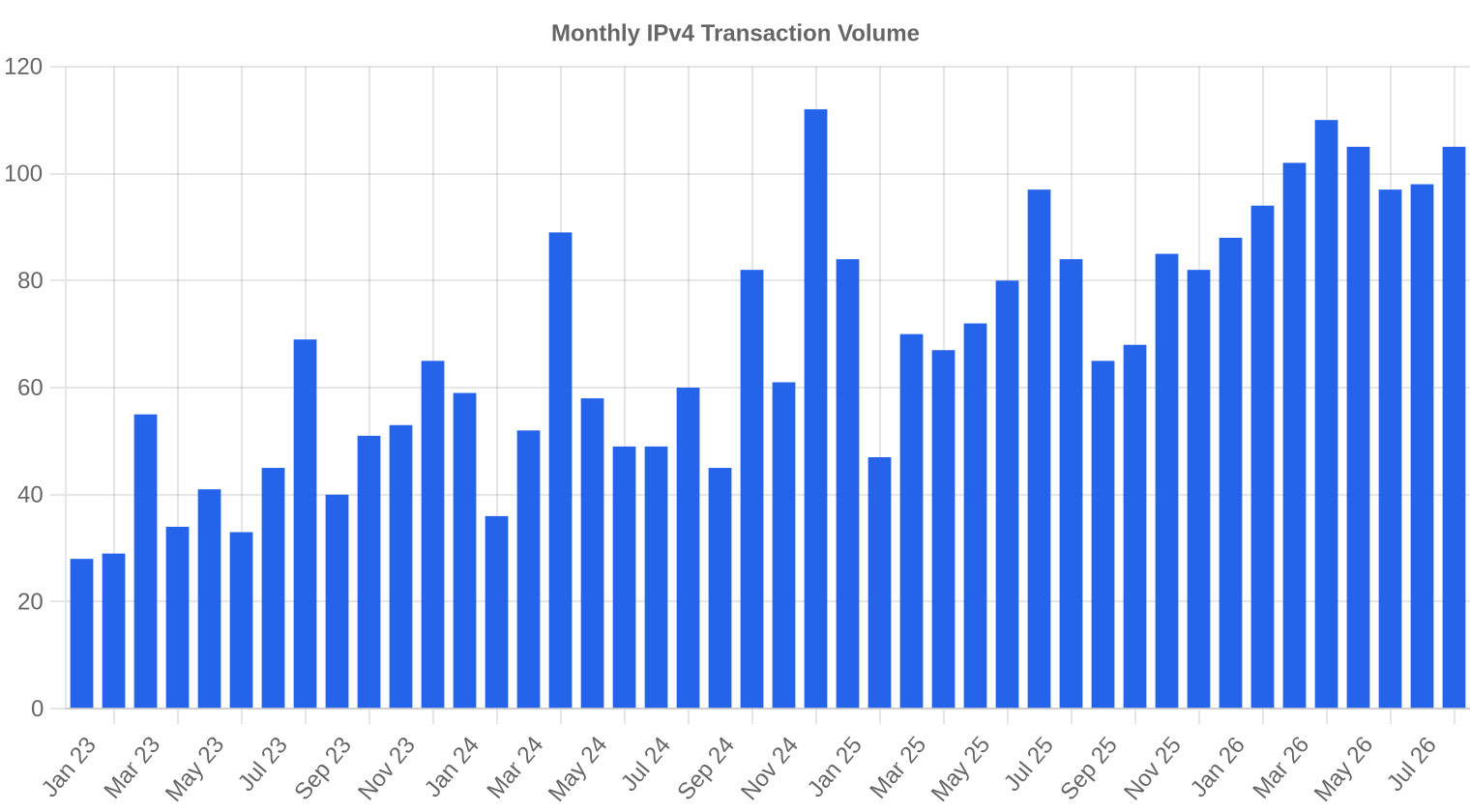
The IPv4 transfer market moved 428,288 addresses across 105 transactions in August 2026, generating $5.9 million in total value. The blended average landed at $20.30/IP, down $1.60 from July 2026 and 21% below August 2025's levels — a year-over-year decline that now looks structural rather than cyclical. Transaction count rose 9.4% month-over-month, suggesting buyers remain active but are extracting better terms. The median of $19.29 confirms that the typical deal is now firmly sub-$20 territory. Market trend classification: stable, with a negligible -0.04% regression slope.Market Overview
| Transactions | 105 |
| IP Addresses Traded | 428,288 |
| Estimated Market Value | $5,898,039 |
| Average Price / IP | $20.30 |
| Median Price / IP | $19.29 |
| RIR Transfers | 196 |
Year-over-Year Comparison
| Metric | This period | A year earlier (August 2025) | Change |
|---|---|---|---|
| Transactions | 105 | 84 | +25.0% |
| IP Addresses Traded | 428,288 | 698,880 | -38.7% |
| Estimated Market Value | $5,898,039 | $12,281,549 | -52.0% |
| Average Price / IP | $20.30 | $25.71 | -21.0% |
| RIR Transfers | 196 | 648 | -69.8% |
Price Dynamics
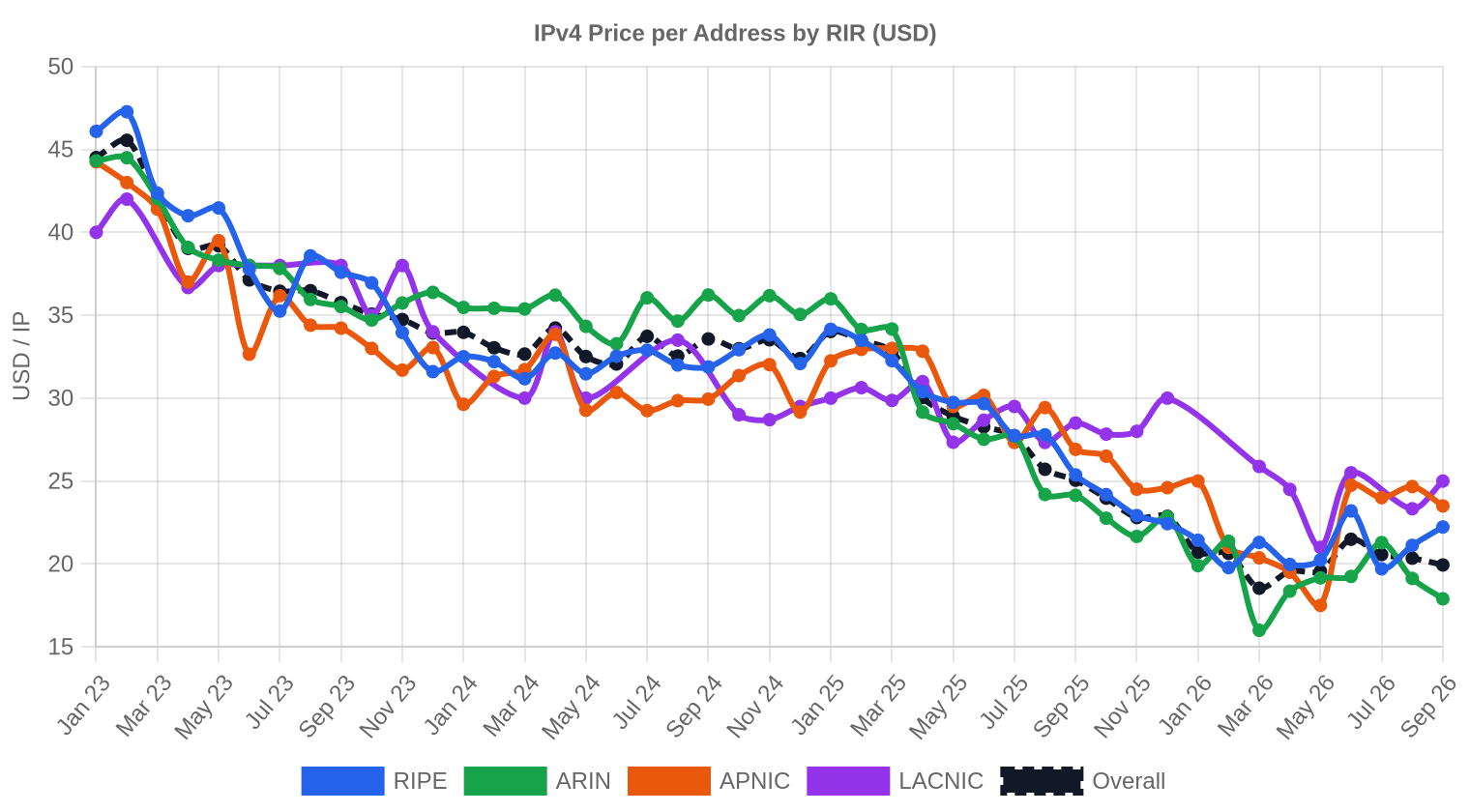
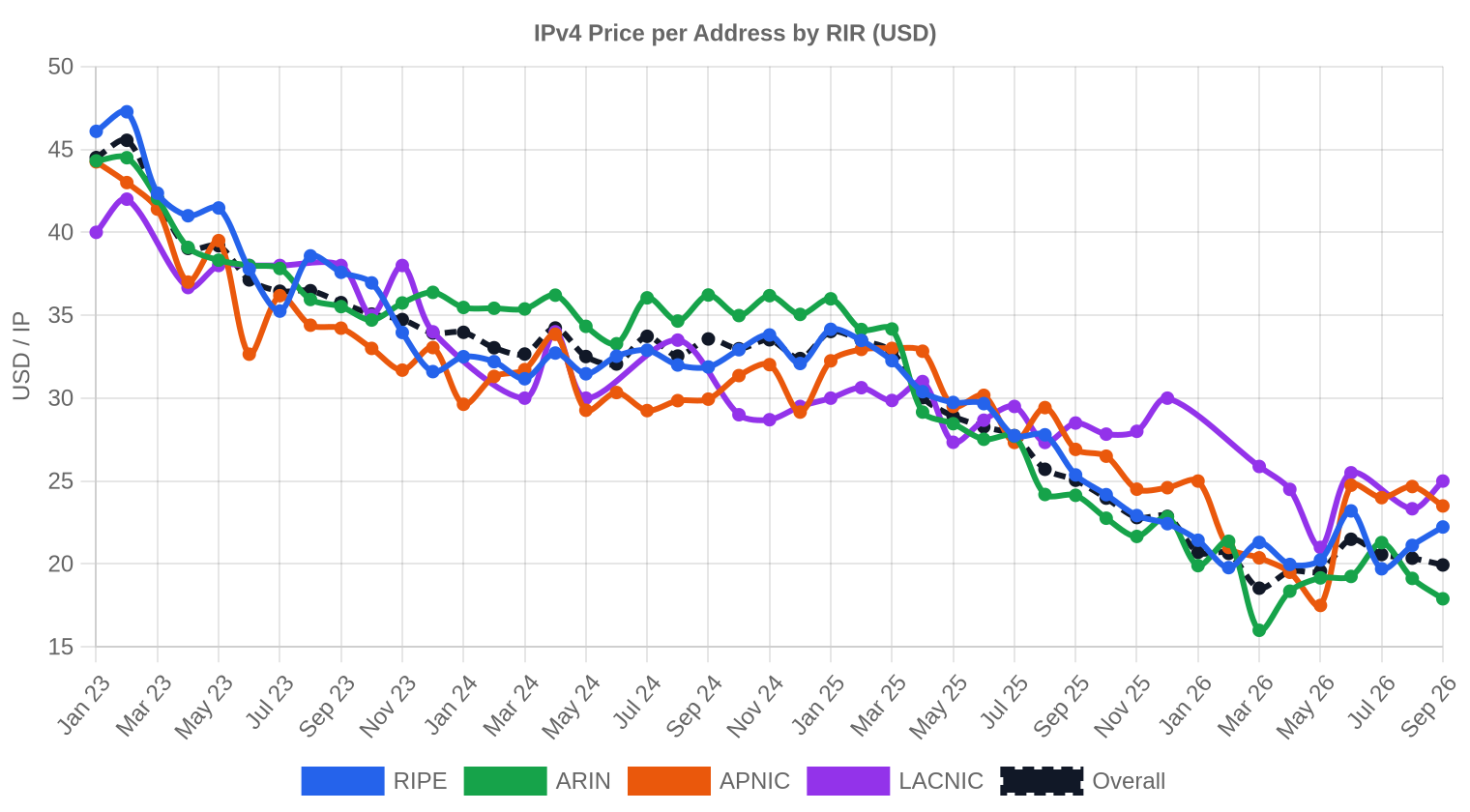
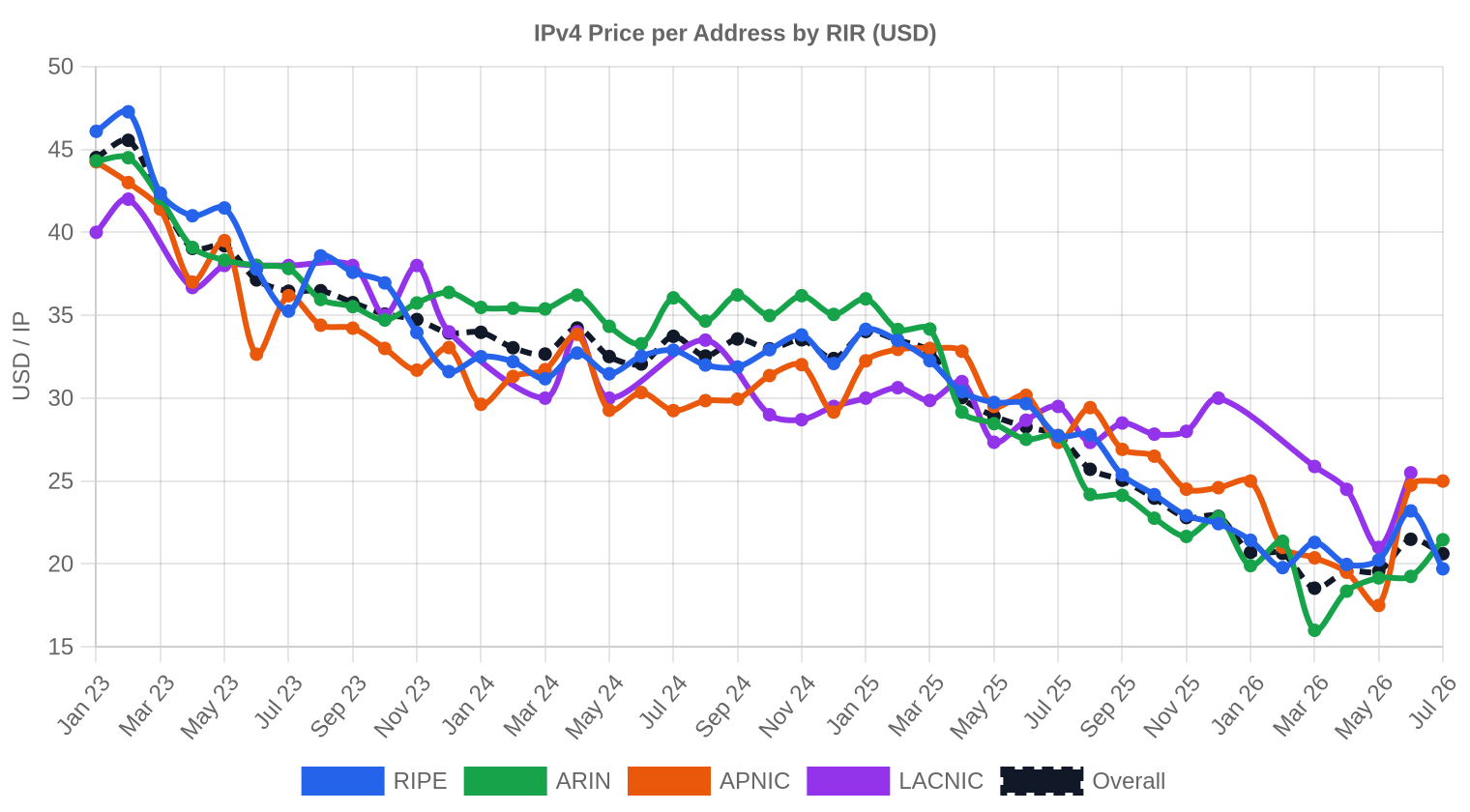
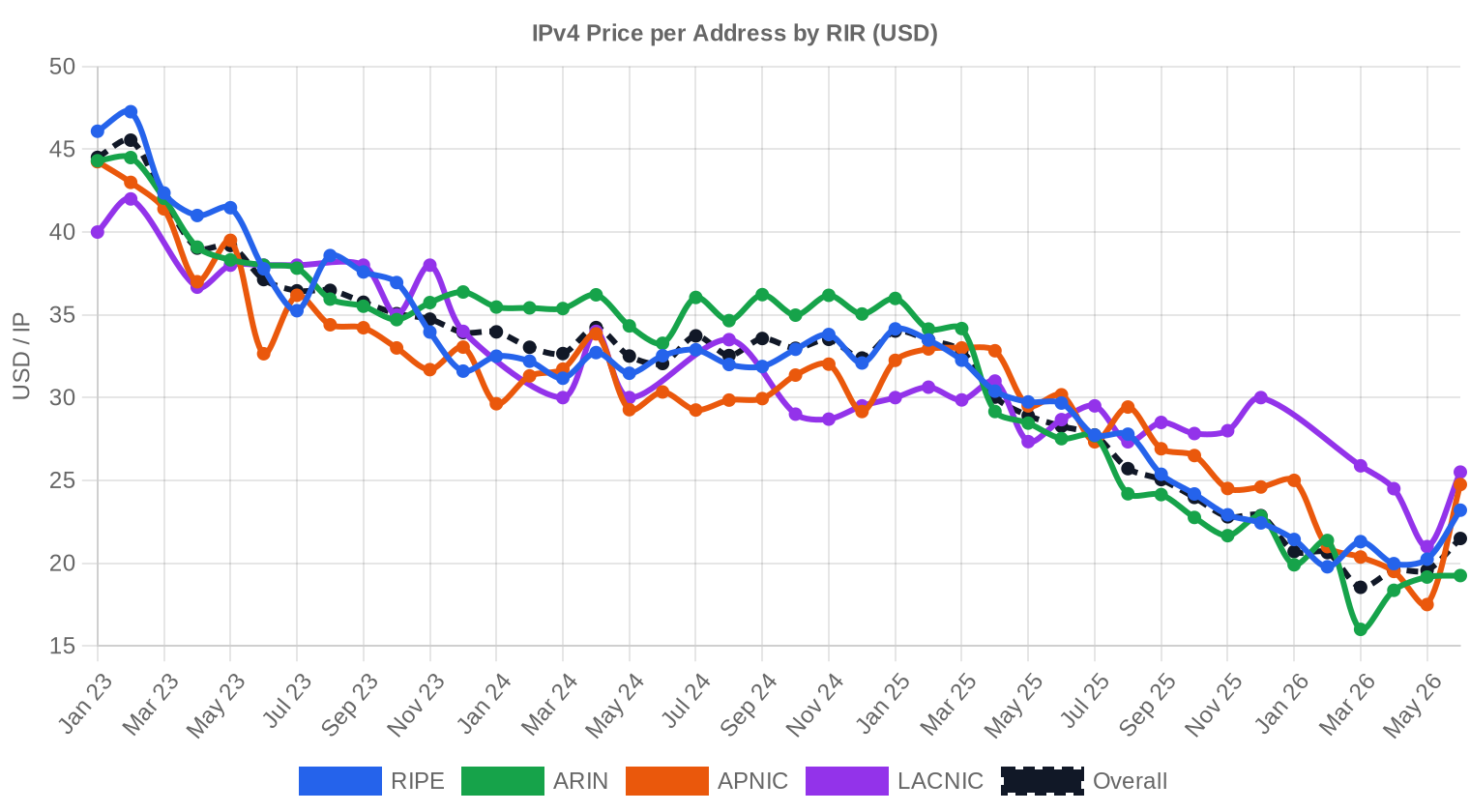
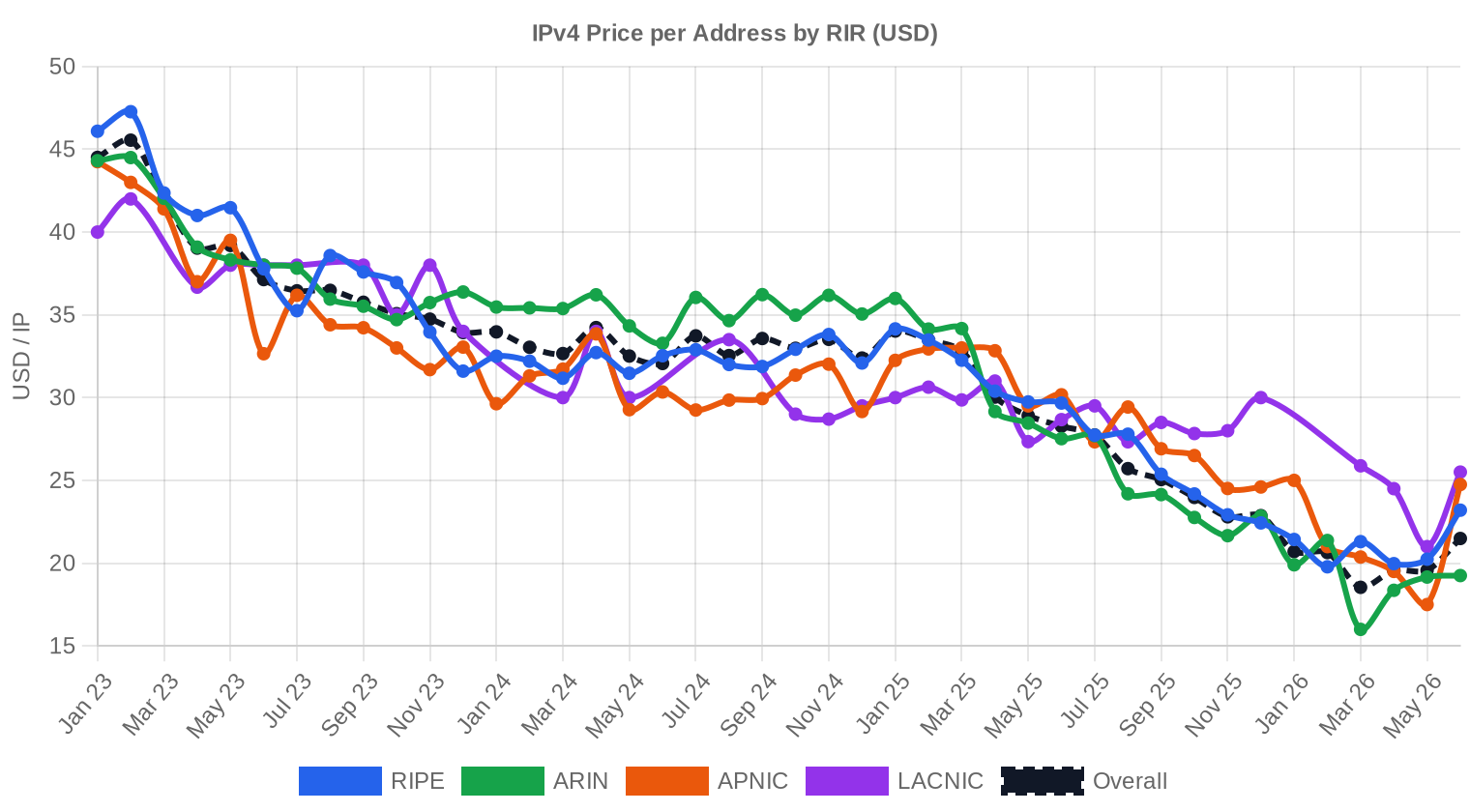
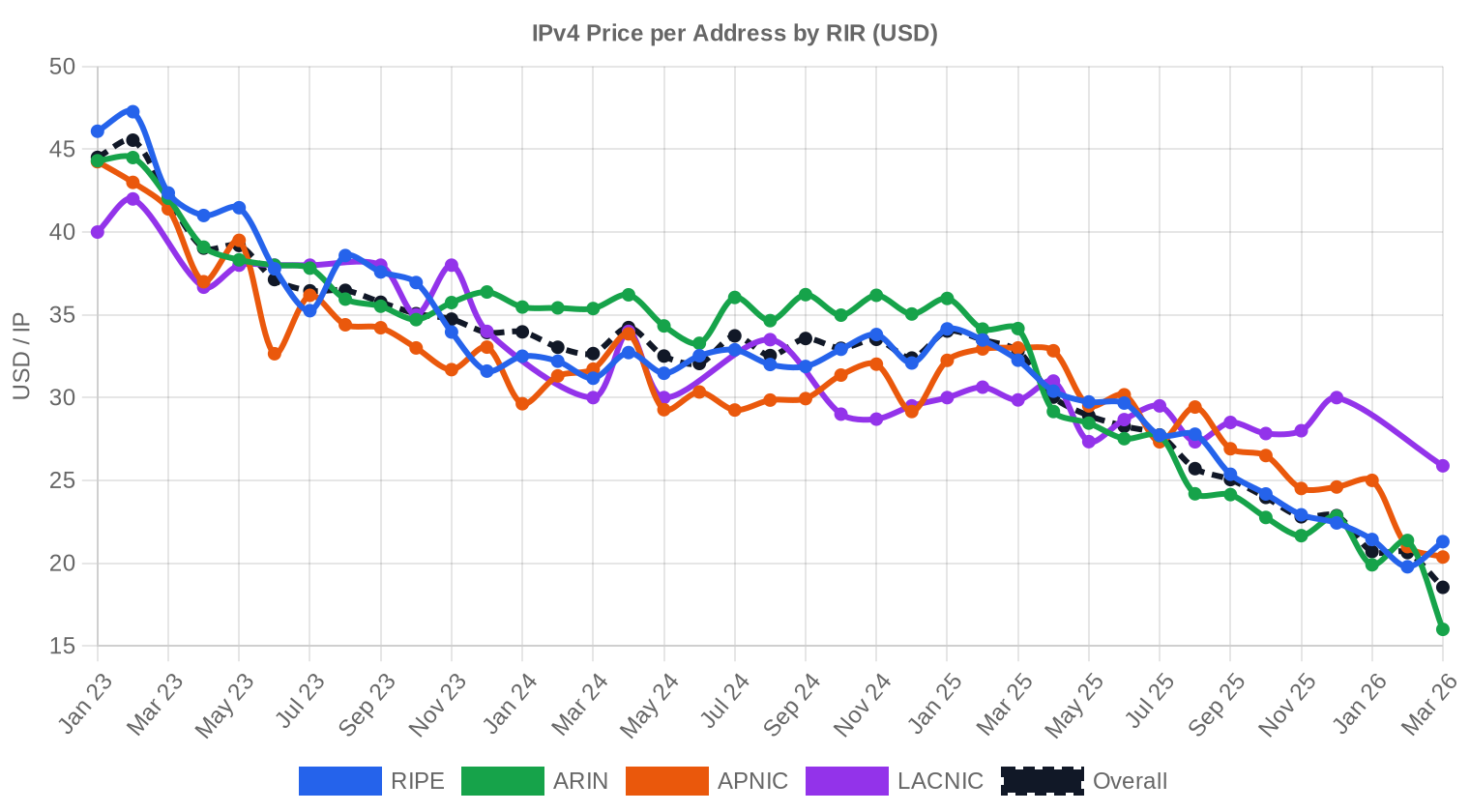
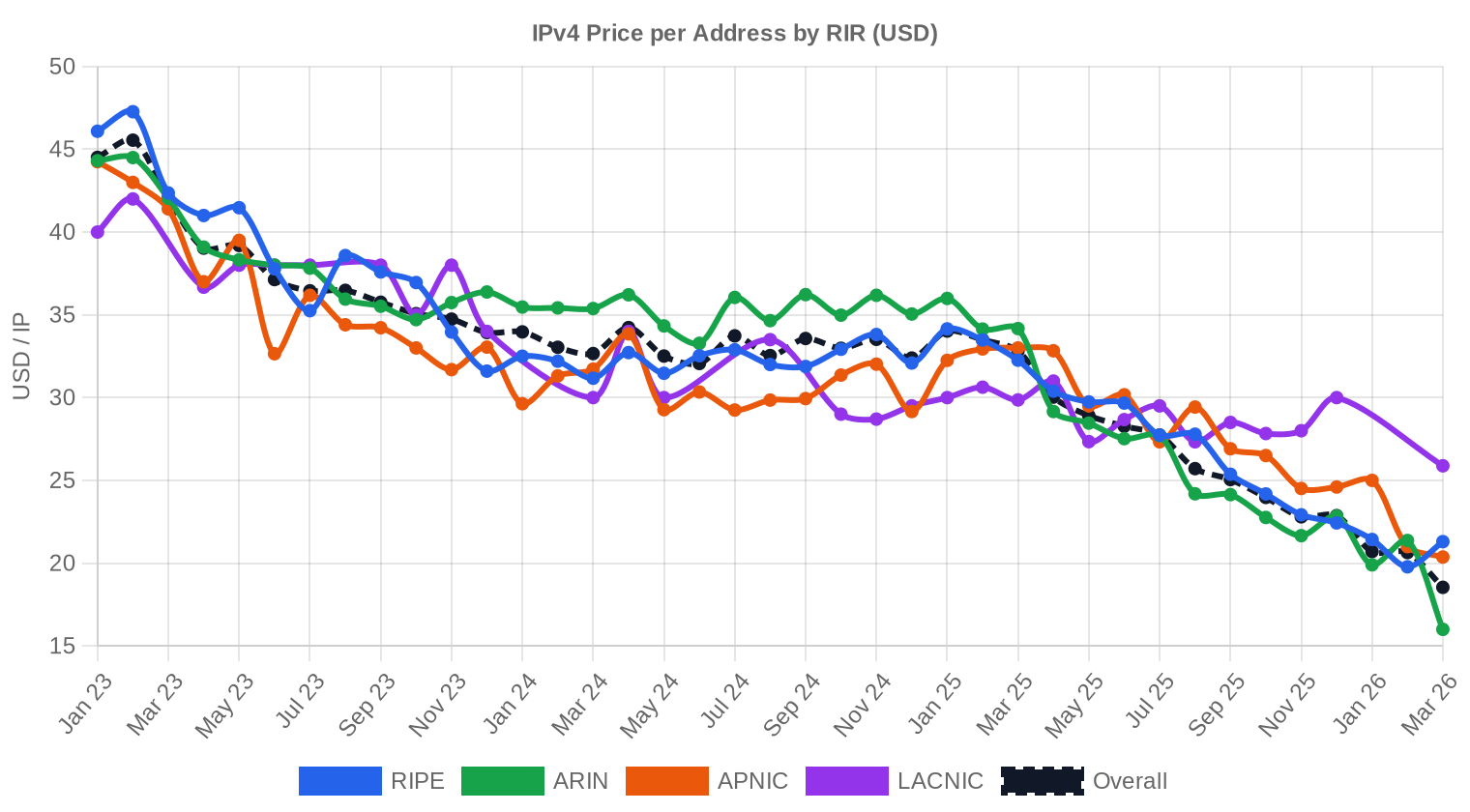
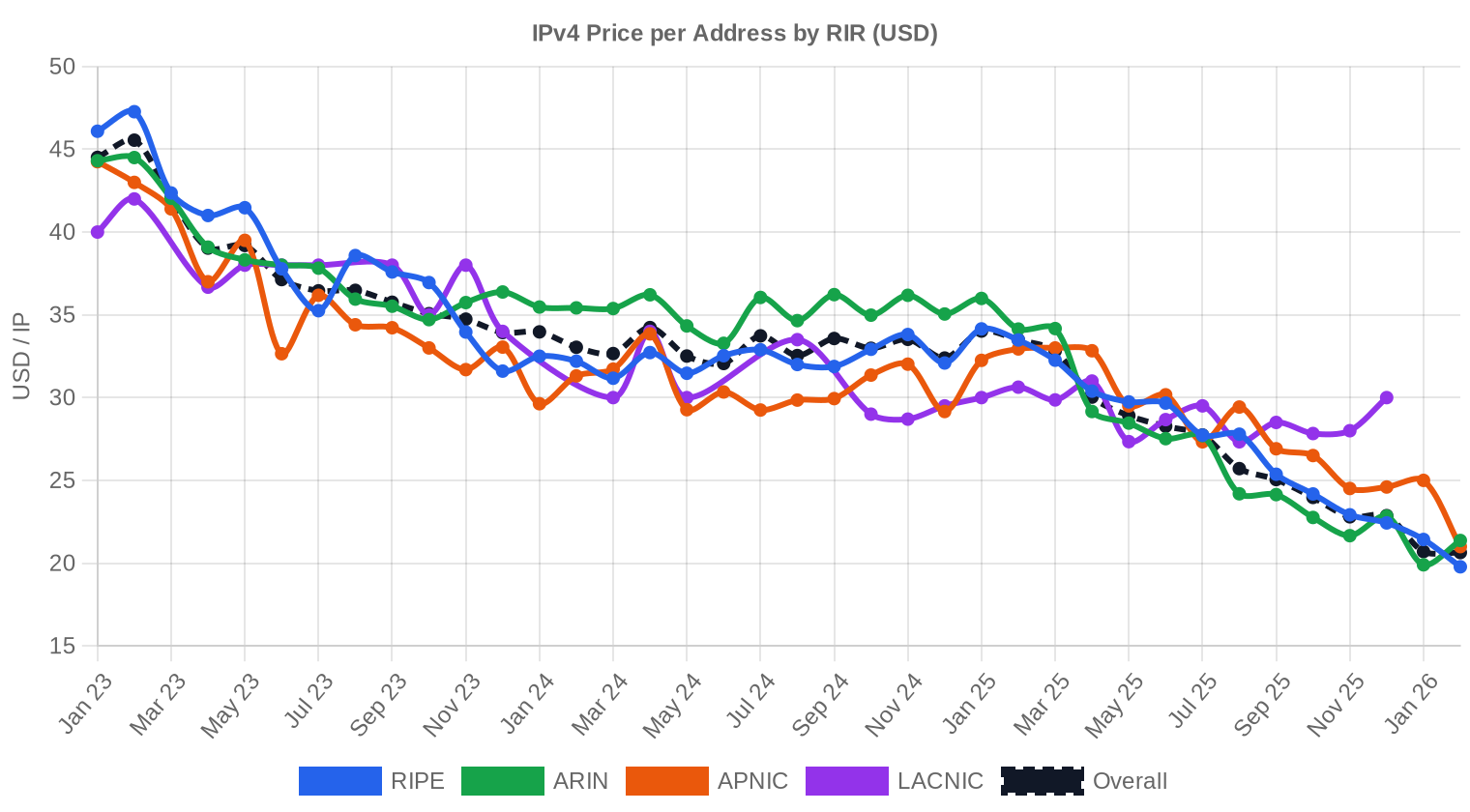
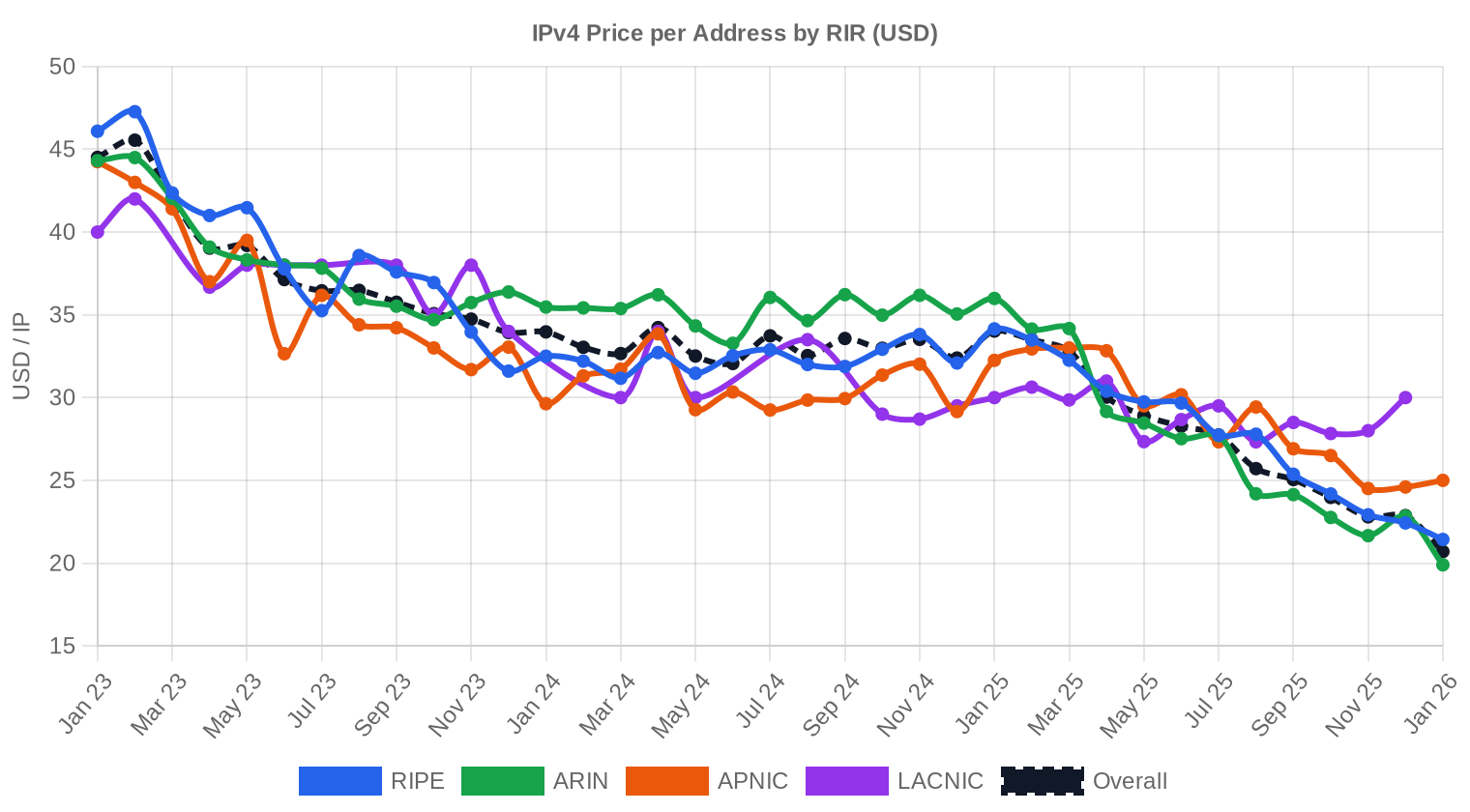
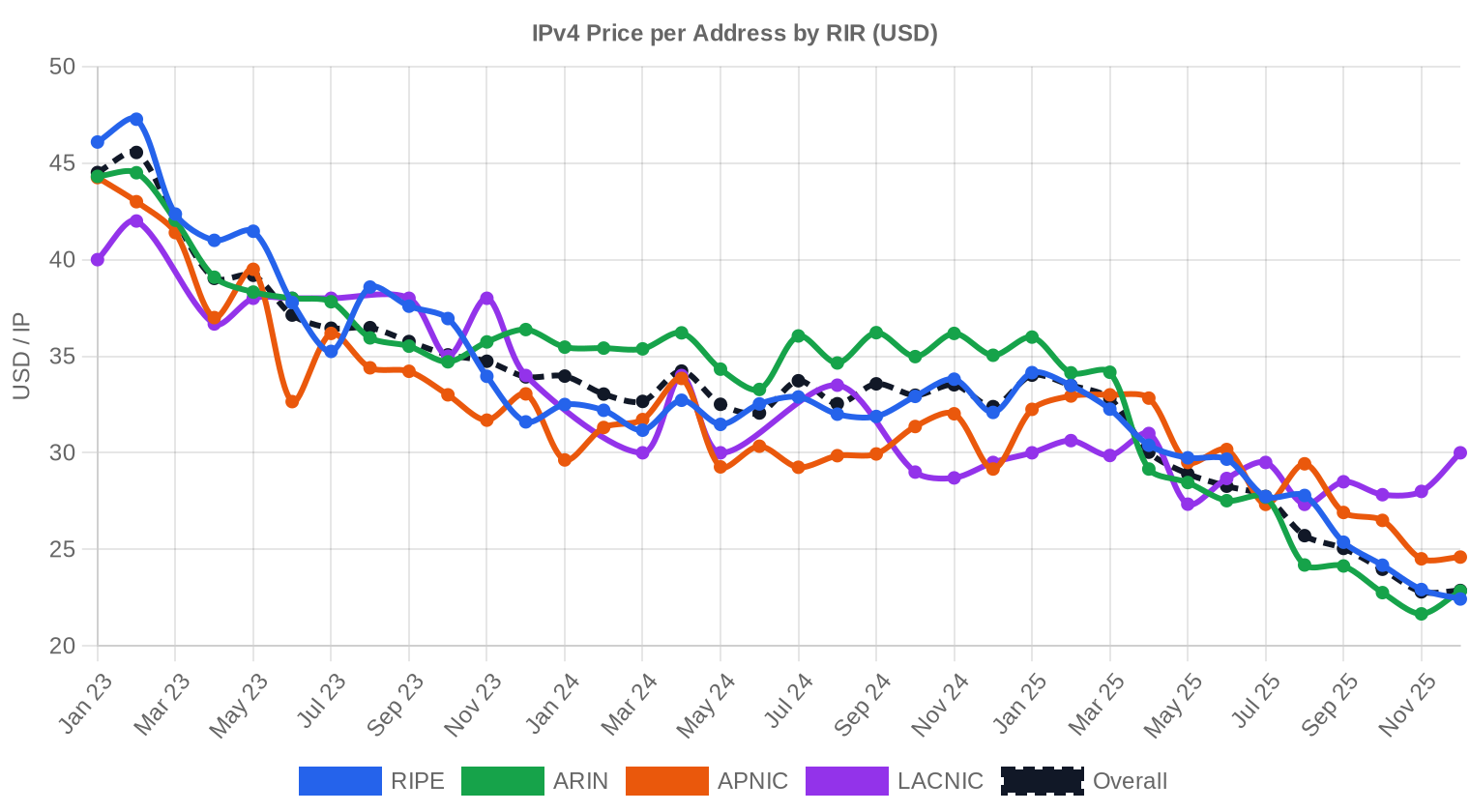
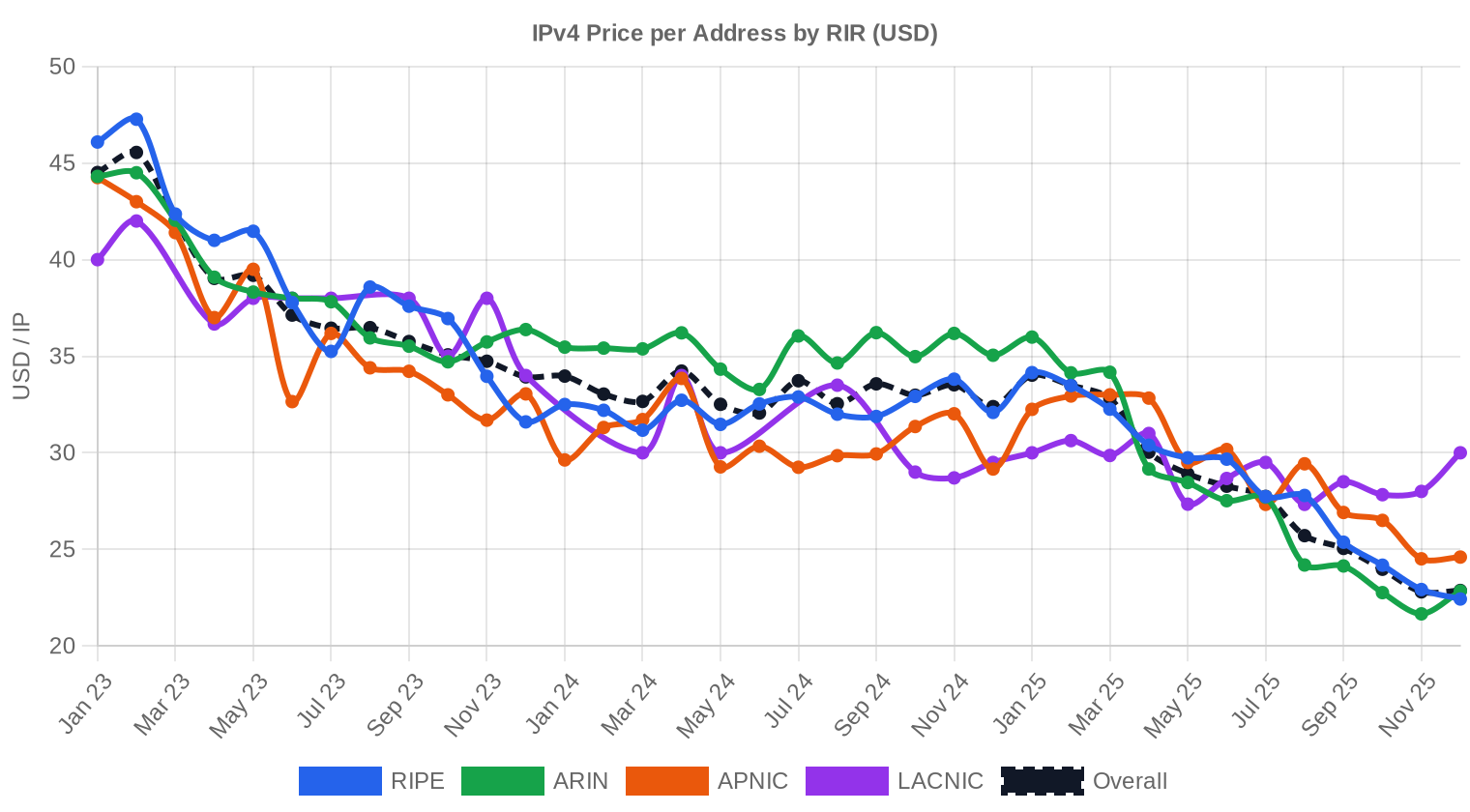
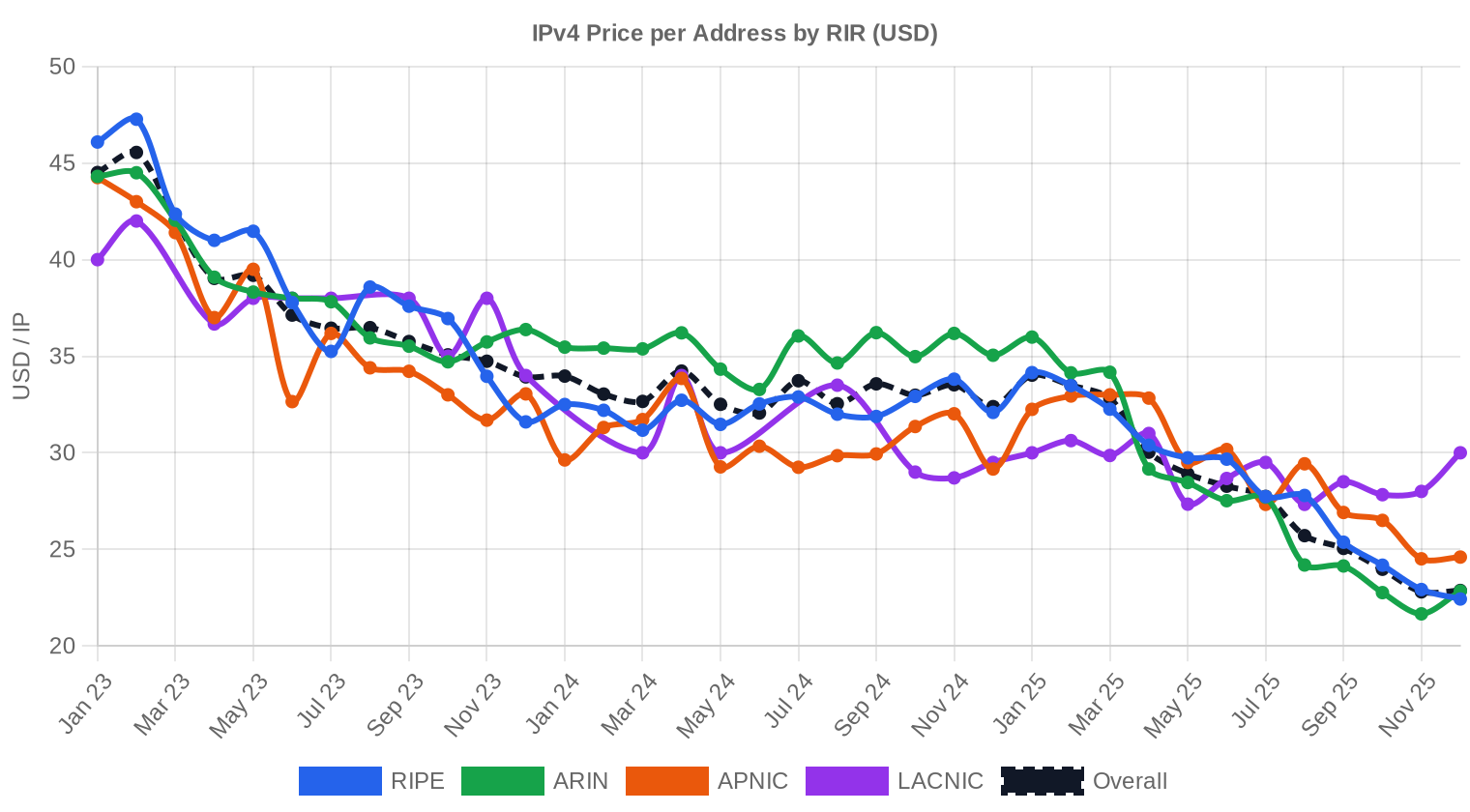
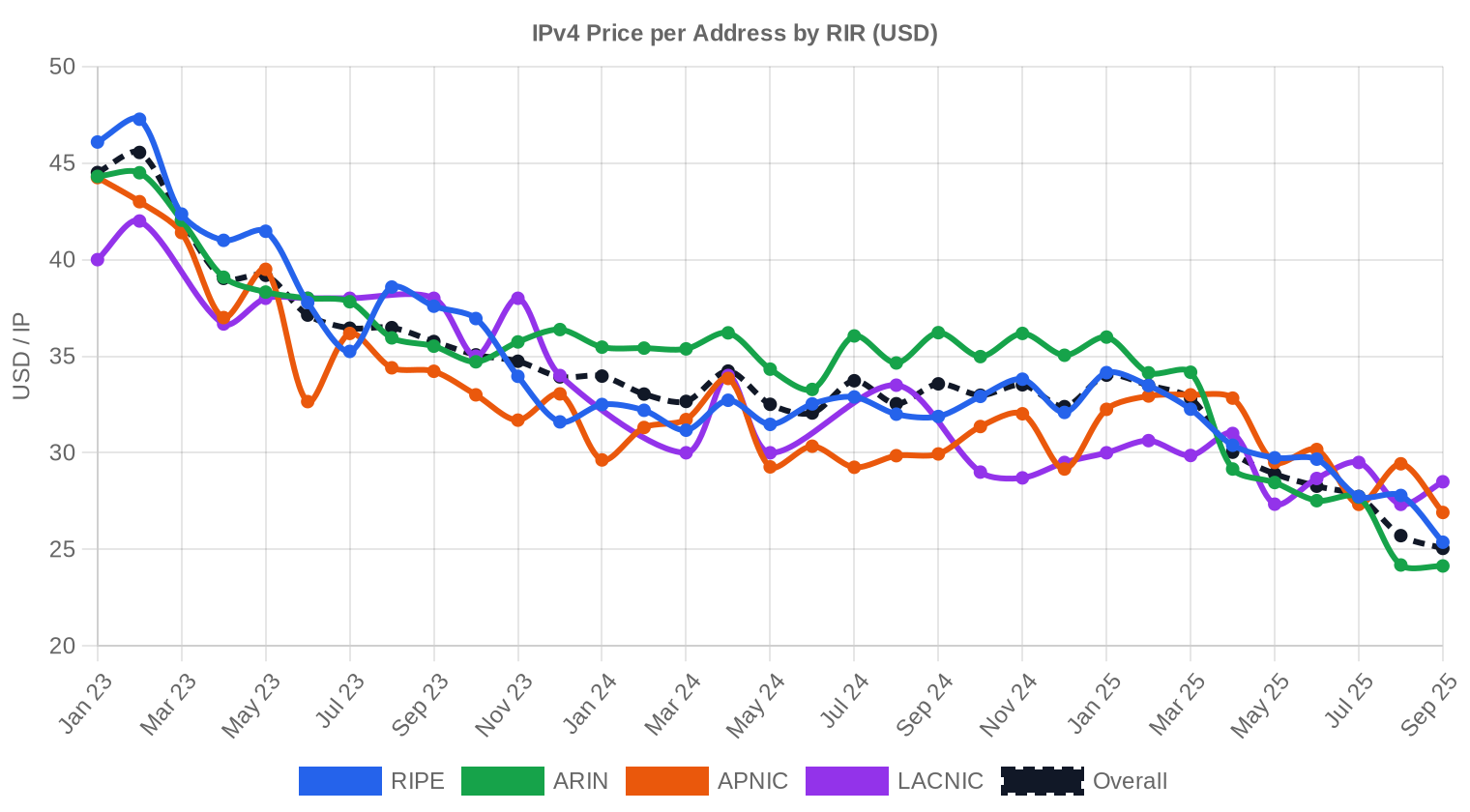
The spread between the cheapest and most expensive IP in August was $10.50 to $40.00, a $29.50 range that reflects the persistent bifurcation between bulk /16+ blocks and small, clean /24s. The $40.00 ceiling came out of ARIN — likely a premium /24 with pristine reputation — while the $10.50 floor also sat in ARIN, almost certainly a large legacy block sold for speed over price. The $1.60 drop from July's average accelerates a decline that has been grinding lower all year. Median at $19.29 versus mean at $20.30 tells us the distribution is right-skewed: a handful of high-priced small blocks pull the average up, but the bulk of transactions are clearing in the $18–$20 band. The 21% year-over-year compression is the sharpest annual decline we've tracked in this cycle, and it maps directly to the AWS public IPv4 charge pushing latent supply into the market since mid-2024.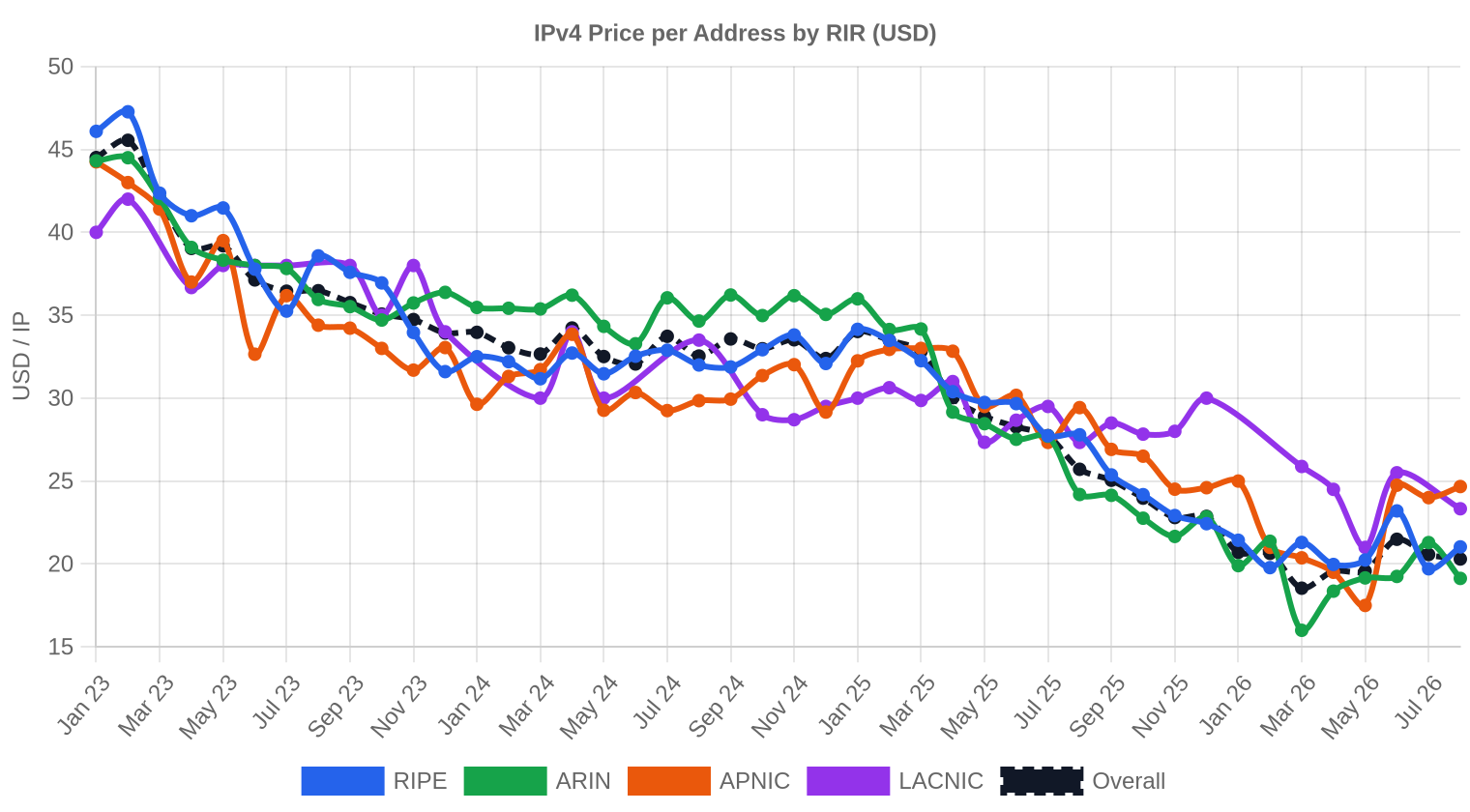
Pricing by RIR
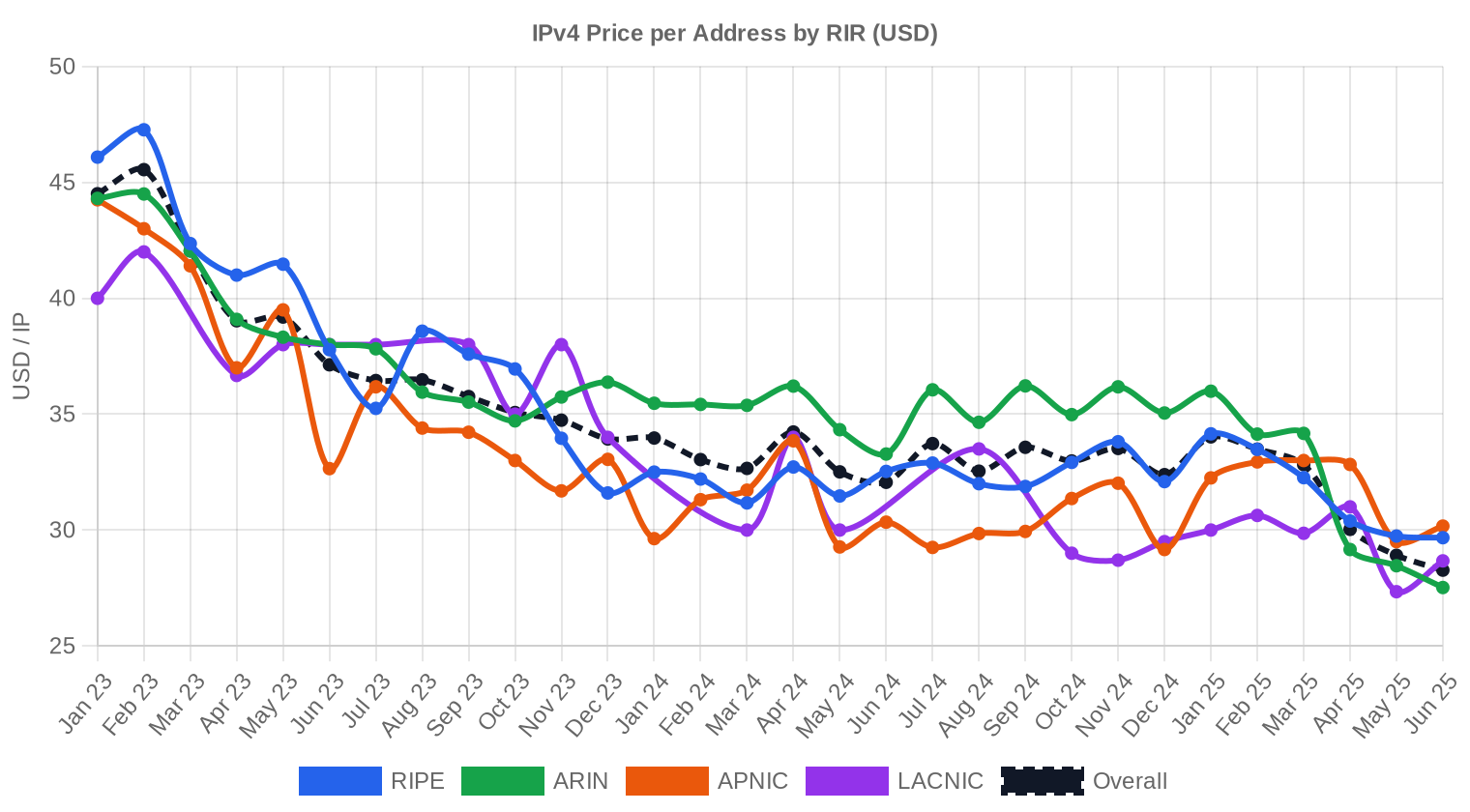
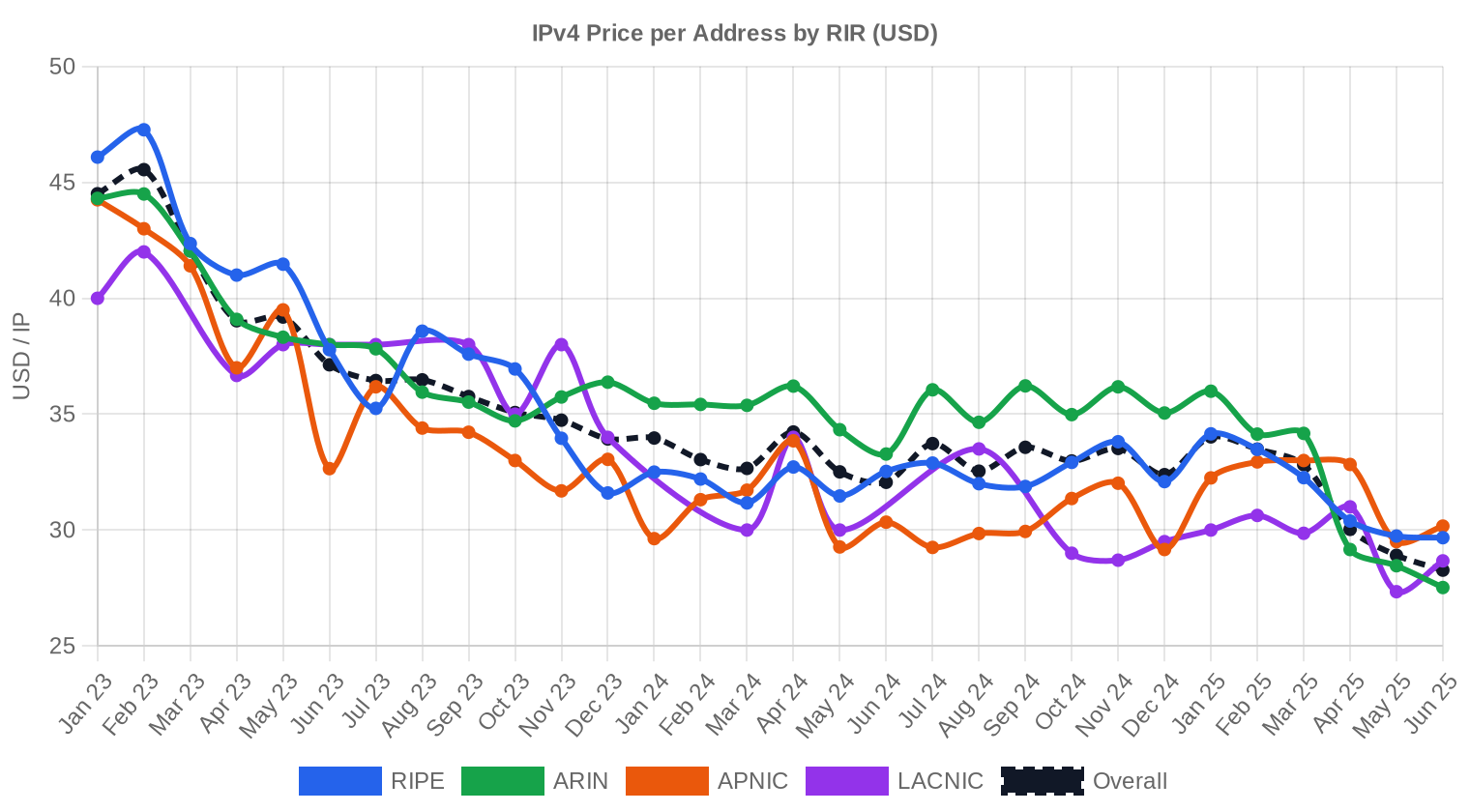
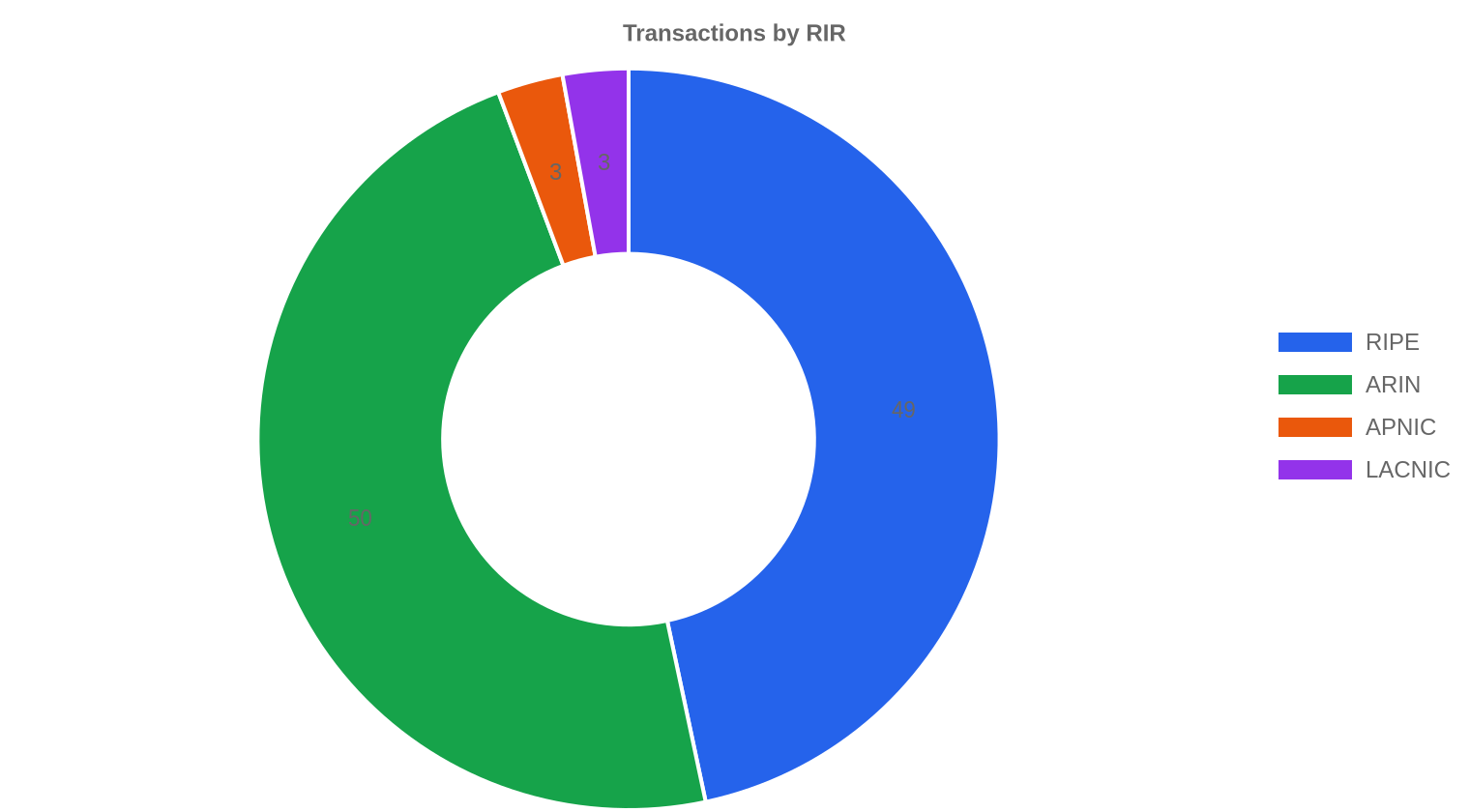
ARIN dominated volume at 263,680 IPs (61.6% of addresses traded) across 50 transactions, but its average of $19.13/IP was the cheapest among active registries. RIPE space averaged $21.03 across 49 deals — a $1.90 premium over ARIN that has been compressing for months. APNIC commands the highest per-IP price at $24.67, though on just three transactions totaling 1,024 IPs, that number is more indicative than statistically robust. LACNIC-origin blocks averaged $23.33 across three deals; what's more relevant here is that brokers report 15+ /16-equivalent LACNIC blocks now moving toward ARIN, RIPE, and APNIC registries, with initial cross-RIR transfers completing in roughly 60 business days and a target timeline of 6–8 weeks. If that velocity becomes repeatable, the historical LACNIC discount should narrow, and mid-sized block liquidity across all RIRs improves materially.ARIN: $19.13/IP across 50 transactions (47.6% of volume).
RIPE NCC: $21.03/IP across 49 transactions (37.7% of volume).
APNIC: $24.67/IP across 3 transactions (0.2% of volume).
LACNIC: $23.33/IP across 3 transactions (0.5% of volume).
AFRINIC: No recorded transactions.
| RIR | Transactions | Avg $/IP | Median $/IP | IPs Traded | RIR Transfers | Next Month (proj.) | Year-End (proj.) |
|---|---|---|---|---|---|---|---|
| RIPE | 49 | $21.03 | $20.00 | 161,536 | 84 | $20.00 | $19.50 |
| ARIN | 50 | $19.13 | $18.38 | 263,680 | 112 | $17.50 | $17.00 |
| APNIC | 3 | $24.67 | $24.50 | 1,024 | 0 | $24.00 | $23.50 |
| LACNIC | 3 | $23.33 | $23.00 | 2,048 | 0 | $22.50 | $22.00 |
Transaction Volume
Supply & Block Sizes
/24 blocks accounted for 33 of 105 deals — 31% of transaction count — confirming that small buyers continue to drive deal frequency even as they contribute a fraction of IP volume. The average deal size held steady at 4,079 IPs (roughly a /14 equivalent), barely changed from July's 4,060. Large blocks dominated dollar volume: two transactions above $1 million accounted for $2.66 million, or 45% of total market value on just 1.9% of deal count.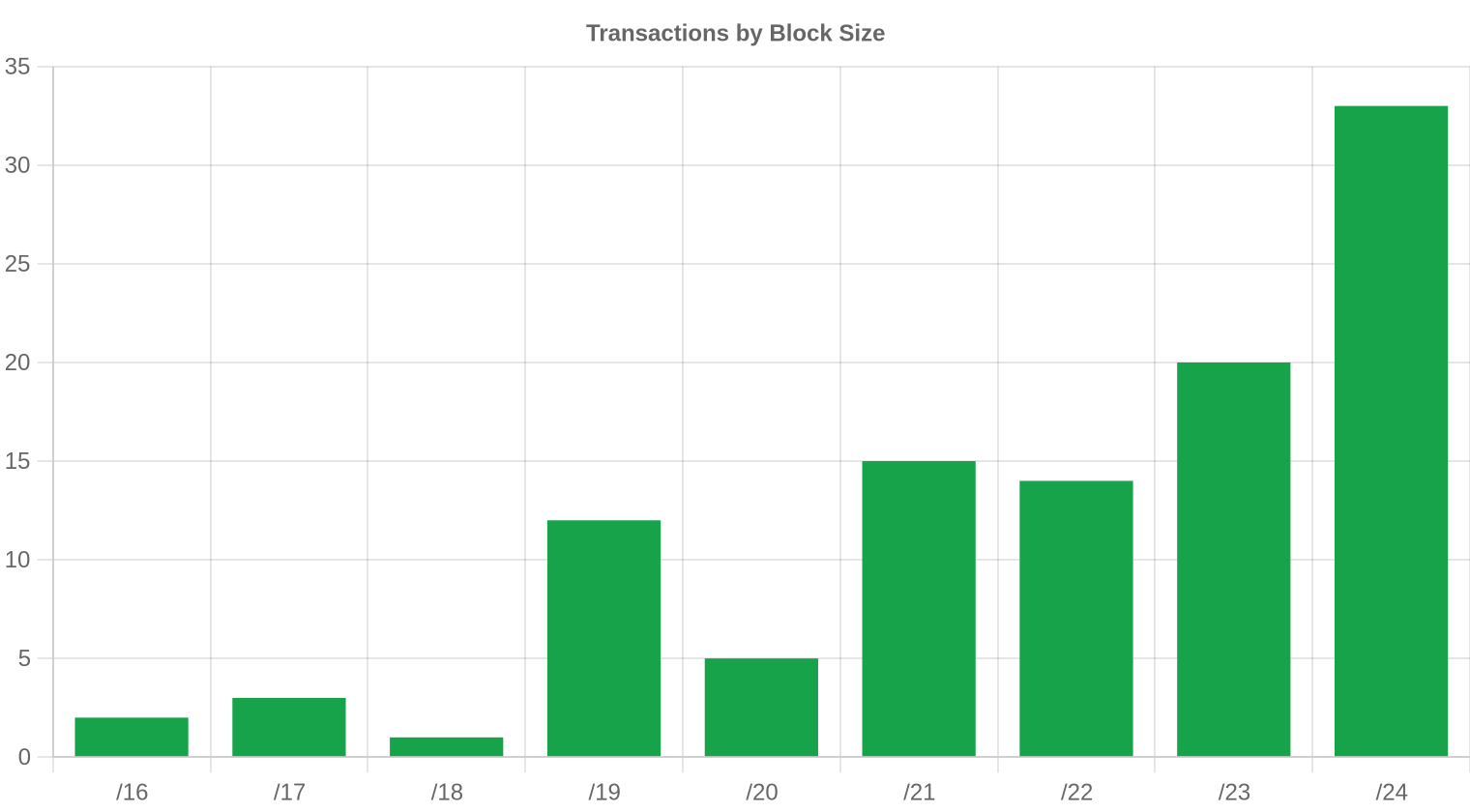
Geographic Activity
The United States led with 41 transactions (39% of deals), followed by Great Britain at 10 and Canada at 8. Spain and Sweden tied at 6 deals each — Sweden's consistent presence reflects Nordic ISP consolidation that has been running for several quarters. The long tail stretched across 21 distinct country codes, including single deals in Hong Kong, Singapore, New Zealand, and Ukraine, which speaks to the genuinely global nature of this market.Registry Transfer Activity
RIR-recorded transfers totaled 196 in August, nearly double the 105 priced transactions in our dataset — the gap represents internal transfers, policy-based moves, and deals closed outside tracked brokerages. ARIN led with 112 transfers (57%), while RIPE recorded 84. APNIC, LACNIC, and AFRINIC registered zero official transfers for the month.Long-Run Transfer Trends
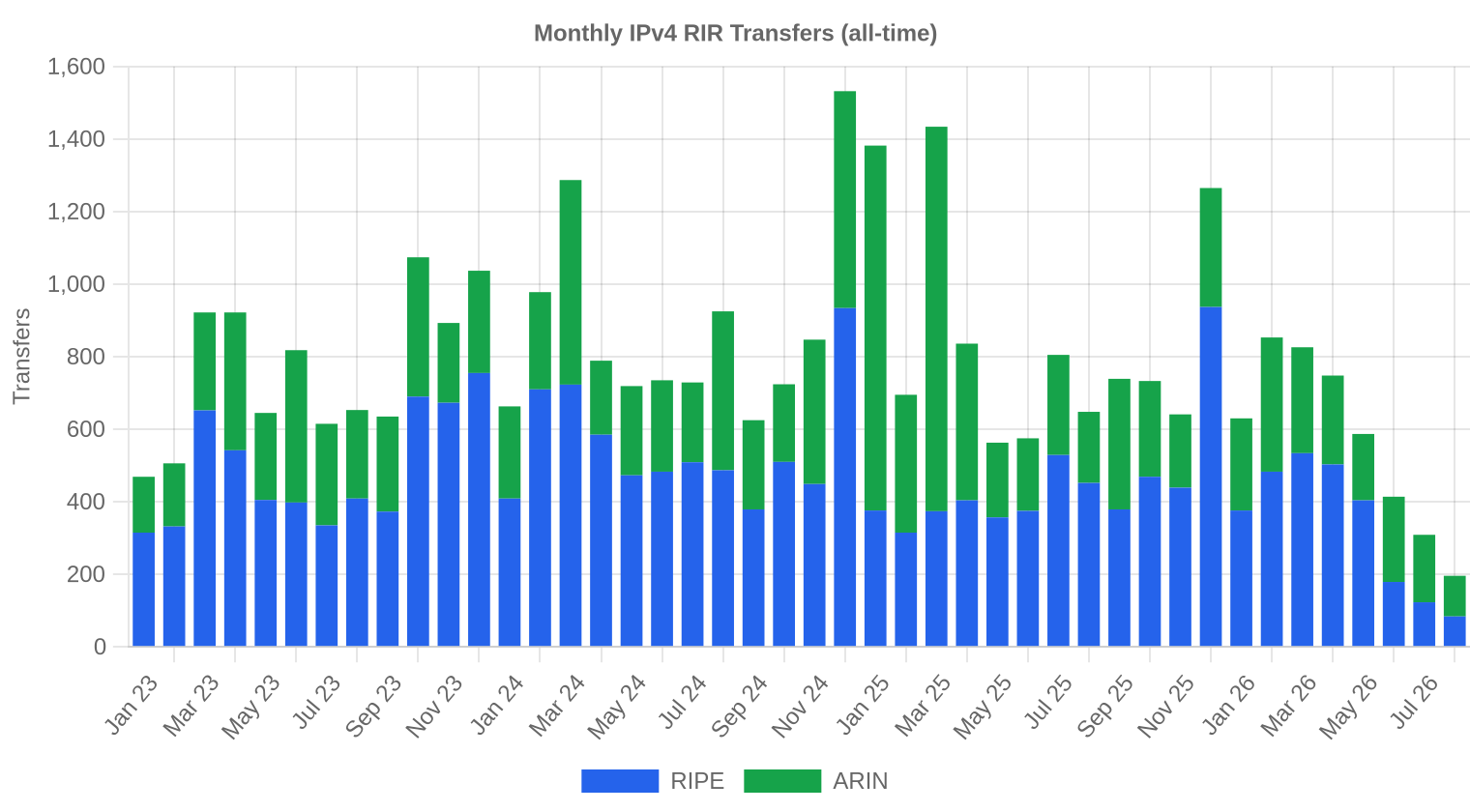
Over the 44 months in our tracking window, 34,621 total transfers have been recorded across all RIRs. The all-time peak remains December 2024, which coincided with year-end tax planning and the initial wave of AWS-driven divestitures. RIPE accounts for 59.6% of cumulative transfers versus ARIN's 40.4% — a split that reflects RIPE's more fragmented holder base and higher transaction frequency on smaller blocks.| RIR | RIR Transfers |
|---|---|
| RIPE | 20,622 |
| ARIN | 13,999 |
| RIR Transfers | 34,621 |
Outlook & Forecast
Forecasting each block-size band and RIR separately with our AI model:
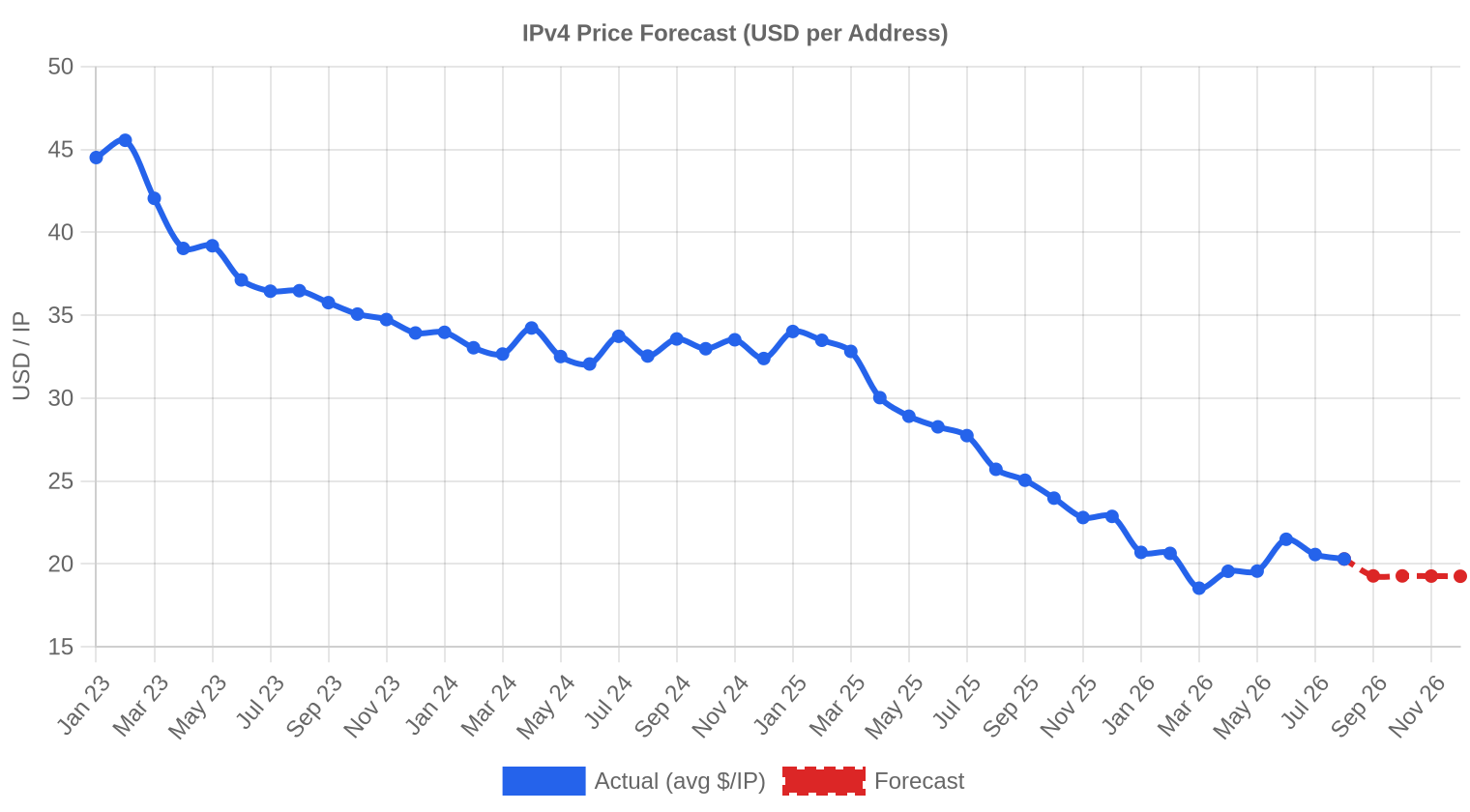
The overall average price per IP is projected to reach $19.26 by December 2026, with a next-month estimate of $19.38 per IP.
- RIPE: projected at $20.00 per IP next month, trending toward $19.50 by December 2026.
- ARIN: projected at $17.50 per IP next month, trending toward $17.00 by December 2026.
- APNIC: projected at $24.00 per IP next month, trending toward $23.50 by December 2026.
- LACNIC: projected at $22.50 per IP next month, trending toward $22.00 by December 2026.
- AFRINIC: insufficient data for a reliable forecast.
Forecast by Block Size
| Block | Current $/IP | Next Month | Year-End | Confidence |
|---|---|---|---|---|
| /24 | $25.38 | $25.00 (-1.5%) | $25.00 (-1.5%) | medium |
| /23 | $19.50 | $19.00 (-2.6%) | $18.50 (-5.1%) | medium |
| /22 | $18.50 | $18.00 (-2.7%) | $18.00 (-2.7%) | medium |
| /21 | $16.50 | $16.50 (0.0%) | $16.50 (0.0%) | medium |
| /20 | $15.95 | $15.75 (-1.3%) | $16.00 (+0.3%) | medium |
| /19 | $14.25 | $14.25 (0.0%) | $14.00 (-1.8%) | medium |
| /18-/16 | $11.66 | $12.00 (+2.9%) | $12.00 (+2.9%) | low |
| /15-up | $10.00 | $10.00 (0.0%) | $9.75 (-2.5%) | low |
Editor's Take: Buy vs. Lease
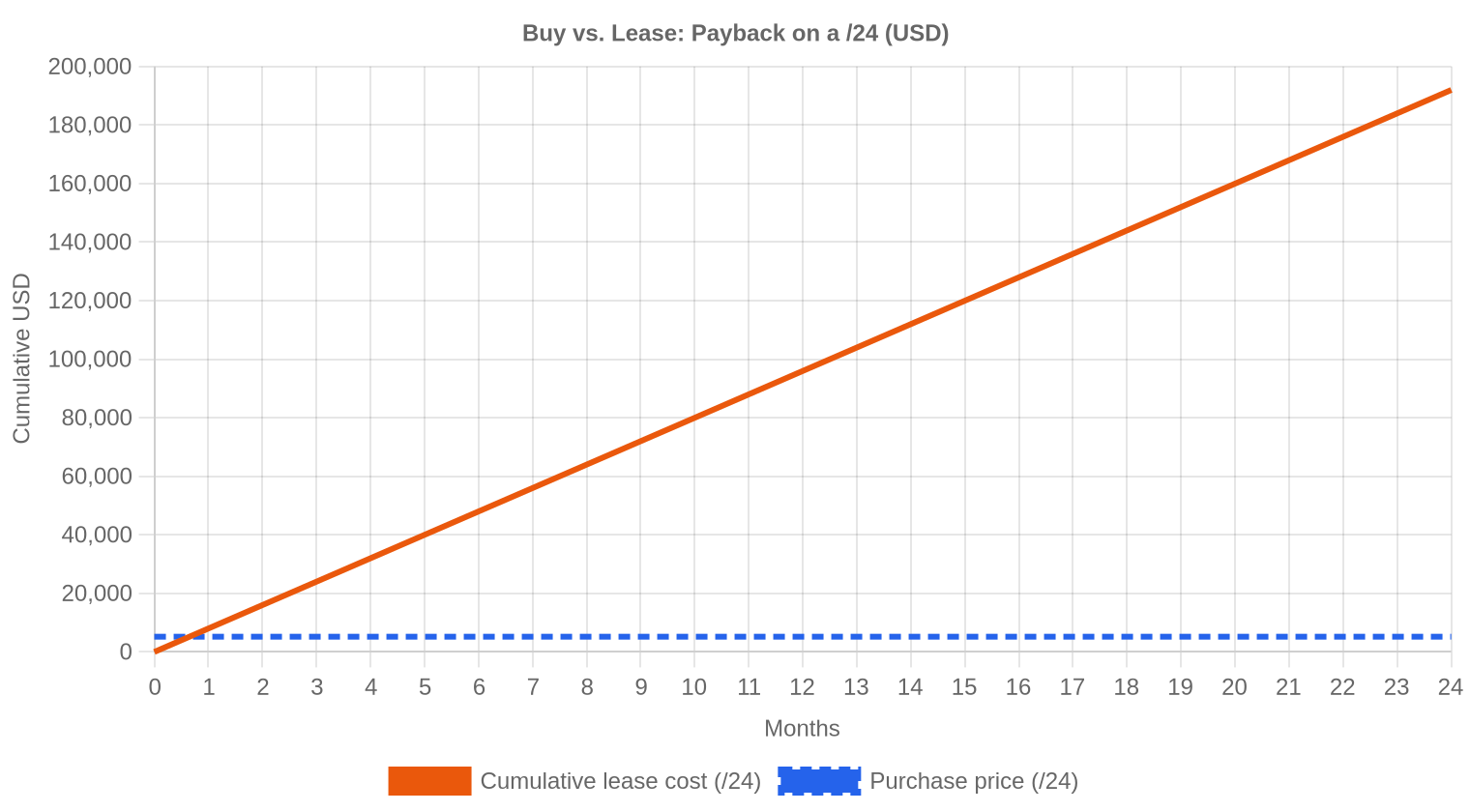
The buy-versus-lease calculus has never been more lopsided. At $20.30/IP purchase price versus $31.25/IP/month lease rate (RIPE sample, n=178), a buyer recoups the purchase cost in under one month of avoided lease payments. A /24 block costs $5,197 to buy outright; leasing the same block runs $8,000 per month. The implied annual yield for a lessor is 1,847% — an extraordinary return that exists because lease pricing has not corrected in line with falling purchase prices. For any organization leasing more than a handful of addresses, the arbitrage is glaring: buy now, eliminate recurring cost, and retain the asset on balance sheet. The LACNIC transfer pipeline improvement adds another dimension — buyers sourcing LACNIC-origin /16s at $23.33/IP can potentially arbitrage into higher-priced RIPE or APNIC registries once cross-RIR transfer timelines compress to the 6–8 week target. That's a capital efficiency play worth watching.| /24 Purchase price | $5,197 |
| /24 Lease price | $8,000 / mo |
| Payback period | 0.6 mo (0.1 yr) |
| Gross annual yield | 1,847.3% |
What This Means for You
Buyers: The market is offering a 21% discount versus a year ago, and forecasts point to further erosion toward $19.26 by December. Urgency is low on price, but block quality degrades as clean inventory gets absorbed. If you need addresses with no blacklist history, move sooner rather than later — the cheapest blocks left tend to carry reputation baggage.Sellers: Holding for a price recovery is a losing trade in the current environment. Every month of delay costs roughly $1/IP in foregone value based on the trailing 12-month trajectory. Liquidate larger blocks now while deal sizes above $250K still attract institutional buyers. The two $1M+ transactions in August prove appetite exists for clean, sizable inventory.
Leasers: At $31.25/IP/month against a $20.30 purchase price, you are paying for the entire block every 19 days of leasing. Transition to ownership immediately unless your address needs are genuinely temporary (under 60 days).
Block Holders: If you're sitting on unused allocations, leasing yields remain extraordinary — nearly 1,850% annualized. That won't last as purchase prices fall and more lessors enter the market, but for now, it's the single best-returning asset class available in this corner of IT infrastructure.
Browse verified IPv4 blocksSell IPv4 →
List your blocks with managed transferLease IPv4 →
Flexible short-term capacityLease Out IPv4 →
Turn idle blocks into recurring revenue
IPv4 Pricing by Block Size
Small /24 blocks command a steep per-IP premium: 33 deals at this prefix size drove the high end of the price range, with clean blocks clearing north of $30/IP. At the other end, /16-equivalent and larger blocks traded closer to $10.50–$15/IP, reflecting the volume discount that institutional buyers demand. The spread between a /24 and a /16 on a per-IP basis is running roughly 2x–3x, consistent with historical norms but stretched compared to the 1.5x–2x range we saw when the market was tighter in 2023.| Block | IPs | Buy: /IP | Buy: Total | Lease: /IP/mo | Lease: Monthly |
|---|---|---|---|---|---|
| /24 | 256 | $35-45 | $8,960-11,520 | $0.38-0.50 | $97-128 |
| /22 | 1,024 | $28-38 | $28,672-38,912 | $0.33-0.45 | $338-461 |
| /20 | 4,096 | $22-32 | $90,112-131,072 | $0.30-0.40 | $1,229-1,638 |
| /18 | 16,384 | $20-30 | $327,680-491,520 | $0.30-0.38 | $4,915-6,226 |
| /16 | 65,536 | $18-28 | $1,179,648-1,835,008 | $0.30-0.35 | $19,661-22,938 |
IPv4 Price History: 2011–2026
IPv4 pricing began from near-zero in 2011 when IANA exhausted its free pool, climbed steadily through the 2010s, and peaked in the $55–$60/IP range in late 2023 for ARIN space. AWS's decision to charge $3.60/IP/year for public IPv4 addresses — effective February 2024 — triggered a supply wave that cratered prices through 2024 and 2025. August 2026's $20.30 average represents a roughly 65% decline from peak, establishing the post-AWS price regime. The market now bifurcates cleanly: small, reputation-clean blocks hold value; large blocks from legacy holders sell at steep discounts to move volume.| Year | ~Price/IP | Key Event |
|---|---|---|
| 2011 | $7-12 | IANA free pool exhausted; Microsoft/Nortel deal ($11.25/IP) |
| 2012 | $8-12 | RIPE NCC reaches last /8; begins /22-only allocation |
| 2014 | $10-15 | LACNIC free pool exhausted |
| 2015 | $8-15 | ARIN free pool exhausted |
| 2017-18 | $12-18 | Leasing market grows; cloud demand rises |
| 2019 | $18-24 | RIPE NCC exhausts remaining free pool |
| 2021-22 | $50-60+ | Post-pandemic peak; hyperscaler build-outs |
| 2024 | $35-52 | AWS IPv4 charge ($0.005/IP/hr); large block correction |
| 2025-26 | $18-45 | Market bifurcation; /16s below $20 for first time since 2019 |
Market Structure: Who Is Buying & Selling
Buyers in August skewed toward mid-market ISPs and hosting companies — the deal size distribution (82 transactions under $50K) confirms this. Cloud infrastructure operators and AI compute providers are present but tend to transact in larger, less frequent chunks; the two deals above $1 million likely fall into this category. On the sell side, legacy corporate holders and telcos continue to divest unused allocations, accelerated by the accounting reality that idle IPv4 blocks now carry a tangible holding cost under the AWS pricing framework.IPv4 vs. Other Asset Classes
At a 1,847% implied annual yield for lessors (purchase at $20.30, lease at $31.25/month), IPv4 addresses are in a class by themselves — no traditional asset comes close. For context, US 10-year Treasuries yield roughly 4.3%, commercial real estate cap rates run 6–8%, and the S&P 500's long-run return averages about 10%. The catch is that lease yields this extreme signal market disequilibrium, not a stable return profile. As purchase prices fall and more holders enter the leasing market, yields will compress — but they'll likely remain well above any conventional fixed-income alternative for the next 12–18 months.| Asset Class | Typical Yield | Liquidity | Primary Risk |
|---|---|---|---|
| IPv4 | 1,847.3% | Moderate | IPv6 adoption, block quality |
| Commercial Real Estate | 5-8% | Low | Vacancy, rate cycle |
| Investment-Grade Bonds | 4-5% | High | Duration, credit risk |
| S&P 500 | ~1,3% | High | Market volatility |
| Money Market / T-Bills | ~4-5% | High | Rate cycle changes |
IPv6 Adoption & Why IPv4 Remains Essential
IPv6 adoption continues to grow — Google's measurements hover around 45% of traffic — but the protocol transition remains a decade-plus undertaking for enterprise networks, IoT deployments, and legacy application stacks. Dual-stack requirements ensure that every new network buildout still needs IPv4 addresses alongside IPv6. The coexistence phase extends the useful economic life of IPv4 blocks well into the 2030s, and possibly beyond, which underpins the floor under current pricing.AI & Cloud Infrastructure Demand
AI infrastructure buildout remains a tailwind for IPv4 demand, though its impact on pricing is more nuanced than headlines suggest. Training clusters and inference farms require public-facing IP space for API endpoints, model-serving infrastructure, and data ingestion pipelines. The LACNIC cross-RIR transfer improvements are directly relevant here: AI compute buildouts in North America and Europe can now source LACNIC-origin blocks with faster turnaround, potentially accessing inventory that was previously considered too slow to transfer for time-sensitive deployments.What Determines IPv4 Block Value
Three factors dominate block valuation: blacklist cleanliness, allocation age, and RIR transferability. A /24 with zero Spamhaus or UCEProtect listings commands $30–$40/IP; the same prefix with active listings might clear $15 or less. Older allocations (pre-2000 vintage) from ARIN carry a premium for their perceived stability and clean transfer history. APNIC and LACNIC blocks face transfer complexity discounts, though the LACNIC pipeline improvements reported this month could narrow that gap if 6–8 week closings become the norm.Sell vs. Lease: A Decision Framework
In the current market, leasing is the superior strategy for holders who expect to retain their blocks long-term — the yield is astronomical and the asset doesn't leave your balance sheet. Selling makes sense if you need immediate capital, if the block carries reputation problems that suppress lease demand, or if you believe prices will continue declining (which our models support). Holders of /16+ blocks should consider a hybrid approach: sell a portion to lock in current value, lease the remainder at $31.25/IP/month.| /24 Purchase price | $5,197 |
| /24 Lease price | $8,000 / mo |
| Payback period | 0.6 mo (0.1 yr) |
| Gross annual yield | 1,847.3% |
RIPE NCC 24-Month Transfer Restriction
RIPE NCC's 24-month holding requirement before re-transfer continues to constrain supply of recently acquired blocks, creating an artificial scarcity premium in the RIPE market. This rule explains part of RIPE's $1.90/IP premium over ARIN — buyers pay more because they know the supply pipeline is gated. For traders, this means RIPE blocks acquired in mid-2024 are just now becoming eligible for re-sale, which could add incremental supply in Q4 2026.Deal Size Distribution
Average deal size held flat at $56,172, essentially unchanged from July's $55,929 — but down sharply from August 2025's $146,209, confirming the shift toward smaller, more frequent transactions. The distribution is heavily bottom-weighted: 82 deals (78%) came in under $50K, generating $1.29 million in aggregate value. The six largest deals (four in the $250K–$1M band and two above $1M) accounted for $4.99 million — 85% of total market value on 5.7% of deal count. This concentration risk means that monthly averages can swing on a handful of block trades.Top Trading Countries
The US at 41 deals and Great Britain at 10 reflect the depth of their respective ISP and hosting markets. Canada's 8 transactions are partly BEAD-adjacent, with rural broadband providers securing addresses ahead of government-funded network buildouts. Spain (6 deals) and Sweden (6 deals) round out the top five — both markets where mid-tier telecoms are actively consolidating IPv4 holdings as they rationalize network infrastructure.BEAD Broadband Program Impact
The $42 billion BEAD broadband program continues to create forward demand for /20 to /16 blocks as grant recipients build out last-mile networks in underserved areas. These buyers are typically price-insensitive relative to their total project budgets — a $50,000 IPv4 purchase is rounding error on a $20 million fiber deployment. As BEAD disbursements accelerate through late 2026 and into 2027, expect tightening supply in the mid-size block segment, particularly for clean ARIN space.Hyperscaler IPv4 Holdings
The major cloud providers — AWS, Azure, Google Cloud — collectively hold millions of IPv4 addresses, and their willingness to lease excess inventory to the market acts as a soft ceiling on prices. AWS's public IPv4 charge continues to push enterprise customers to either release addresses back to market or migrate to IPv6, sustaining the supply overhang that has driven prices from $55+ to $20 in two years. Any policy change by a hyperscaler — particularly around pricing or return policies — would immediately move this market.Macroeconomic Conditions & Market Impact
Interest rates remain elevated but stable, which cuts both ways for IPv4: higher cost of capital discourages speculative inventory accumulation, but enterprise IT budgets are expanding as organizations invest in cloud migration and AI infrastructure. The net effect is a market where buyers are price-sensitive but active — exactly the pattern reflected in August's 9.4% transaction count increase alongside falling per-IP prices. Currency effects remain minimal given the dollar-denominated nature of most transactions.Model Update & Calibration
As part of our continuous improvement process, we backtested previous forecasts against realised prices and fine-tuned the model accordingly. Recent months now carry more influence than older data, and the confidence bands have been widened or narrowed based on how well they captured actual outcomes in the past. You can see the full backtest results in the table and chart below.
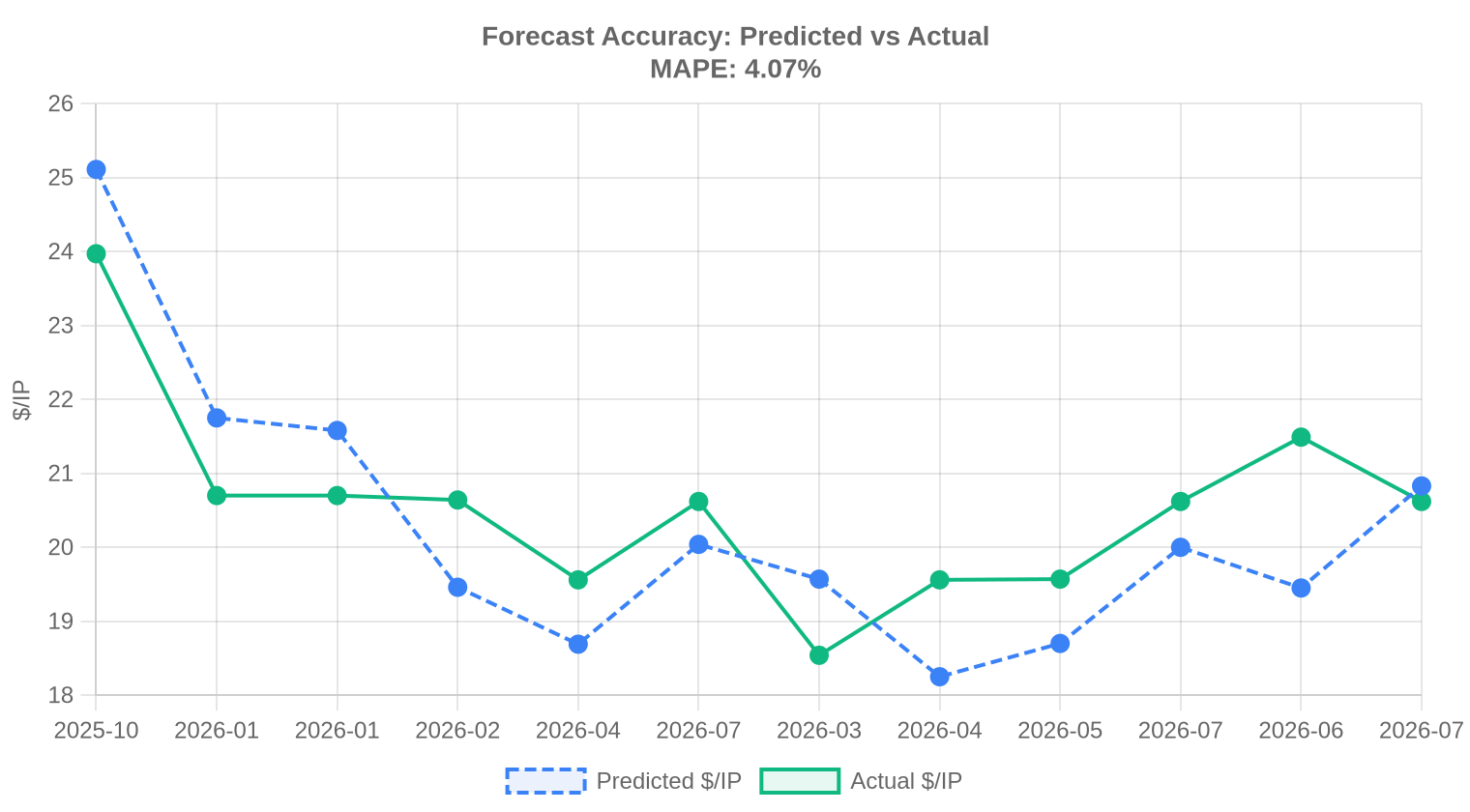
| Report Period | Target Month | Predicted | Actual | Deviation |
|---|---|---|---|---|
| 2026-02 | 2026-03 | $20 | $19 | +6% |
| 2026-03 | 2026-04 | $18 | $20 | -7% |
| 2026-04 | 2026-05 | $19 | $20 | -4% |
| 2026-Q2 | 2026-07 | $20 | $21 | -3% |
| 2026-05 | 2026-06 | $19 | $21 | -9% |
| 2026-06 | 2026-07 | $21 | $21 | +1% |
Methodology
Figures are based on completed IPv4Center marketplace transactions and RIR transfer statistics. Prices are in US dollars per IP address. Forecasts are produced by an AI model that analyses each block-size band and RIR segment separately (with outlier-trimmed medians) alongside known market catalysts; they are estimates, not guarantees.
Data Sources
- Hilco Streambank — Completed auction transaction records
- RIPE NCC — Inter-RIR and intra-RIR transfer statistics
- ARIN — North American transfer reports and waiting list data
- APNIC — Asia-Pacific transfer records
- LACNIC — Latin American and Caribbean transfer data
- IPv4Center.com — Proprietary marketplace transaction and lease pricing data
This report is generated automatically for informational purposes only and does not constitute financial advice.
Frequently Asked Questions
What is the average price of an IPv4 address in August 2026?
The blended average is $20.30/IP across 105 transactions, down from $21.90 in July 2026 and 21% below August 2025 levels.
How much does a /24 IPv4 block cost in August 2026?
A /24 block (256 IPs) costs approximately $5,197 at the market average. Premium /24s with clean reputation can reach $40/IP, or $10,240 per block.
How much does a /16 IPv4 block cost?
At the August 2026 average of $20.30/IP, a /16 block (65,536 IPs) would cost approximately $1.33 million. Large blocks typically trade at discounts to this average — closer to $10.50–$15/IP.
Why are APNIC IPv4 addresses more expensive?
APNIC addresses averaged $24.67/IP in August 2026, reflecting constrained supply in the Asia-Pacific region and limited cross-RIR transfer options. However, only 3 transactions recorded this month, so the sample is small.
What is the difference in price between ARIN and RIPE IPv4 addresses?
ARIN averaged $19.13/IP versus RIPE at $21.03/IP — a $1.90 gap. RIPE's premium is partly driven by the 24-month holding rule that constrains resale supply.
How many IPv4 addresses were traded in August 2026?
A total of 428,288 IPv4 addresses changed hands across 105 priced transactions, generating $5.9 million in total market value.
Is it better to buy or lease IPv4 addresses?
Buying is strongly favored. At $20.30/IP purchase versus $31.25/IP/month lease cost, the purchase pays for itself in under one month of avoided lease payments. A /24 costs $5,197 to buy versus $8,000/month to lease.
How long does an IPv4 transfer take?
ARIN transfers typically complete in 2–4 weeks. RIPE transfers take 2–6 weeks depending on documentation. LACNIC cross-RIR transfers, which historically took months, are now reportedly completing in roughly 60 business days with a target of 6–8 weeks.
What is the IPv4 lease rate in August 2026?
Monthly lease rates average $31.25/IP, or $8,000/month for a /24 block, based on a sample of 178 lease transactions. Annual cost per IP is $375.
Will IPv4 prices go up or down in late 2026?
Our regression model projects $19.38/IP for September and $19.26/IP by December 2026. The data points to continued modest decline, not recovery.
Why have IPv4 prices dropped 21% year-over-year?
The primary driver is the supply wave triggered by AWS's public IPv4 charging policy (effective February 2024), which pushed enterprises to release unused addresses. Increased supply against stable demand has compressed prices from $55+ in late 2023 to $20.30 today.
What is the payback period for buying IPv4 instead of leasing?
Less than one month. At $20.30/IP purchase cost versus $31.25/IP/month lease rate, you recoup the purchase price in approximately 19 days of avoided lease payments.
What countries are most active in IPv4 trading?
The US leads with 41 transactions (39%), followed by Great Britain (10), Canada (8), Spain (6), and Sweden (6). Twenty-one countries recorded at least one deal in August 2026.
What mistakes should be avoided when buying IPv4 addresses?
The most common mistakes are skipping blacklist verification, failing to use escrow, and not confirming the block's RIR transfer eligibility before committing funds. A block with active Spamhaus listings can lose 50% or more of its usable value.
What are the risks of skipping blacklist verification?
Purchasing a block with active blacklist entries on Spamhaus, UCEProtect, or similar services means your addresses may be blocked by major email providers, CDNs, and firewalls. Delisting can take weeks to months, and some listings are effectively permanent. Always verify before closing.
Why shouldn't you skip escrow when buying IPv4?
IPv4 transfers are irreversible once completed at the RIR level. Without escrow, a buyer who wires funds has no recourse if the seller fails to initiate the transfer. Escrow ensures funds are released only after the RIR confirms the transfer is complete.
What is RIPE's 24-month holding rule?
RIPE NCC requires that IPv4 blocks be held for 24 months before they can be transferred again. This limits speculative flipping and constrains short-term supply, contributing to RIPE's pricing premium over ARIN.
How does the BEAD program affect IPv4 prices?
The $42 billion US BEAD broadband program is creating forward demand for /20 to /16 blocks as rural ISPs build last-mile networks. These buyers are relatively price-insensitive, which could tighten supply in the mid-size block segment through 2027.
What is the annual yield on leasing IPv4 addresses?
Based on August 2026 data, the implied annual yield is approximately 1,847% — a figure that reflects extreme market disequilibrium between purchase and lease pricing. This yield will compress as more holders enter the leasing market.
How does AI infrastructure affect IPv4 demand?
AI training clusters and inference platforms require public IPv4 addresses for API endpoints, data ingestion, and model serving. This creates incremental demand alongside traditional ISP and enterprise buyers.
Are LACNIC IPv4 blocks harder to transfer?
Historically yes, but transfer times are improving. Brokers report cross-RIR LACNIC transfers completing in roughly 60 business days, with a target of 6–8 weeks. If this becomes consistent, the historical discount on LACNIC space should narrow.
What makes an IPv4 block more valuable?
The key factors are blacklist cleanliness, allocation age (pre-2000 vintage commands premiums), RIR jurisdiction, and block size. A clean /24 from ARIN can fetch $35–$40/IP while a flagged block of similar size might clear at $15 or less.
Should I sell or lease my IPv4 addresses?
If you want to retain the asset, lease — the yield is extraordinary at current rates. If you need capital or believe prices will continue declining (our models support this), sell now. Holders of large blocks can consider a hybrid strategy.
What is the minimum IPv4 block size that can be transferred?
A /24 (256 addresses) is the smallest block that can be practically routed and transferred at most RIRs. Blocks smaller than /24 are not globally routable and have minimal market value.
How many RIR transfers were recorded in August 2026?
A total of 196 official RIR transfers were recorded — 112 at ARIN and 84 at RIPE NCC. This exceeds the 105 priced transactions in our dataset due to internal transfers and untracked deals.
What is the cheapest RIR for IPv4 in August 2026?
ARIN space is cheapest at $19.13/IP average, followed by RIPE at $21.03. LACNIC averages $23.33 and APNIC leads at $24.67, though both have very small sample sizes (3 deals each).
What percentage of IPv4 deals are under $50,000?
78% of August 2026 deals (82 of 105) were under $50,000, but these accounted for only $1.29 million — 22% of total market value. The market's dollar volume is driven by a handful of large transactions.
When did IPv4 prices peak?
IPv4 prices peaked in late 2023, with ARIN blocks reaching $55–$60/IP. The introduction of AWS's $3.60/IP/year public IPv4 charge in early 2024 triggered a supply wave that has driven prices down approximately 65% to current levels.
Will IPv6 make IPv4 worthless?
Not in the foreseeable future. IPv6 adoption is around 45% of global traffic, but dual-stack requirements, legacy systems, and IoT deployments ensure IPv4 remains essential well into the 2030s. Prices are declining for supply reasons, not because of IPv6 displacement.