Buy IPv4 Addresses – Verified IPv4 Blocks with Secure Escrow
Buy verified IPv4 blocks from RIPE, ARIN, APNIC, and other RIR regions with secure escrow. Compare prices, manage contracts, and handle the entire transfer process from a single platform.
With over 1,500 verified IPv4 purchases completed, IPv4Center offers IPv4 purchasing, escrow payments, and full transfer management under one roof. Prices vary by block size and RIR region.
You can buy IPv4 addresses from $15 to $28 per IP through IPv4Center.com. Prices depend on block size (/24 to /16) and RIR region. All blocks are verified blacklist-free with secure escrow payments and full RIR transfer management included.
$15–$28/IP
Price Range
5–14 Days
Transfer Time
/24 to /12
Blocks Available
All 5
RIR Regions
Understanding the IPv4 Buying Process
Since the global IPv4 pool was exhausted years ago, new IPv4 blocks are no longer directly allocated. Companies looking to buy IP addresses today acquire the address space they need from existing holders through the secondary market. Whether you need to buy ip address blocks for a data center expansion or a single /24 for a new project, reliable seller verification, technical due diligence, and transfer compliance are the most critical parts of the process.
Every block listed on our marketplace is verified as clean IP addresses — screened against 300+ blacklist databases before publication. A secure purchase process requires careful examination of not just the price, but also the block's history, blacklist status, BGP announcement records, and potential abuse risks. An experienced broker or a marketplace with strong verification processes ensures that IPv4 blocks listed for sale are transfer-ready and safe.
As an experienced IPv4 transfer facilitator, IPv4Center.com manages every step from purchase agreement to payment coordination and the official RIR transfer process, reducing the technical and operational burden on companies. This way, buyers can focus on safely deploying their new IPv4 blocks rather than tracking each step individually.
Transfer timelines can vary by region. RIPE NCC internal transfers are typically completed within 5–10 business days, while ARIN processes may take longer. For inter-RIR transfers, both parties' policies and approval processes must be carefully managed.
- ✔Blacklist scanning across 300+ databases before listing
- ✔BGP announcement history and usage history verification
- ✔Hijacking, VPN, and proxy abuse checks
- ✔Detailed due diligence report for each listing
- ✔Secure payment options via SWIFT, Stripe, Wise, or USDT
- ✔Optional Escrow.com protection until transfer completes
- ✔Process management within legally binding purchase agreements
Current IPv4 Prices & IPv4 Purchase Costs
Live pricing updated from our marketplace listings. Prices reflect current market rates across all RIR regions.
| Feature | /24 | /23 | /22 | /20 | /16 |
|---|---|---|---|---|---|
| RIR | All Regions | All Regions | All Regions | All Regions | All Regions |
| Escrow Fee | Buyer pays | Buyer pays | Buyer pays | Buyer pays | Buyer pays |
| Broker Commission | None | None | None | None | None |
| Hidden Fees | None | None | None | None | None |
| Setup Fee | None | None | None | None | None |
| Blacklist Free | Yes | Yes | Yes | Yes | Yes |
| Clean BGP & Routes | Yes | Yes | Yes | Yes | Yes |
How to Buy IPv4 Addresses — Step by Step
From browsing to full ownership — we guide you through every step
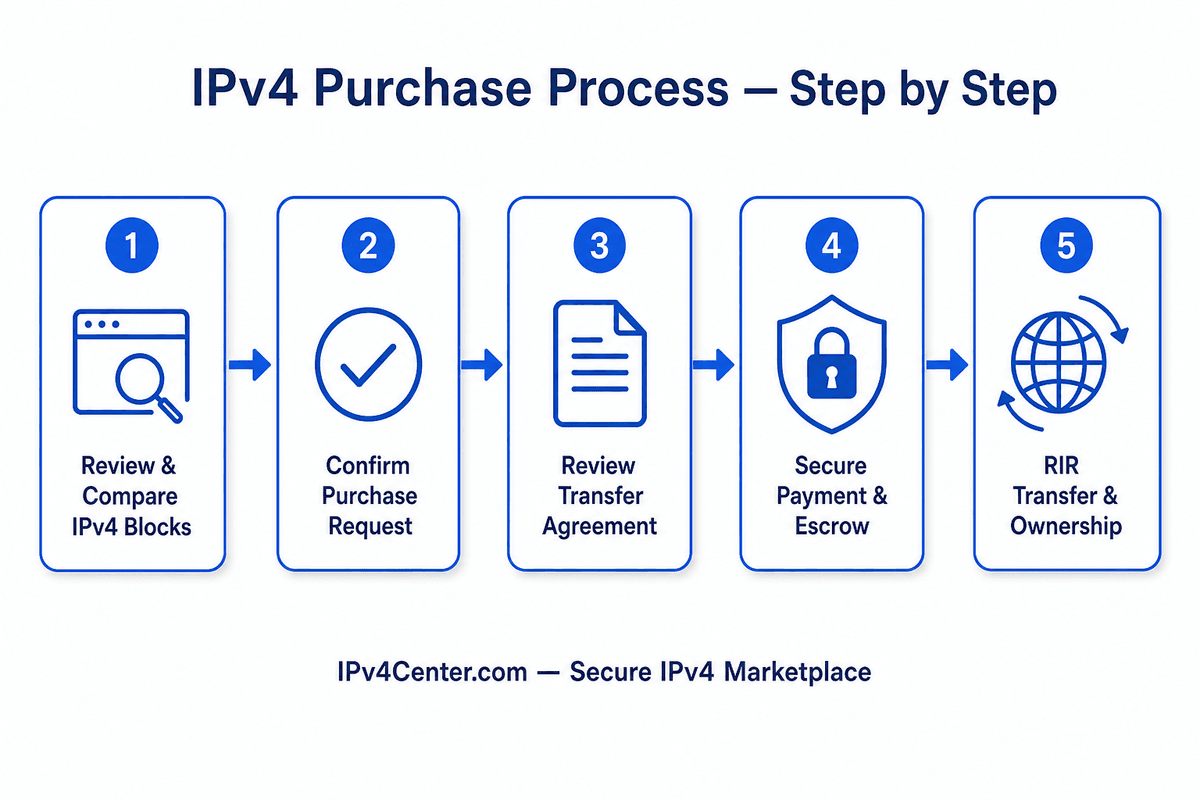
Review & Compare IPv4 Blocks
Browse IPv4 blocks for sale on our marketplace. Compare by prefix size, RIR region, price range, and location to find the most suitable IPv4 address block.
Confirm Your IPv4 Purchase Request
Select your preferred IPv4 block, confirm your purchase request, and initiate the steps required for the transfer process. The listing is temporarily reserved for you during paperwork preparation.
Review & Approve the IPv4 Transfer Agreement
We prepare a legally binding IPv4 transfer agreement between buyer and seller. Both parties review the terms and approve digitally through the platform in a secure manner.
Secure Payment & Escrow Process
Complete your payment via SWIFT bank transfer or Stripe credit card. Funds are held in secure escrow protection until the IPv4 transfer is completed.
RIR Transfer & IPv4 Ownership Transfer
We submit the IPv4 transfer request to the relevant RIR and manage the entire process until the IPv4 block is officially assigned to your organization.
IPv4 Purchase Costs & Buyer Commission
Transparent IPv4 pricing — clear cost structure including commission, escrow, and transfer process
IPv4Center Platform-Managed Purchase
IPv4Center manages seller sourcing, negotiation, contracts, escrow, and the full RIR transfer process on your behalf.
- No commission for the buyer
- No upfront deposit required
- SWIFT transfer — no extra fee
- Stripe credit card — 5% processing fee
- Full escrow protection until IPv4 transfer completes
- Lowest-risk IPv4 purchase model for enterprise buyers
Independent Seller Listing
The seller manages their own listing. A buyer-side commission applies to cover platform services and escrow.
- 5% commission on transaction value
- No upfront deposit required
- SWIFT transfer — no extra fee
- Stripe credit card — 5% processing fee
- Full escrow protection
IPv4 Block Verification & Due Diligence
Every IPv4 block listing undergoes blacklist, BGP, WHOIS, and ownership verification processes before being published on our marketplace.
IPv4 Blacklist Scan
IPv4 block cleanliness is verified against 300+ blacklist providers — comprehensive risk checks applied before listing.
IPv4 Abuse History Check
The IPv4 block's VPN, Tor, Proxy, and abuse history is thoroughly checked.
IPv4 BGP Routing History
The IPv4 block's BGP routing history is verified — hijack or unauthorized announcement risk is checked.
Seller & RIR Ownership Verification
Seller identity, official records, and RIR ownership information are verified.
IPv4 Subnet Geo-Location Accuracy
Geo-location and registration accuracy is checked for each IPv4 subnet.
WHOIS, Route Objects & Registration Verification
WHOIS records, route objects, and core ownership data are verified.
Why Buy Through IPv4Center.com?
A transparent marketplace built for organizations that demand reliability, buyer protection, and a secure IPv4 transfer process at every stage
Blacklist-Free Guarantee
Every IPv4 block is screened against major blacklist databases including Spamhaus, SURBL, and CBL before listing. We guarantee clean address space.
KYC-Verified Sellers
All sellers complete KYC verification and prove legitimate RIR ownership. You deal only with authenticated organizations.
All RIR Regions
Access IPv4 blocks from RIPE NCC, ARIN, APNIC, LACNIC, and AFRINIC. Global coverage for wherever your network operates.
Fully Managed RIR Transfers
Our team handles the entire RIR transfer workflow — from contract preparation and submission to post-transfer verification.
Secure Escrow & Payment Protection
Buyer funds are held in escrow until the RIR transfer is fully confirmed. Your payment is protected throughout the process.
Fast Process
Streamlined workflow means RIPE transfers complete in as little as 1–2 weeks. Other registries typically within 2–5 weeks.
What You Get After Purchase
Every IPv4 purchase includes enterprise-grade post-acquisition services at no extra cost
1 Year Free IP Blacklist Monitoring
Your purchased IPv4 blocks are monitored 24/7 across 300+ blacklist databases for a full year after purchase. Instant alerts if any IP appears on a blacklist.
IP Due Diligence Report
Comprehensive report covering previous ASN announcements, country-level routing history, blacklist records, and abuse history for every block you purchase.
Automatic Geofeed Configuration
Geolocation data is automatically published to MaxMind, IPinfo, IP2Location, and other major providers so your IPs show correct location from day one.
RPKI/ROA Setup Assistance
Post-purchase routing configuration support including ROA creation, route object setup, and BGP announcement guidance for your new IPv4 blocks.
rDNS Management
Configure PTR records through IPv4Center nameservers or delegate to your own nameservers. Both modes available at no extra cost for purchased blocks.
Dedicated Transfer Support
End-to-end RIR transfer management with dedicated support throughout the process. Post-transfer verification ensures everything is properly registered.
Complete Purchase Workflow
Two secure pathways to acquire IPv4 addresses — choose the one that fits your needs
Direct Payment
Browse marketplace, select your subnet
Accept the purchase commitment terms
We verify your organization documents (KYC)
Purchase agreement prepared and sent to you
You sign and return the agreement within 3 business days (stamped)
Invoice issued for the full amount
You send payment to our bank account
Payment confirmed — Transfer Agreement prepared
Transfer Agreement signed: first buyer, then seller
Seller initiates Transfer Request on RIR (with company registration papers)
RIR verifies and completes transfer (1–3 business days for RIPE)
Transfer confirmed — seller receives their payment
Via Escrow.com
Browse marketplace, select your subnet
Accept the purchase commitment terms
We verify your organization documents (KYC)
Purchase agreement prepared and signed by both parties
Escrow.com transaction created with release condition
Condition: "IP organization changed to ORG-xxx in RIR database"
You send funds to Escrow.com — fully secured
Funds secured — Transfer Agreement prepared and signed
Seller initiates Transfer Request on RIR (with company registration papers)
RIR verifies and completes transfer (1–3 business days for RIPE)
Transfer confirmed → Escrow.com releases payment to seller
Secure Payment Options
Multiple payment methods to suit your organization — all protected with escrow
Bank Wire / SWIFT
Direct USD transfers, no processing fee, escrow protected.
Stripe
Visa, Mastercard, Amex. 5% processing fee. Instant confirmation.
Wise.com
40+ currencies (EUR, GBP, JPY, AUD, CAD, CHF, SGD, HKD, etc.). Competitive rates.
Crypto Currencies
Pay with USDT via Ethereum (ERC-20). Fast, borderless transactions.
Supported RIR Regions & IPv4 Transfer Timelines
IPv4 block purchase and transfer support from all major RIR regions including RIPE NCC, ARIN, APNIC, LACNIC, and AFRINIC
RIPE NCC Registration Fees
Signup Fee: €1,000
Annual Fee: €1,800
ARIN Registration Fees
Signup Fee: $50
Annual Fee: $250
RIR Transfer Fees (2026)
Transfer fees charged by Regional Internet Registries for IPv4 address transfers. These are separate from the IPv4 purchase price.
Intra-RIR Transfers (Same Registry)
| Transfer Route | Fee | Paid By | Note |
|---|---|---|---|
| RIPE → RIPE | No fee | — | No RIR transfer fee for intra-RIPE |
| ARIN → ARIN | $500 + recipient fee | Source pays $500, Recipient pays tier fee | Recipient fee based on block size |
| APNIC → APNIC | 20% of annual fee | Recipient (Buyer) | Based on membership tier |
| LACNIC → LACNIC | $200 + $1,000–$1,500 | Ticket: Seller, Transfer: Buyer | $1,000 for < /19, $1,500 for ≥ /19 |
| AFRINIC → AFRINIC | Varies | Contact AFRINIC | Intra-RIR only, no inter-RIR transfers |
Inter-RIR Transfers (Between Registries)
| Transfer Route | Source RIR Fee | Receiving RIR Fee | Total Estimated |
|---|---|---|---|
| ARIN → RIPE | $500 (ARIN) | No fee (RIPE) | ~$500 |
| RIPE → ARIN | No fee (RIPE) | $500 + tier fee (ARIN) | $500 + tier |
| APNIC → RIPE | 20% annual (APNIC) | No fee (RIPE) | ~AUD 250 |
| RIPE → APNIC | No fee (RIPE) | 20% annual (APNIC) | ~AUD 250 |
| ARIN → APNIC | $500 (ARIN) | 20% annual (APNIC) | $500 + ~AUD 250 |
| APNIC → ARIN | 20% annual (APNIC) | $500 + tier fee (ARIN) | ~AUD 250 + $500 + tier |
| LACNIC → RIPE | $1,200 (LACNIC) | No fee (RIPE) | $1,200 |
| RIPE → LACNIC | No fee (RIPE) | $1,200 (LACNIC) | $1,200 |
ARIN Recipient (Buyer) Transfer Fee Tiers
| Block Size | Recipient Fee |
|---|---|
| /24 or smaller | $187.50 |
| /24 – /22 | $375 |
| /22 – /20 | $750 |
| /20 – /18 | $1,500 |
| /18 – /16 | $3,000 |
| /16 – /14 | $6,000 |
| /14 – /12 | $12,000 |
| /12 – /10 | $24,000 |
* ARIN recipient fees are in addition to the $500 source processing fee. Fees apply to both intra-ARIN and inter-RIR transfers where ARIN is the receiving registry.
Who Pays the Transfer Fees?
RIPE NCC: No RIR transfer fee for intra-RIPE transfers.
ARIN: $500 processing fee paid by the source (seller). Recipient (buyer) pays a separate tiered fee based on block size ($187.50 – $192,000).
APNIC: 20% of annual membership fee — typically paid by the recipient (buyer) for intra-APNIC, source pays for inter-RIR transfers out.
LACNIC: $200 initial ticket fee (seller opens) + $1,000–$1,500 transfer fee (buyer pays).
Transfer fees are separate from the IPv4 purchase price and IPv4Center.com commissions. Fees are subject to change by each RIR — last verified February 2026.
What You Need to Buy IPv4
Make sure the required membership, documents, network plan, and payment preparations are completed before starting the IPv4 transfer process
RIR Membership or Sponsorship
You need an active LIR account (RIPE), Org ID (ARIN), or equivalent membership at the relevant registry. We can guide you through the signup process if needed.
Organization Documents
Valid company registration certificate, articles of incorporation, or equivalent government-issued documents proving your organization's legal standing.
Network Justification
A brief plan explaining how you intend to use the IPv4 address space. This is required by most RIRs to approve the incoming transfer.
Payment Capability
Ability to pay via SWIFT international bank transfer, credit card (Stripe), Wise.com, or cryptocurrency (USDT ERC-20). Full payment due after signing the purchase agreement.
Corporate Documents Required for IPv4 Purchase
Prepare the required company, RIR, and identity documents in advance for a fast and smooth IPv4 transfer process
Things to Check Before Buying IPv4
Reduce risks and protect your investment by performing proper due diligence before buying IPv4
Verify Clean IP Reputation
Check that the block has no active entries on Spamhaus, SURBL, Barracuda, or other major blacklist databases.
Review BGP History
Examine the prefix's routing history for any hijacking incidents, unauthorized announcements, or suspicious activity.
Confirm Seller Ownership
Validate that the seller is the legitimate holder through official RIR WHOIS records and registration data.
Use Escrow Protection
Never send payment directly to a seller. Always use a trusted escrow mechanism to protect your funds until transfer is confirmed.
Check for Existing ROAs
Ensure no conflicting Route Origin Authorizations exist that could interfere with your ability to announce the prefix.
Understand Transfer Policies
Each RIR has specific transfer requirements and timelines. Know the process for your target registry before committing.
Plan Your Announcement Strategy
Prepare your BGP configuration, create ROA (Route Origin Authorization) records, and coordinate with your upstream providers before the transfer completes.
IPv4 Due Diligence Checklist
Every item on this checklist must be verified before committing to an IPv4 purchase. A single overlooked issue can render the block unusable.
Clean Blacklist Status
Verify the block against Spamhaus (ZEN, SBL, XBL, PBL), Barracuda, SORBS, SpamCop, and 300+ additional blacklist databases. A single SBL listing can reduce email inbox placement from 95% to below 10%.
No Unauthorized Routing
Check BGP archive data (RIPE RIS, RouteViews) to confirm no active routing by unauthorized parties. Blocks showing signs of hijacking or inconsistent announcements pose significant operational risk.
Clear Ownership Chain
Verify the complete ownership chain in RIR WHOIS records. Ensure the registration data matches the seller and that no sub-allocations or assignments conflict with the transfer.
No Pending Disputes or Legal Claims
Confirm there are no ongoing disputes, legal claims, or encumbrances on the address block. Outstanding issues at the RIR level can delay or block transfers entirely.
Block Not Part of Active Allocation
Ensure the block is not part of a larger allocation that remains in active use. Splitting or carving out sub-blocks from live infrastructure requires additional coordination.
Seller Authority Verification
Verify the seller has legitimate authority to transfer by checking their LOA (Letter of Authorization), RIR account status, and that the account holder matches the transfer agreement signer.
No Geolocation Issues
Check that the geolocation data (MaxMind, IP2Location, IPinfo) matches your intended use. Incorrect geolocation can affect CDN routing, ad targeting, and content licensing compliance.
Transfer Types and Timelines
The type of address space determines documentation requirements, processing time, and transfer complexity at the registry level.
Legacy
Address space allocated before the RIR system existed. Transferable, but holder authority verification may require extra documentation. These blocks predate modern registry policies.
PA (Provider Aggregatable)
Space allocated to LIRs (Local Internet Registries). The most common transfer type in the RIPE region, with the fastest processing times — typically 1–2 weeks.
PI (Provider Independent)
Space assigned directly to end users. In the RIPE region, receiving PI space requires a sponsoring LIR relationship. Transfer processing is similar to PA.
Inter-RIR
Transfers between two different registries (e.g. ARIN to RIPE). Both RIRs must independently approve the transfer, which extends the timeline to 3–6 weeks.
Avoid these frequent mistakes that can delay your transfer, increase costs, or leave you with unusable address space.
Skipping IP Reputation Due Diligence
A Spamhaus SBL listing can render addresses unusable for email. Always verify against Spamhaus, Barracuda, SORBS, SpamCop, and 300+ additional databases before committing to a purchase.
Underestimating Transfer Timelines
While standard transfers take 2–4 weeks, complex scenarios — inter-RIR transfers, legacy blocks with unclear documentation, or sub-allocation splitting — can extend to 6–8 weeks. Plan with buffer time.
Failing to Verify Seller Authority
RIRs reject transfer requests if the account holder doesn't match the agreement signer, if active sub-allocations haven't been reclaimed, or if there are outstanding fees on the seller's account.
Not Planning Post-Transfer Setup
After receiving IPv4 addresses, you need to create RPKI ROA records, configure BGP announcements, update geofeed records for geolocation accuracy, and gradually warm the IPs if using them for email (2–4 week warm-up recommended).
Everything You Need to Know About Buying IPv4 Addresses
With the large-scale exhaustion of global IPv4 pools, IPv4 address space acquisition has become an established secondary market based on transfers between existing holders rather than new allocations. Today, organizations evaluate IPv4 block purchase or lease options to meet network growth, data center capacity, hosting infrastructure, and long-term operational needs. Whether you are targeting a single /24 block or a larger /16 address space, understanding market structure, price dynamics, and transfer processes is critically important for informed decision-making.
In Europe, the Middle East, and surrounding regions, RIPE NCC transfer processes generally proceed faster and more predictably, while ARIN may have more pronounced needs-based justification and additional compliance steps. Therefore, in the IPv4 purchasing process, not just price but also RIR policies, document preparation, and transfer management matter. Working with an experienced IPv4 broker or transparent IPv4 marketplace can strengthen both registry compliance and transaction security.
IPv4 prices can vary by block size (/24, /23, /22 and above), RIR region, supply-demand balance, usage history quality, and transfer ease. Global IPv4 demand continues to remain strong due to cloud providers, ISPs, hosting companies, and growing enterprise networks. With thousands of IP addresses for sale across multiple RIR regions, live market visibility, block quality analysis, and transparent price comparison provide significant advantages in the purchasing process.
At the foundation of a secure IPv4 purchase lies comprehensive due diligence. Before purchasing, blacklist records, WHOIS ownership, BGP routing history, ROA compliance, and abuse history must be carefully examined. Clean-history, verified, and transfer-ready IPv4 blocks can reduce operational risks while increasing future usage flexibility.
Escrow protection is an important security layer, especially for high-value IPv4 transactions. Through secure payment structures, funds can be protected until the official RIR transfer process is completed. Transfer timelines may vary across RIPE NCC, ARIN, APNIC, and other RIR regions; therefore, proper planning, document preparation, and process management directly affect deployment speed.
Understanding IPv4 block structure also carries strategic importance. While historical Class A, B, and C address structures are largely evaluated using CIDR notation today, knowing the logic behind these structures in terms of block size, liquidity, pricing, and usage scenarios is beneficial. /24 blocks in particular are a popular starting point for many businesses due to their accessibility and widespread use.
Unlike IPv4 auction platforms where pricing can be unpredictable and support limited, IPv4Center.com provides full broker support with transparent fixed pricing, comprehensive due diligence, and managed RIR transfers. Managed processes like IPv4Center.com can make the purchasing process more secure and predictable by offering marketplace transparency, seller verification, blacklist analysis, escrow protection, and RIR transfer management under one roof. From initial research to post-transfer ownership verification, proper process management can turn IPv4 acquisition not just into a technical need but also a strategic infrastructure investment.
Understanding IPv4 Address Classes
Differences and use cases between Class A, B, C, D, and E IPv4 addresses
Although modern networks largely use the CIDR structure, Classes A–E are still important for understanding IPv4 block structure, historical allocation logic, and market dynamics.
Class A
AvailableClass A addresses use the first octet for network identification, leaving three octets for host addresses. Originally allocated to the largest organizations like IBM, AT&T, Apple, and US government agencies. A single Class A block (/8) contains over 16 million IP addresses, making these extremely valuable and rarely available on the secondary market.
Class B
AvailableClass B addresses use two octets for network identification. A /16 block provides 65,534 usable host addresses, suitable for large enterprises, universities, and regional ISPs. Class B equivalent blocks on the secondary market are valued at approximately $983,000–$1,311,000.
Class C
AvailableClass C addresses use three octets for network identification. A /24 block (the smallest routable prefix on the internet) provides 254 usable host addresses. Class C blocks are the most commonly traded in the IPv4 market, with prices ranging from $5,600–$7,200 for a /24 subnet.
Class D
Class D addresses are reserved for multicast traffic. Unlike unicast addresses, multicast addresses identify a group of receivers rather than a single host. These addresses are not available for purchase or transfer and are used for applications like IPTV, video conferencing, and network discovery protocols.
Class E
Class E addresses are reserved by IANA for experimental purposes and future use. They are not allocated for general use on the public internet and cannot be purchased or transferred. The address 255.255.255.255 is the broadcast address used for network-wide communications.
In the IPv4 secondary market, only Class A, B, and C addresses (1.0.0.0 – 223.255.255.255) are available for purchase. Most transactions involve /24 (Class C equivalent) through /16 (Class B equivalent) blocks. Class A equivalent /8 blocks are extremely rare and typically held by major corporations and governments.
Permanent Ownership or Flexibility? IPv4 Buying vs. Leasing Comparison
Compare the advantages of both approaches to determine the model that best fits your investment strategy
Buy IPv4…
When long-term ownership and investment value are the priority
- You want permanent ownership and to show the addresses as assets on your balance sheet
- Your infrastructure requires fixed IP capacity for 2+ years
- You prefer a one-time investment over recurring monthly payments
- You want the right to sub-lease your blocks to third parties
- You expect your IP assets to appreciate in value over time
- You want full independence with no dependency on any provider
Lease IPv4…
When operational agility and low initial costs matter
- You need quick access to IPv4 capacity without a large capital investment
- You have project-based or seasonal IP requirements
- You want to avoid dealing with RIR transfer processes
- You need to flexibly scale IP capacity up or down based on demand
- You want to test a new market or region with low risk
- You need addresses ready for announcement within days
Buy IPv4 Address Blocks by Size — /24 to /16
Choose the right block size for your network needs and budget
The most commonly traded IPv4 block size. Ideal for small businesses, branch offices, and startups needing a routable prefix with manageable investment.
A solid mid-range option for growing companies that need more capacity than a single /24 but want to keep per-IP costs competitive.
Popular among ISPs, hosting providers, and medium enterprises. Offers better per-IP economics while maintaining high liquidity on the secondary market.
Best suited for large-scale deployments including data centers, cloud providers, and enterprise networks with significant growth projections.
IPv4 Market Prices in 2026 — What to Expect
Regional price ranges based on current market conditions and recent transactions
Prices are approximate and change based on market conditions, block size, and reputation history.
Why Trust IPv4Center for Your IPv4 Purchase
Over a decade of hands-on experience in IPv4 transfers, RIR compliance, and market intelligence
IPv4Center.com was founded in 2010 by Mustafa Enes Akdeniz, a RIPE NCC member and network engineering professional with firsthand experience navigating complex IPv4 transfers across all five Regional Internet Registries. What started as a focused brokerage has grown into a full-service marketplace serving organizations in over 70 countries.
Our team has directly managed more than 1,500 IPv4 transactions totaling millions of IP addresses transferred. This operational depth means we have encountered and resolved virtually every edge case — from legacy block transfers requiring historical ownership verification to complex inter-RIR moves involving simultaneous approvals from both ARIN and RIPE NCC. Every process improvement in our platform comes from real-world transfer experience, not theoretical assumptions.
Unlike platforms that simply list blocks and let buyers figure out the rest, IPv4Center provides end-to-end management: we verify seller ownership against RIR databases, screen every block against 300+ blacklist providers, prepare legally binding transfer agreements, coordinate escrow payments, and manage the official RIR transfer from initiation to completion. Our 4.9/5 Trustpilot rating reflects this comprehensive approach to buyer protection.
We also maintain direct relationships with all major RIR transfer teams, enabling us to anticipate policy changes and resolve documentation issues before they cause delays. When RIPE NCC updated their transfer policy in 2025, our clients experienced zero disruption because we had already adapted our workflow months in advance.
IPv4Center vs Alternative Acquisition Methods
Compare how our managed marketplace model differs from auction platforms and traditional brokers
| Feature | IPv4Center | Auction Platforms | Traditional Brokers |
|---|---|---|---|
| Price Transparency | Live pricing, visible to all | Hidden until bidding ends | Negotiated case-by-case |
| Buyer Commission | 0% for managed listings | 5–15% buyer premium | 5–10% commission |
| Blacklist Screening | 300+ databases, automated | Buyer responsibility | Varies by broker |
| Escrow Protection | Built-in with every purchase | Optional, extra cost | Depends on broker |
| RIR Transfer Management | End-to-end, included | Not included | Partial assistance |
| Post-Purchase Support | Free RPKI, geofeed, monitoring | None | Limited |
| Average Transfer Time | 1–2 weeks (RIPE) | 3–6 weeks | 2–4 weeks |
| Due Diligence Report | Included for every listing | Not provided | Available at cost |
Frequently Asked Questions
Everything you need to know about purchasing IPv4 address blocks
How do I buy an IPv4 address block?
Is it better to buy or lease IPv4?
What are current IPv4 prices?
What checks should be done before buying IPv4?
How long does an IPv4 transfer take?
What documents are needed to buy IPv4?
IPv4 broker, marketplace, or direct seller: Which is safer?
What is a /24 IPv4 block and why is it so popular?
Why are IPv4 addresses valuable?
What is the difference between IPv4 and IPv6?
Are IPv4 classes (A, B, C) still important today?
What happens after buying IPv4?
Which block size is best for my business when buying IPv4?
What is the safest process for companies buying IPv4 for the first time?
Is escrow necessary when buying IPv4?
Why can a transparent marketplace model provide a price advantage when buying IPv4?
Can I resell the IPv4 block I purchased in the future?
Why do businesses planning long-term growth prefer buying IPv4?
How can you identify a reliable IPv4 seller?
What are the most common mistakes when buying IPv4?
What affects IPv4 block prices the most?
Why do many businesses prefer managed processes like IPv4Center?
What is the due diligence process before buying IPv4?
What are the different transfer types (Legacy, PA, PI, Inter-RIR)?
What are common mistakes when buying IPv4 addresses?
What should I do after receiving my IPv4 block?
How much does an IPv4 address cost in 2026?
Can I buy a single /24 IPv4 block?
Is it safe to buy IPv4 addresses online?
How are IPv4 purchase and lease payments securely processed?
Why do IPv4 prices keep rising?
What is the difference between /24, /20, and /16 subnets?
What Our Clients Say
Trusted by ISPs, hosting providers, banks, and enterprises across 70+ countries for secure IPv4 transactions
We have purchased over a dozen subnets ranging from /20 to /24 through IPv4Center.com. Every block was clean, and the RIPE and ARIN transfers were managed end-to-end. Pricing transparency across all listings made comparing offers effortless.
3NT
VP of Engineering
Multiple /20–/24 subnets purchased
We acquired a full /16 block for our global hosting infrastructure. IPv4Center.com handled the due diligence, escrow, and RIR transfer flawlessly. Having 65,536 clean IPs under a single allocation was critical for our scale.
ISHosting
Technical Director
/16 block purchased (65,536 IPs)
Fifty /24 subnets — all purchased through IPv4Center.com over the past year. Each block came with a clean blacklist report and the transfers averaged under 10 business days. Their inventory depth is unmatched.
Truview
Network Architect
50x /24 subnets purchased
Between our five /20 blocks, the /19, and two /21s, IPv4Center.com has been our sole IPv4 supplier. The team understands enterprise-scale procurement — documentation, compliance, escrow, everything was handled professionally.
Steel-Axis
Infrastructure Lead
5x /20, 1x /19, 2x /21 purchased
We are satisfied with our experience with IPv4Center.com. We purchased 768 IP addresses and the entire process was completed quickly and efficiently.
Türkiye Halk Bankası A.Ş.
IT Department
768 IPs purchased
As a crypto exchange, IP reputation directly impacts our deliverability and security posture. IPv4Center.com sourced us a pristine /23 block with no proxy, VPN, or abuse history. The transfer was handled professionally.
BtcTürk
IT Security
512 IPs purchased
Brands That Trust Us for IPv4 Transfers
Related Resources
IPv4 Price Tracker
Track live IPv4 prices across all RIR regions and block sizes.
Learn MoreBuy IPv4 Addresses
Guide to finding and purchasing IPv4 address blocks.
Learn MoreLease IPv4 Addresses
Flexible IPv4 leasing as an alternative to buying.
Learn MoreIPv4Center vs IPXO
See how IPv4Center compares to IPXO for buying IPv4.
Learn More