20 min read
This report analyzes the IPv4 transfer market for July 2026, based on completed IPv4Center marketplace transactions and official RIR transfer records.
Executive Summary
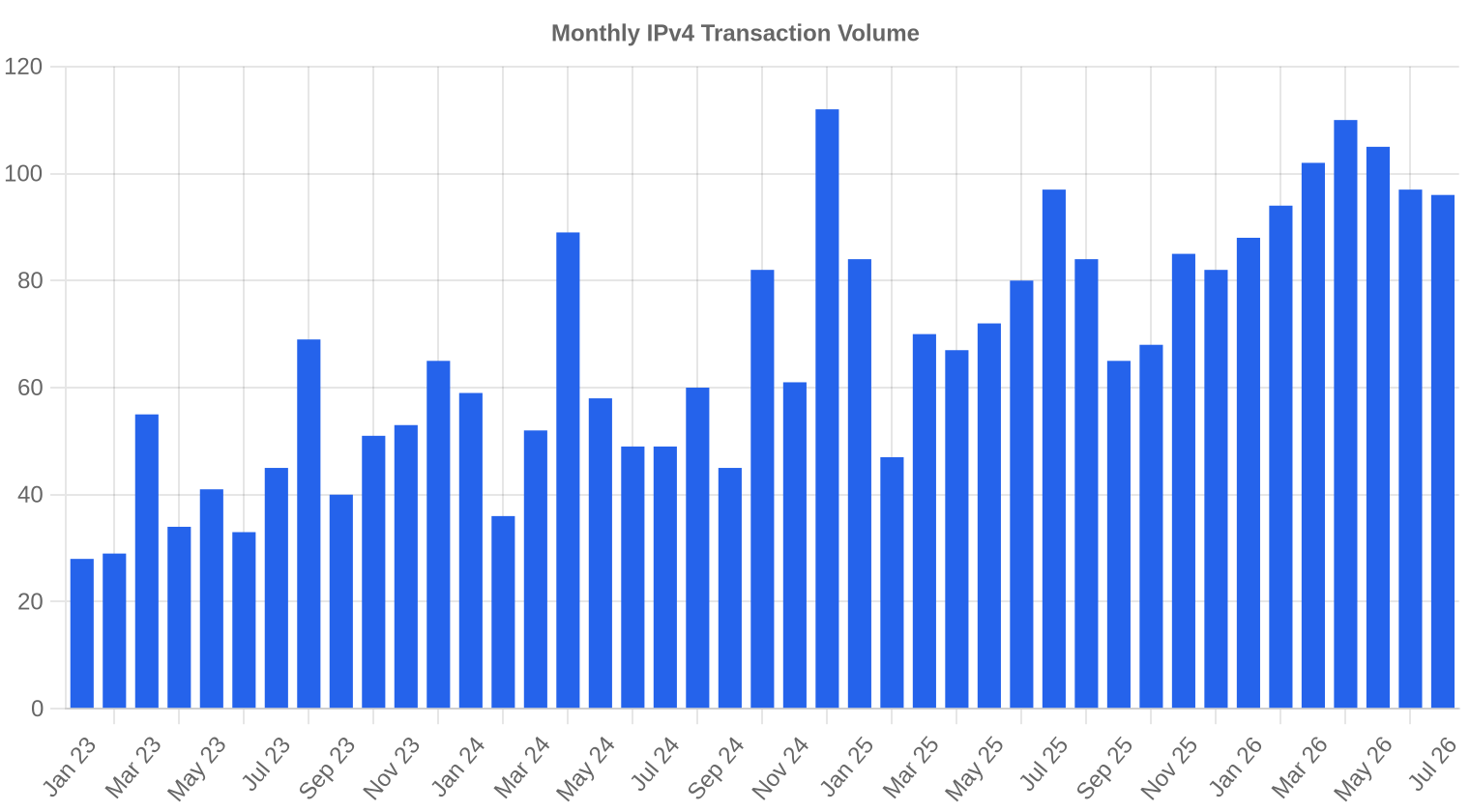
The IPv4 transfer market posted 96 transactions in July 2026, moving 380,160 addresses at a weighted average of $20.62/IP. That figure is down 4% from June and a stark 25.7% below July 2025's levels — the steepest year-over-year decline we've tracked in this cycle. Total deal value came in at $5.37 million, with a median price of $19.38/IP indicating the average isn't being dragged by a handful of outliers. The trend is firmly down, with the regression line slipping another 0.37% month-on-month, and there's little in the pipeline to suggest a reversal before year-end.Market Overview
| Transactions | 96 |
| IP Addresses Traded | 380,160 |
| Estimated Market Value | $5,369,142 |
| Average Price / IP | $20.62 |
| Median Price / IP | $19.38 |
| RIR Transfers | 294 |
Year-over-Year Comparison
| Metric | This period | A year earlier (July 2025) | Change |
|---|---|---|---|
| Transactions | 96 | 97 | -1.0% |
| IP Addresses Traded | 380,160 | 272,384 | +39.6% |
| Estimated Market Value | $5,369,142 | $5,768,137 | -6.9% |
| Average Price / IP | $20.62 | $27.74 | -25.7% |
| RIR Transfers | 294 | 805 | -63.5% |
Price Dynamics
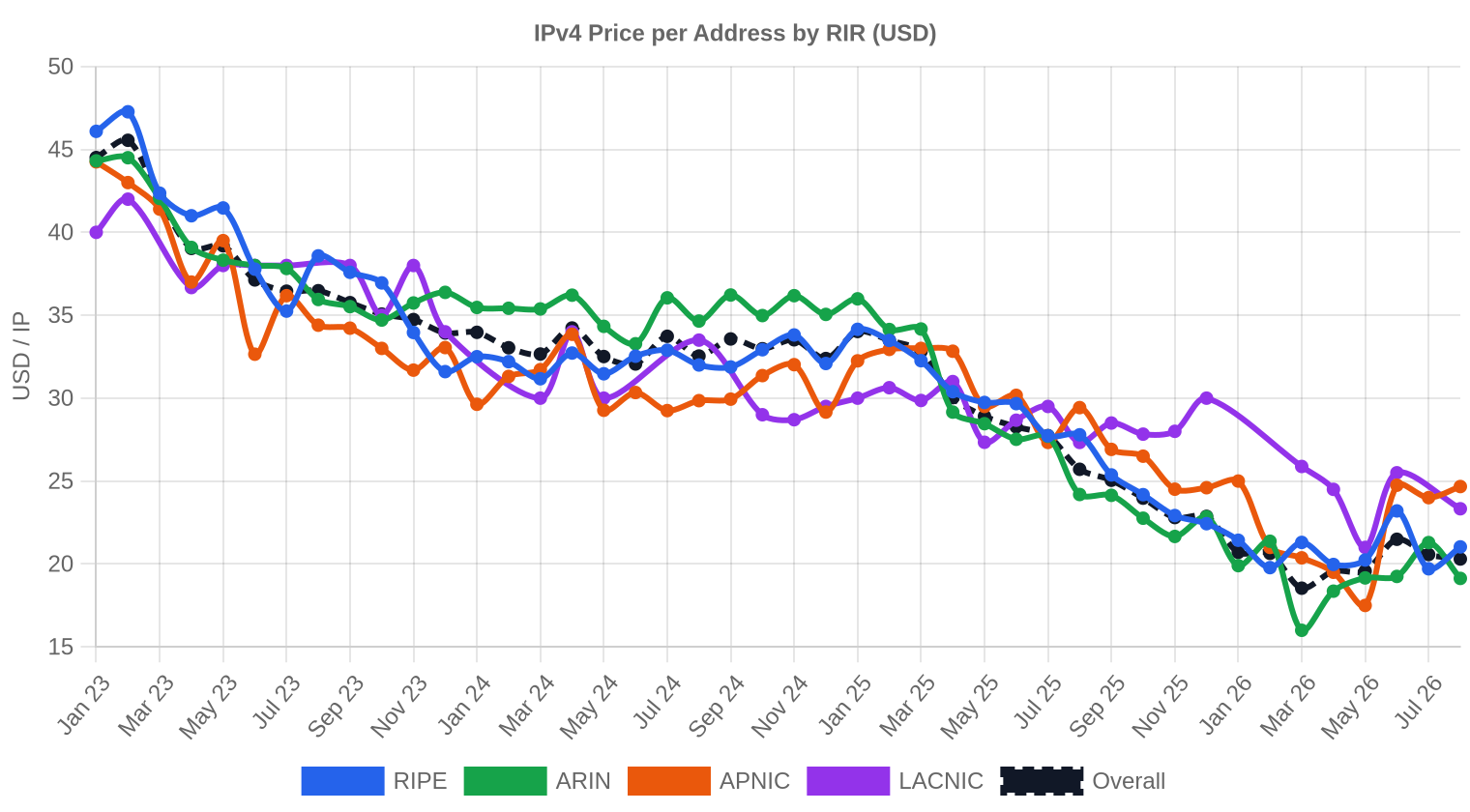
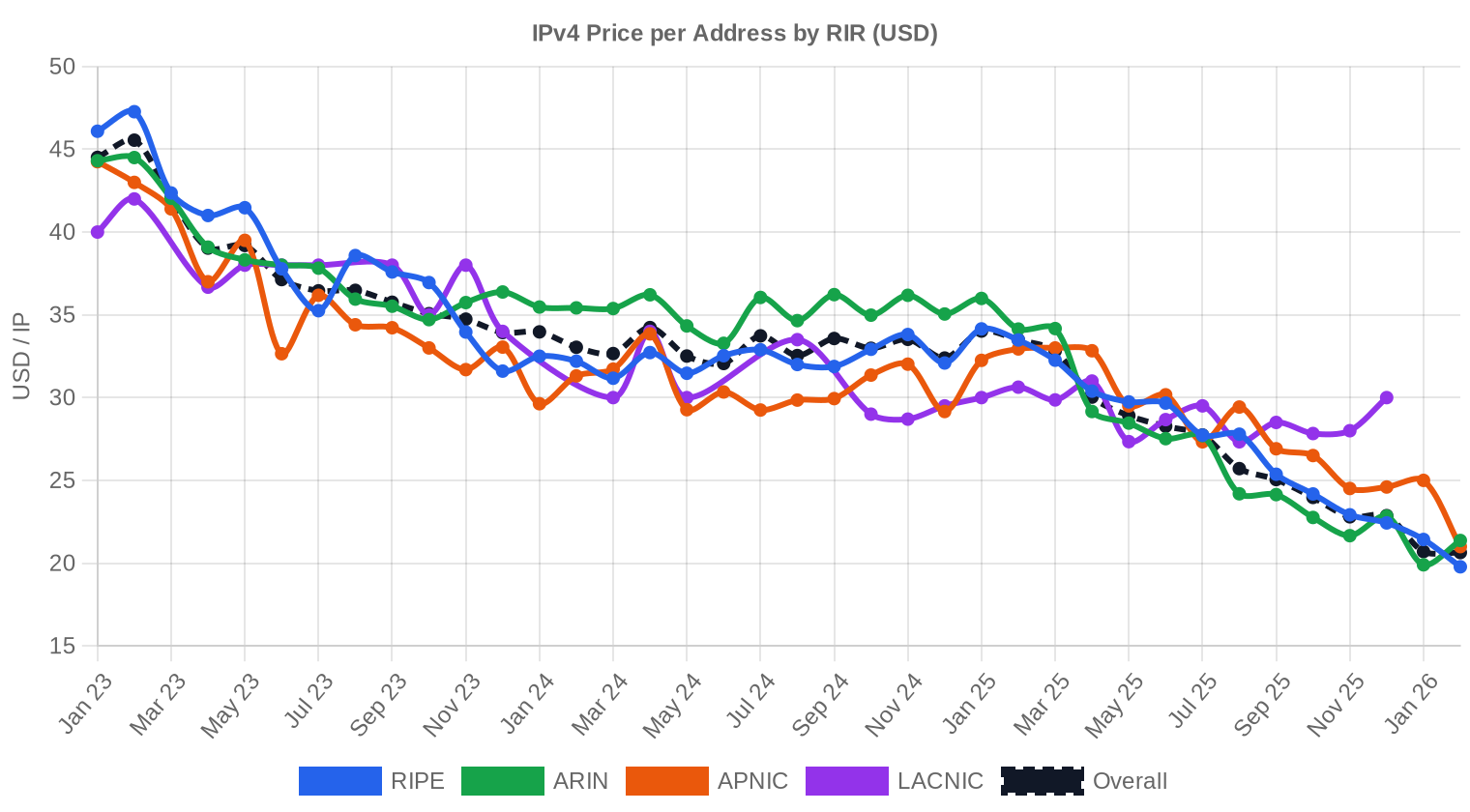
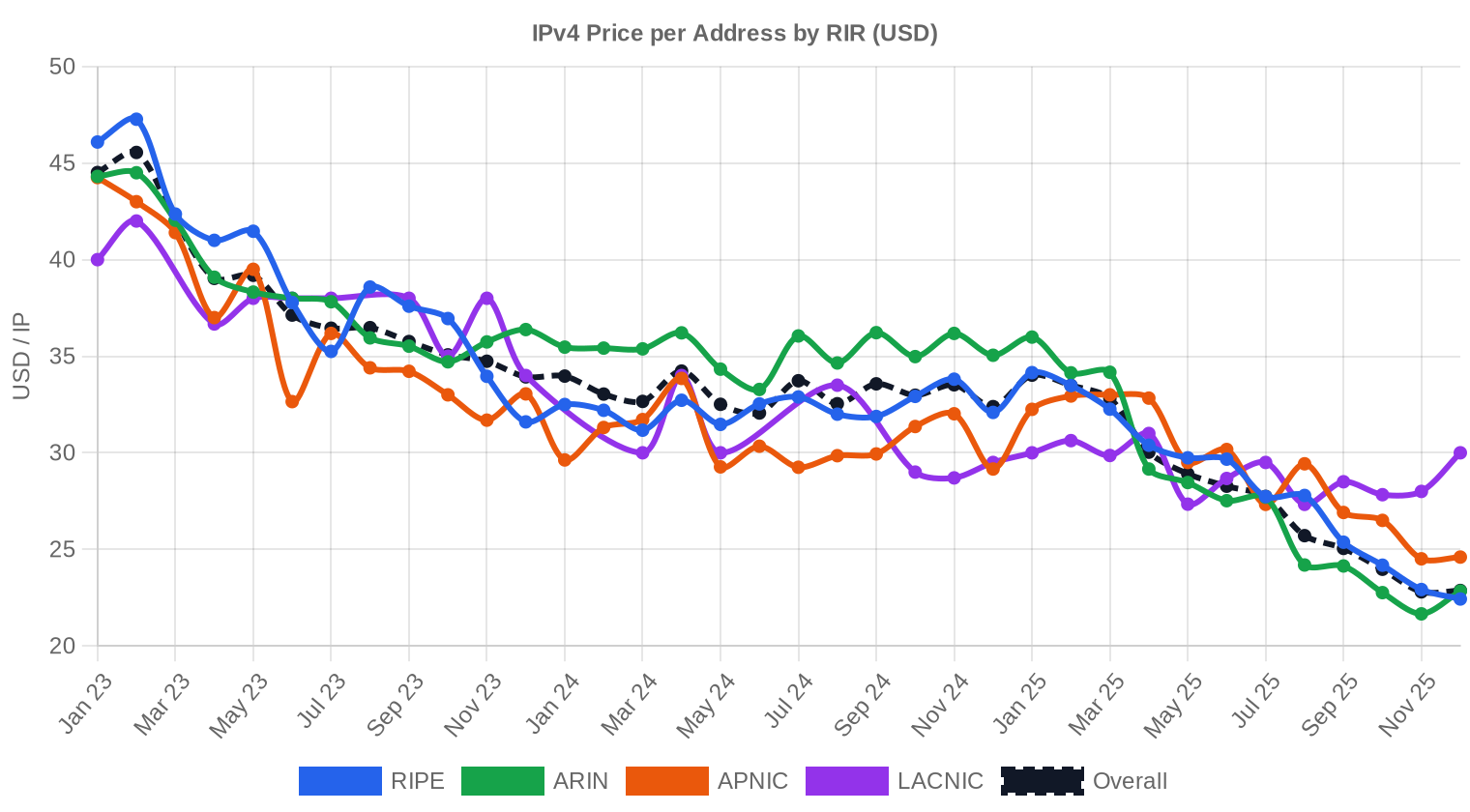
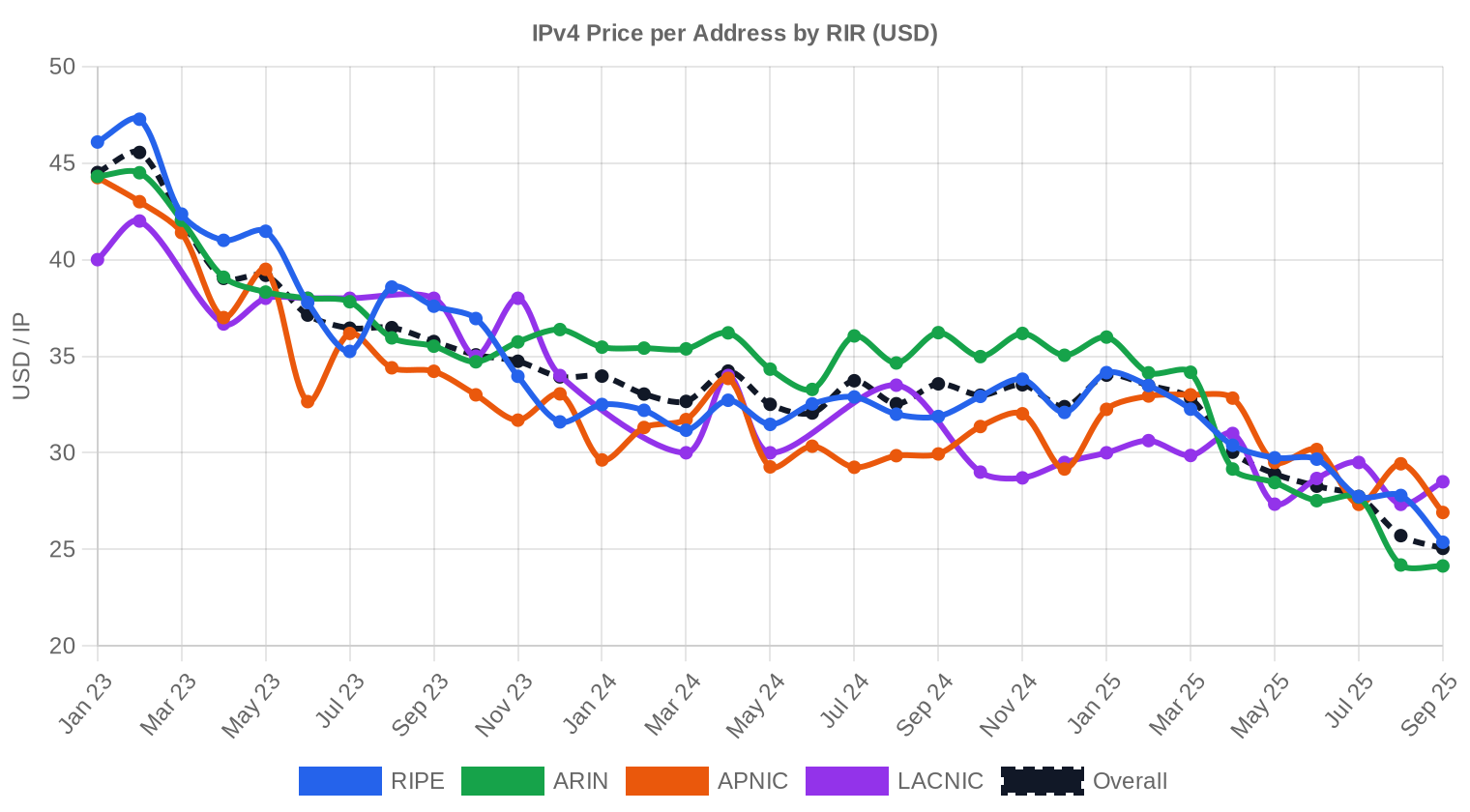
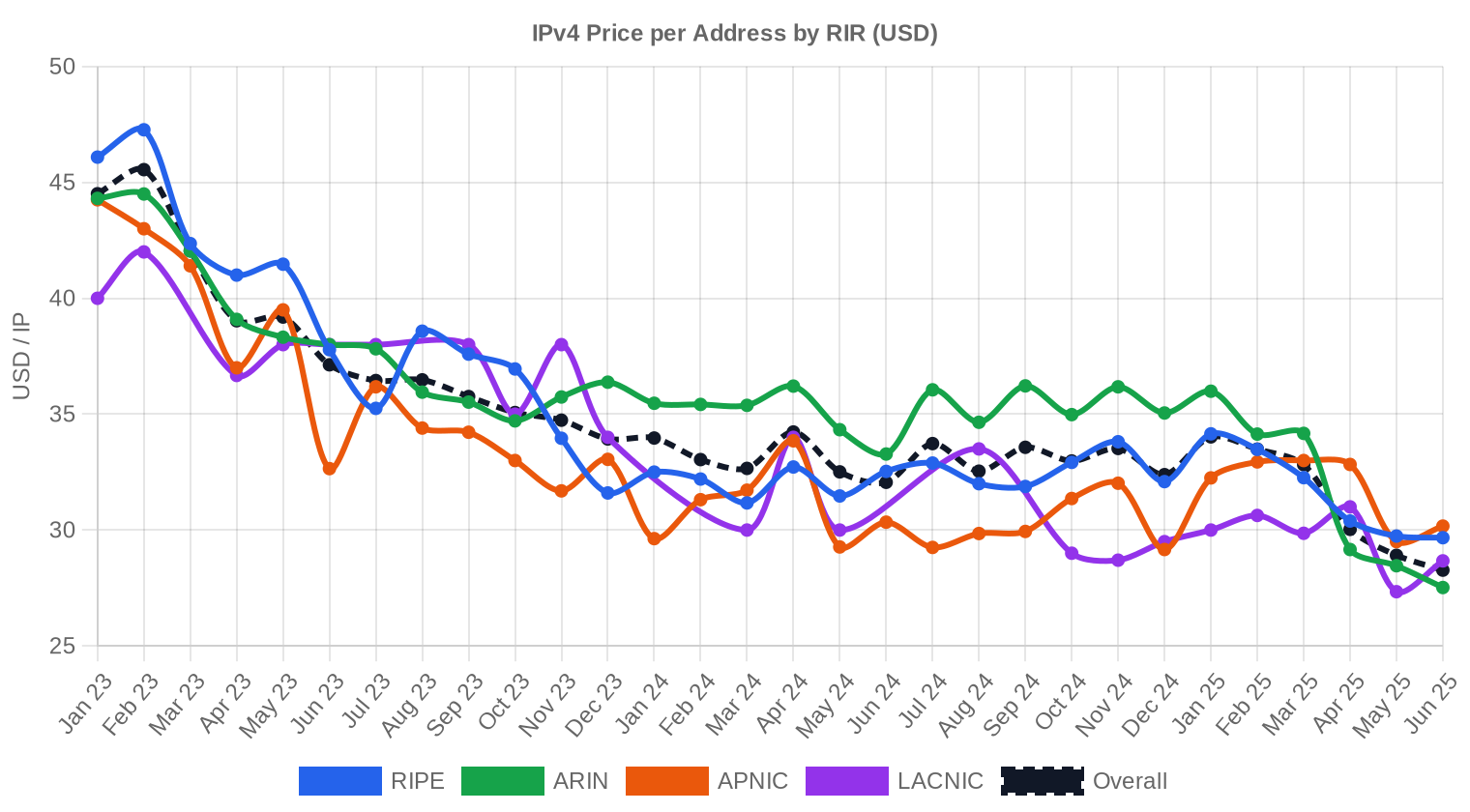
Prices ranged from $10/IP at the floor to $35/IP at the ceiling — a $25 spread that reflects the ongoing bifurcation between clean, well-documented blocks and everything else. The $35 top print came from RIPE inventory, likely a small, pristine /24 with no blacklist baggage. The $10 floor landed in ARIN territory, probably a larger block where the buyer took on cleanup risk. The 4% drop from June's average pushed pricing below the $21 threshold for the first time since early in the post-AWS-charge recalibration. Median at $19.38 sits tight against the average, which tells us the distribution is compressing — fewer outlier deals on either end.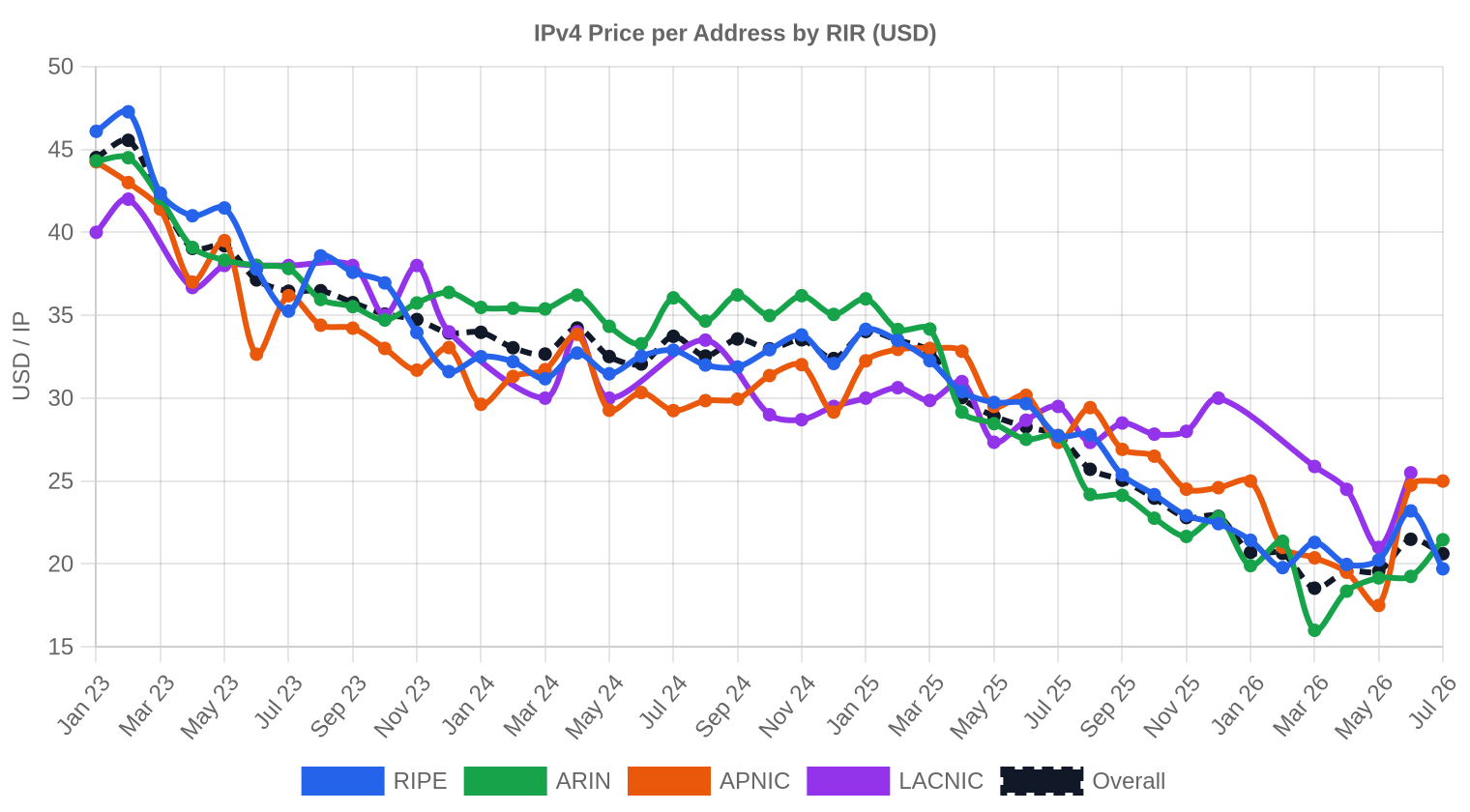
Pricing by RIR
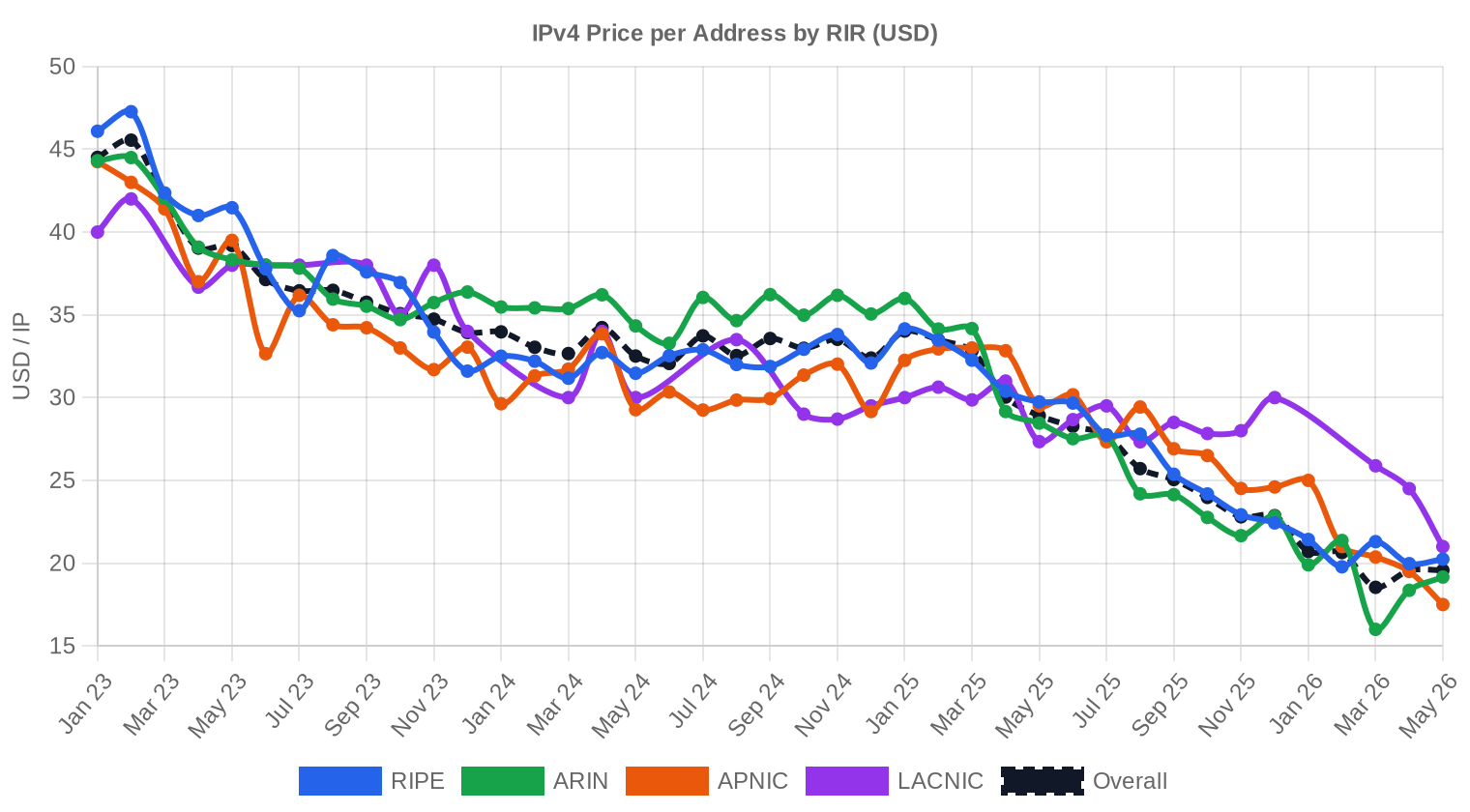
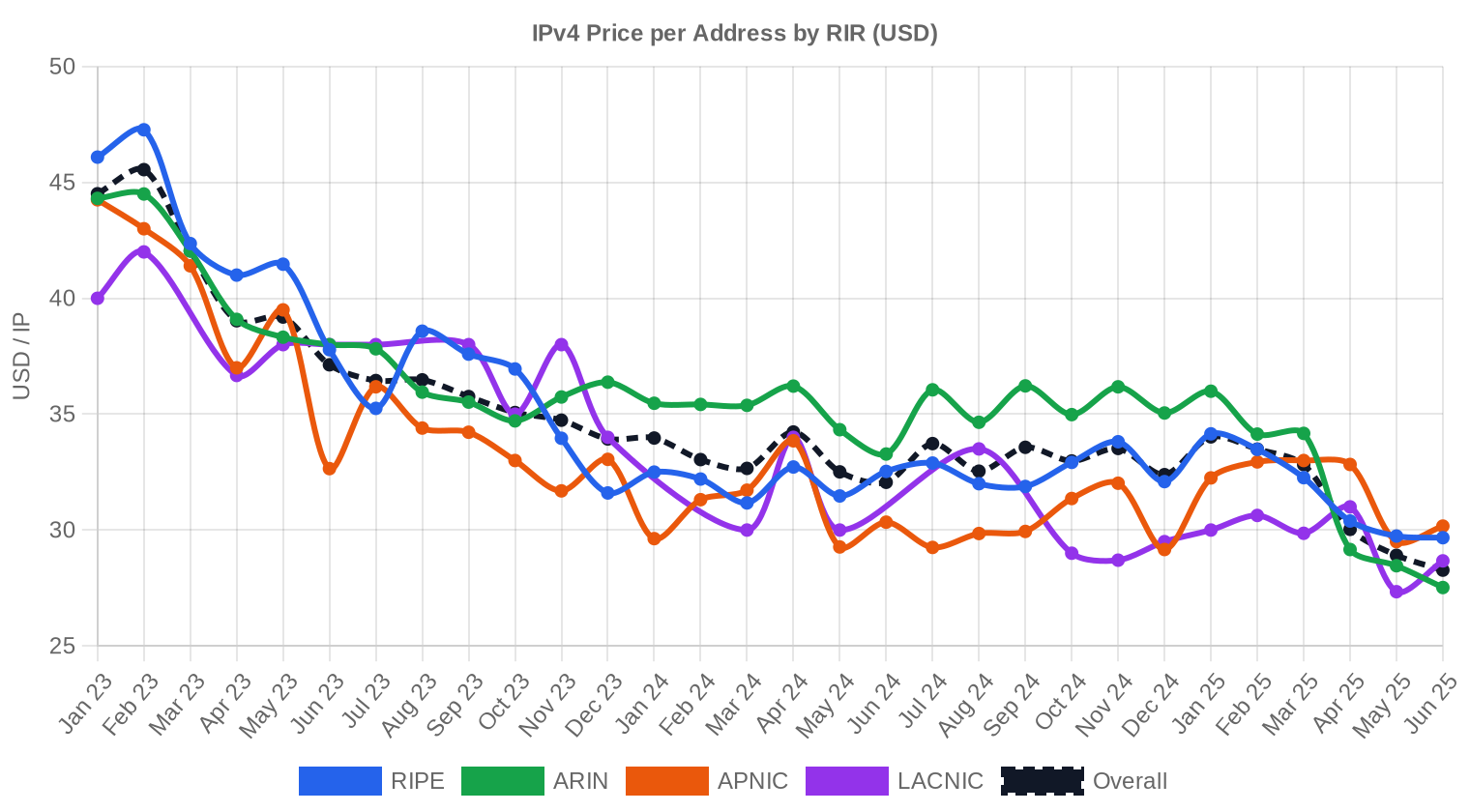
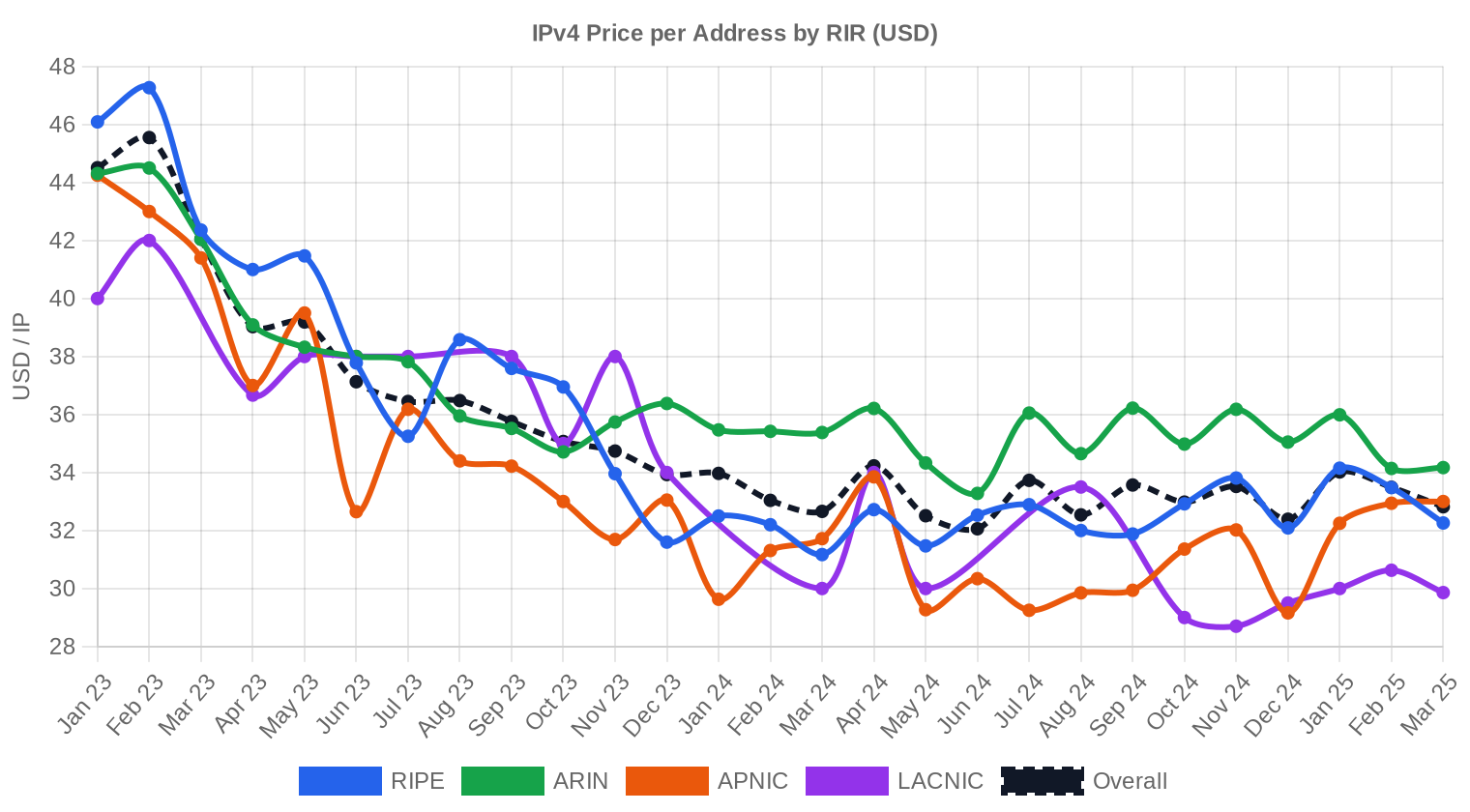
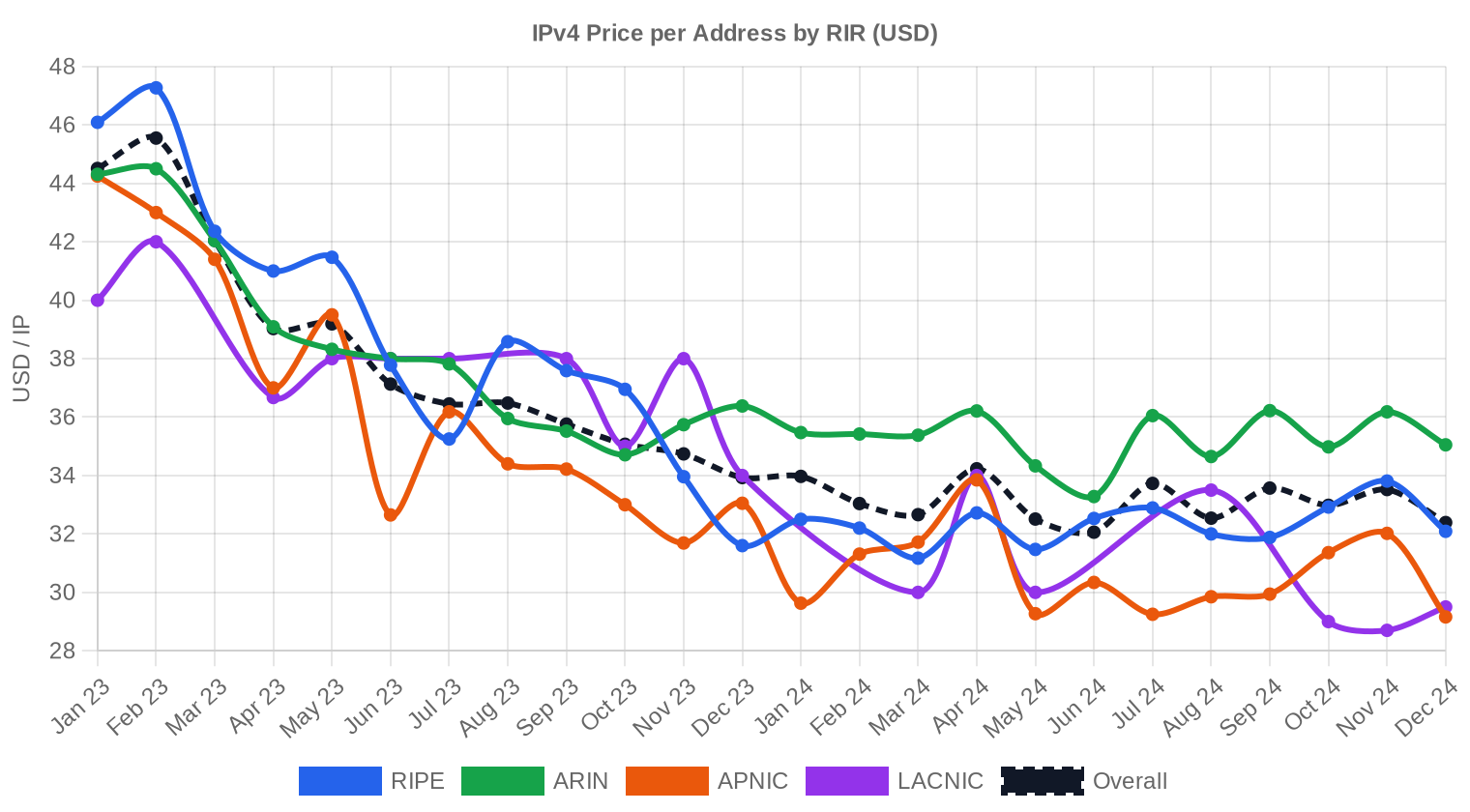
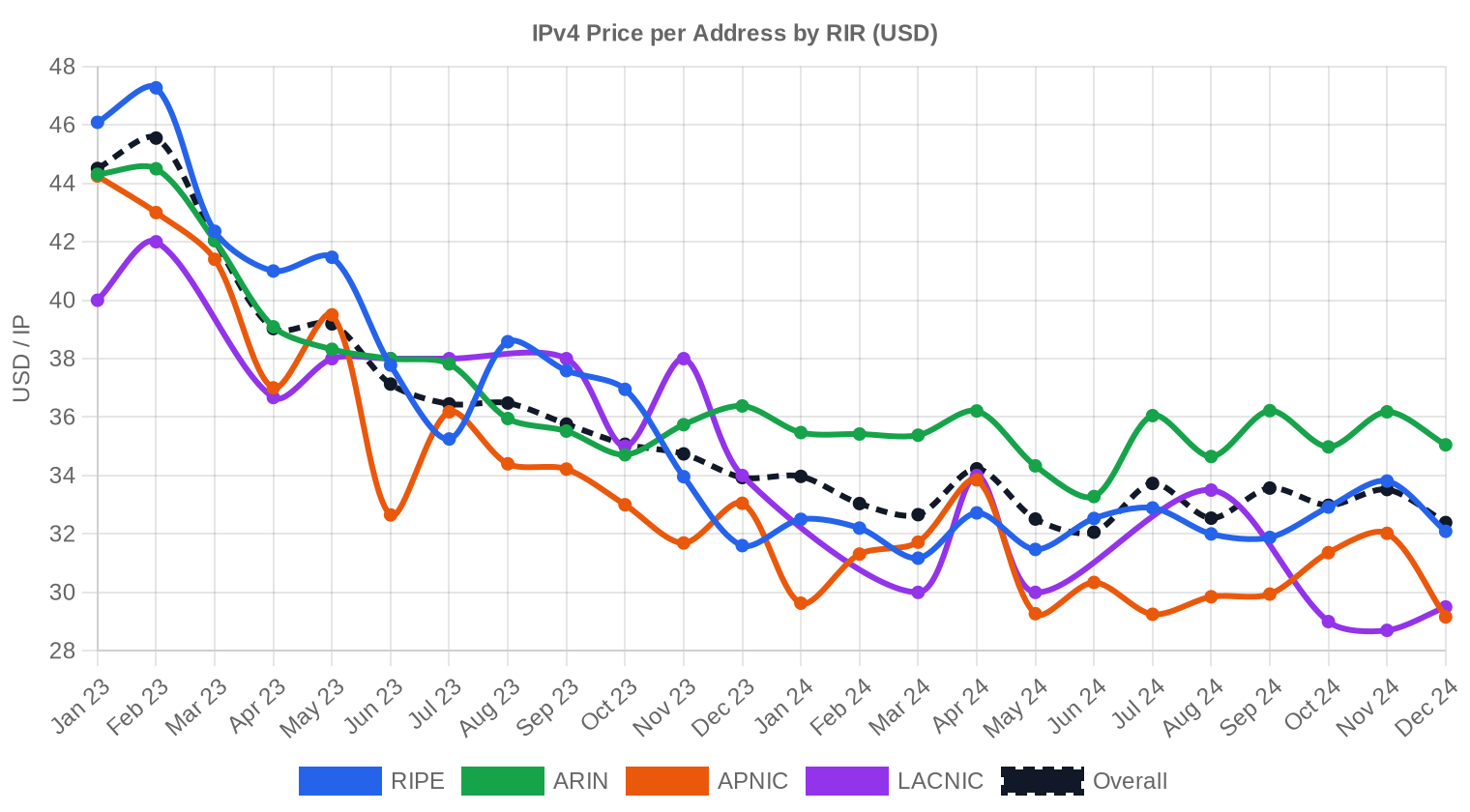
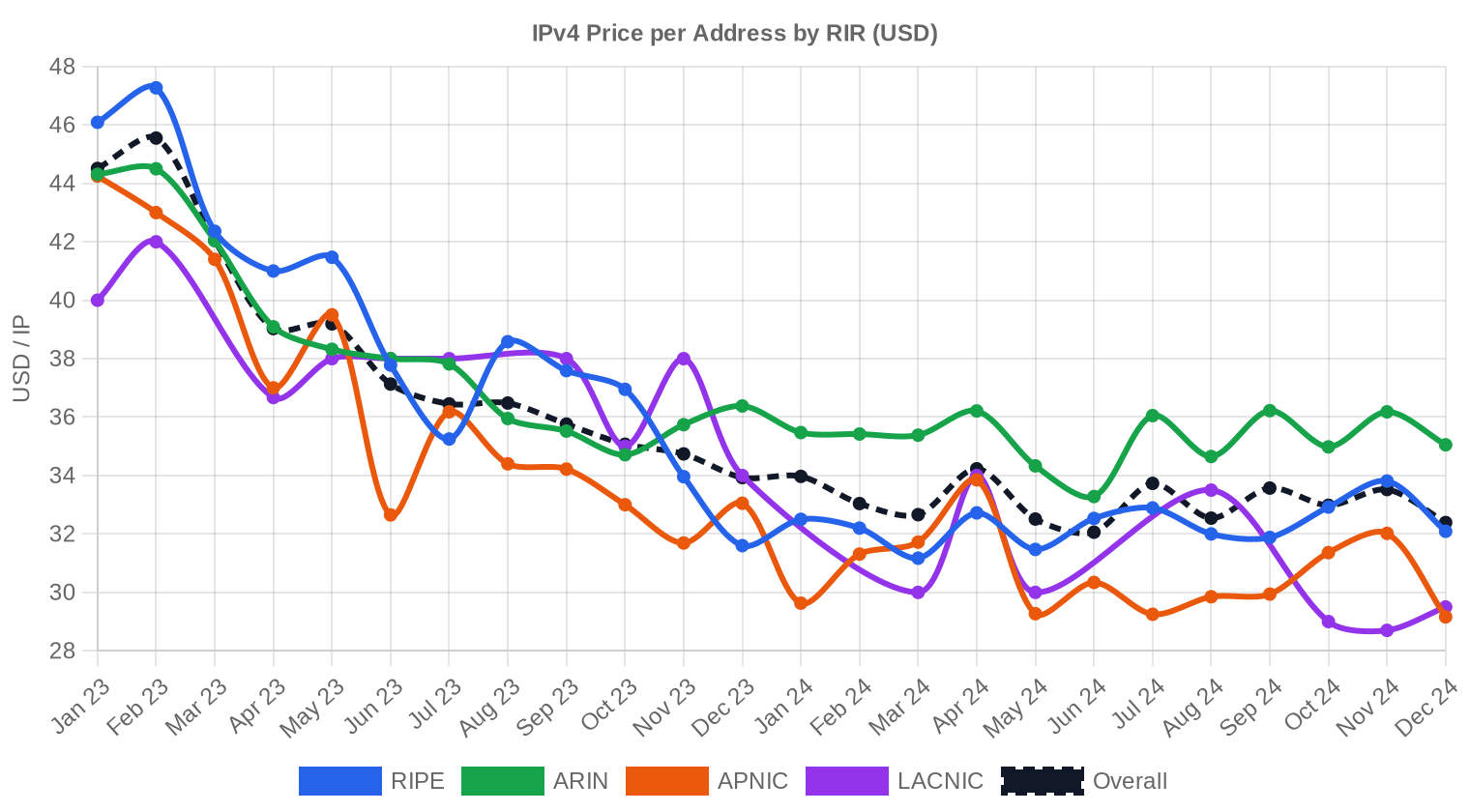
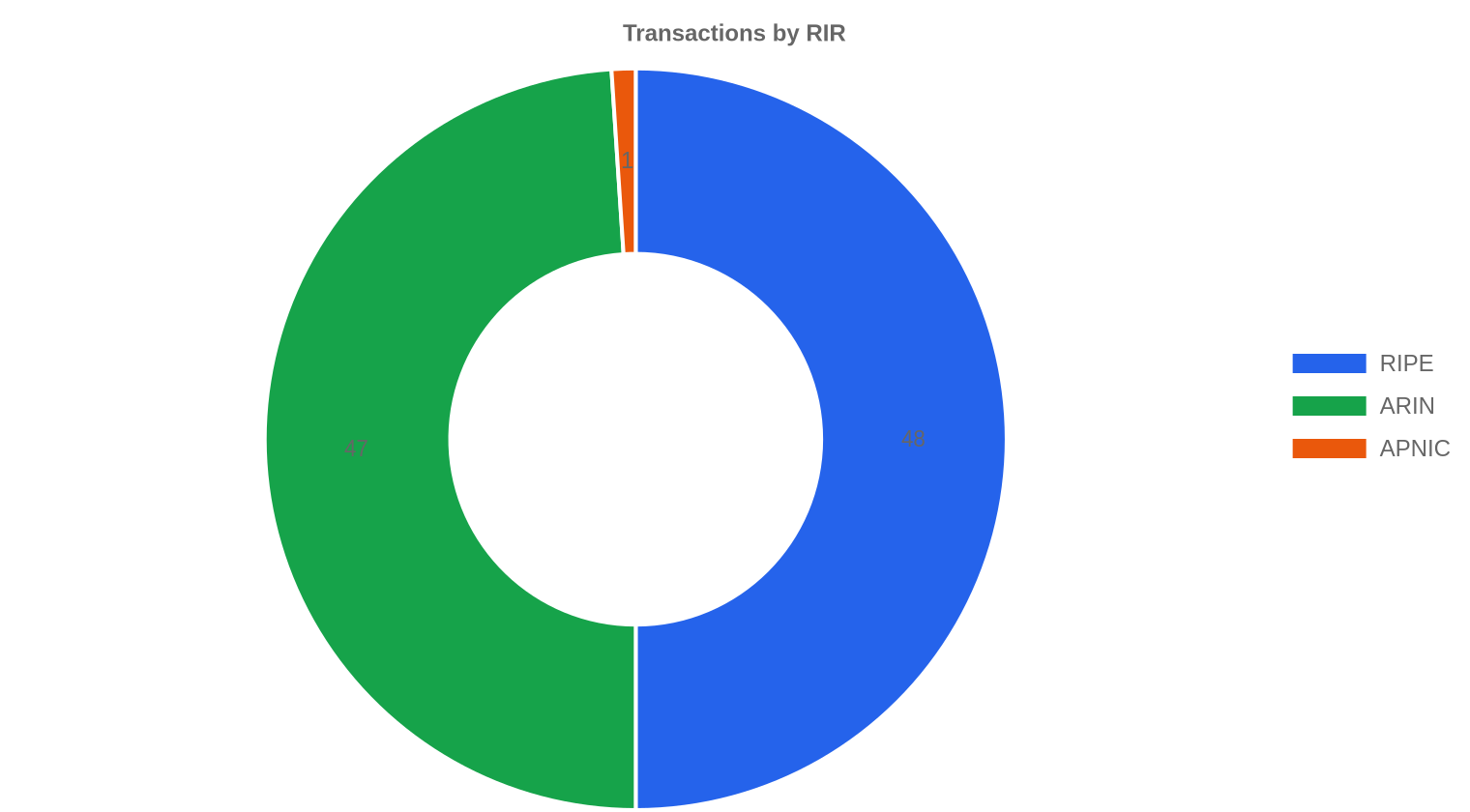
RIPE and ARIN split this month's volume almost perfectly down the middle, but their pricing profiles diverge in telling ways. ARIN's average of $21.46/IP actually ran $1.75 above RIPE's $19.71, a gap that has narrowed considerably from the $4-5 spread we saw eighteen months ago. RIPE's median of $18/IP versus ARIN's $23 median tells a more nuanced story: RIPE's deal flow includes more small, competitively priced blocks pulling the median down, while ARIN's distribution clusters higher.RIPE NCC: $19.71/IP average across 48 transactions (50% of volume). Median $18/IP, range $13.50–$35.
ARIN: $21.46/IP average across 47 transactions (49.5% of volume). Median $23/IP, range $10–$30.
APNIC: $25/IP on a single /24 transaction (0.5% of volume). One deal doesn't make a trend, but APNIC blocks continue to command a premium when they do trade.
LACNIC / AFRINIC: Zero transactions recorded. LACNIC has been quiet for months. AFRINIC remains effectively frozen.
| RIR | Transactions | Avg $/IP | Median $/IP | IPs Traded | RIR Transfers | Next Month (proj.) | Year-End (proj.) |
|---|---|---|---|---|---|---|---|
| RIPE | 48 | $19.71 | $18.00 | 191,232 | 112 | $19.00 | $18.00 |
| ARIN | 47 | $21.46 | $23.00 | 188,672 | 182 | $21.00 | $20.00 |
| APNIC | 1 | $25.00 | $25.00 | 256 | 0 | $23.00 | $22.00 |
Transaction Volume
Supply & Block Sizes
/24 blocks dominated the deal count again at 31 transactions — roughly a third of all trades. Buyers continue to favor /24s for targeted deployments: email reputation, DNS, small hosting operations. The preference keeps per-IP premiums elevated at the small-block end, even as larger blocks drag the volume-weighted average lower.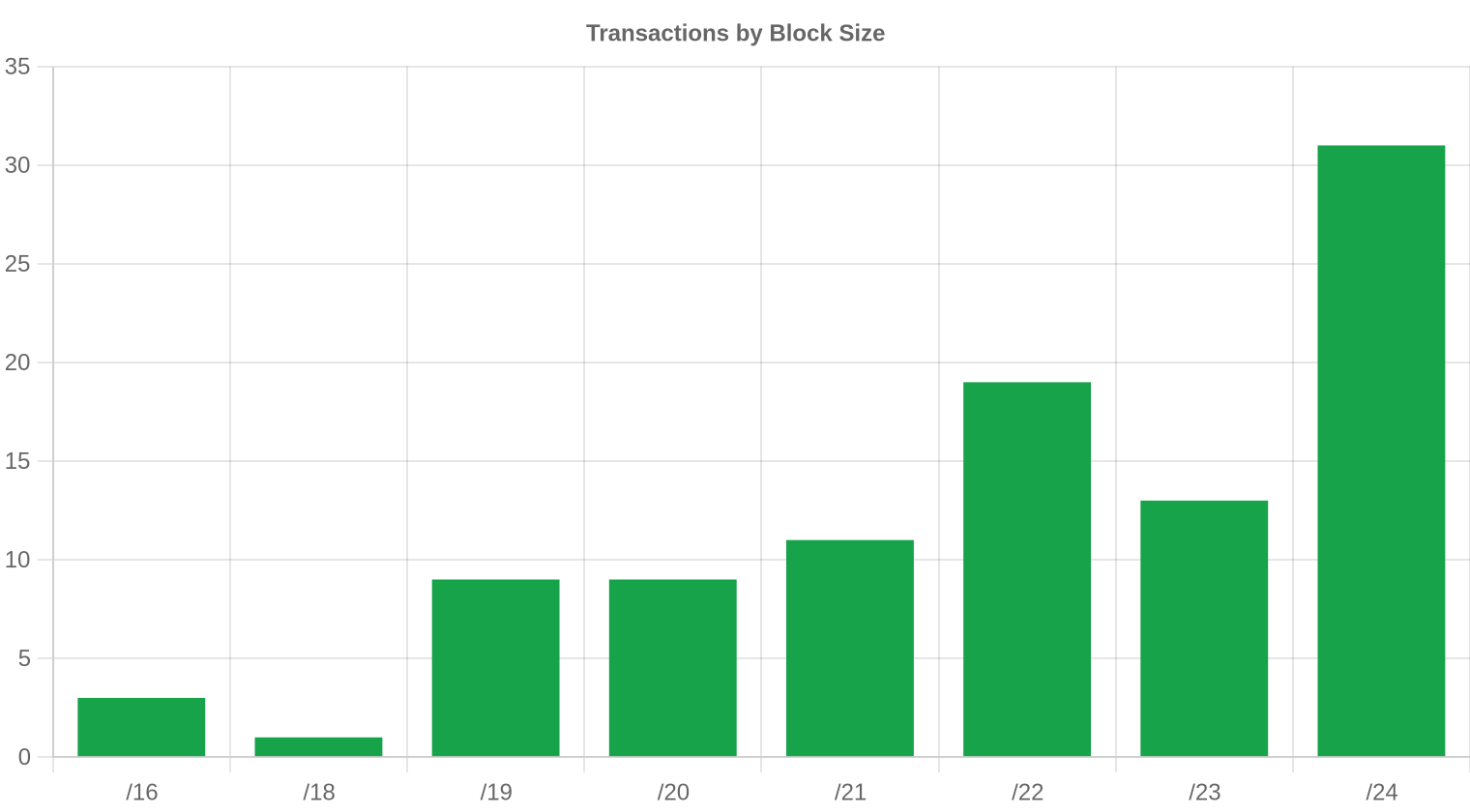
Geographic Activity
The US led with 36 transactions, followed by the UK at 21 and Canada at 9. Ireland (4), Italy (3), and Spain (3) rounded out the European contingent. This distribution tracks closely with enterprise IT spending patterns — the US remains the deepest market by far, while UK activity reflects London's role as a hosting and financial services hub.Registry Transfer Activity
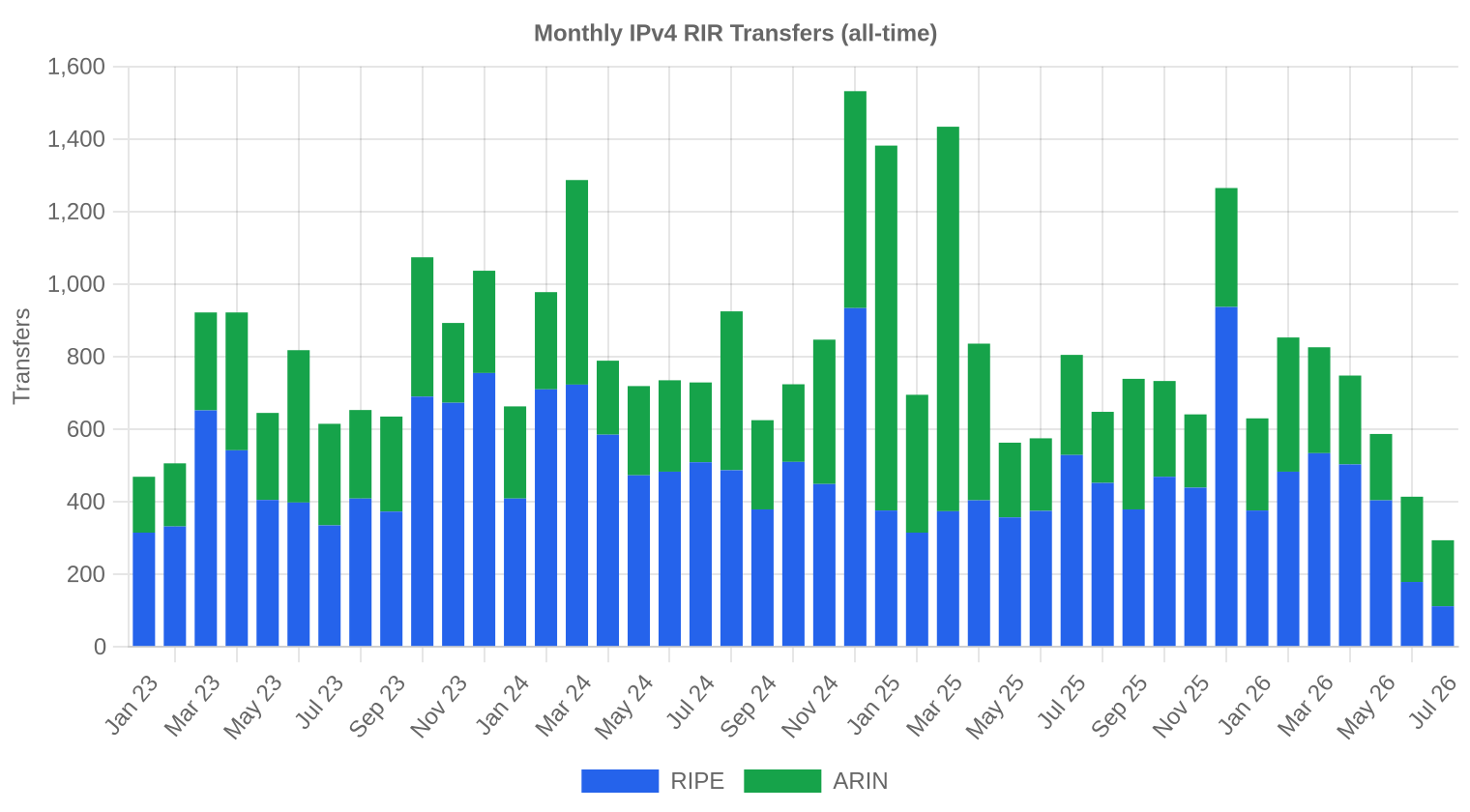
Total RIR-recorded transfers hit 294 for July, well above the 96 priced transactions we captured. ARIN led transfer volume with 182 recorded moves, versus RIPE's 112. The gap between transfer counts and priced deals reflects internal reorganizations, corporate restructurings, and pre-positioned inventory that changes hands without a market-rate transaction.Long-Run Transfer Trends
Over the 43 months we've tracked, cumulative transfers stand at 34,410. The historical peak month was December 2024, which coincided with end-of-year budget flushes and pre-AWS-charge positioning. RIPE accounts for 59.7% of all-time transfer volume versus ARIN's 40.3% — a ratio that has held remarkably stable despite shifts in pricing dynamics between the two registries.| RIR | RIR Transfers |
|---|---|
| RIPE | 20,527 |
| ARIN | 13,883 |
| RIR Transfers | 34,410 |
Outlook & Forecast
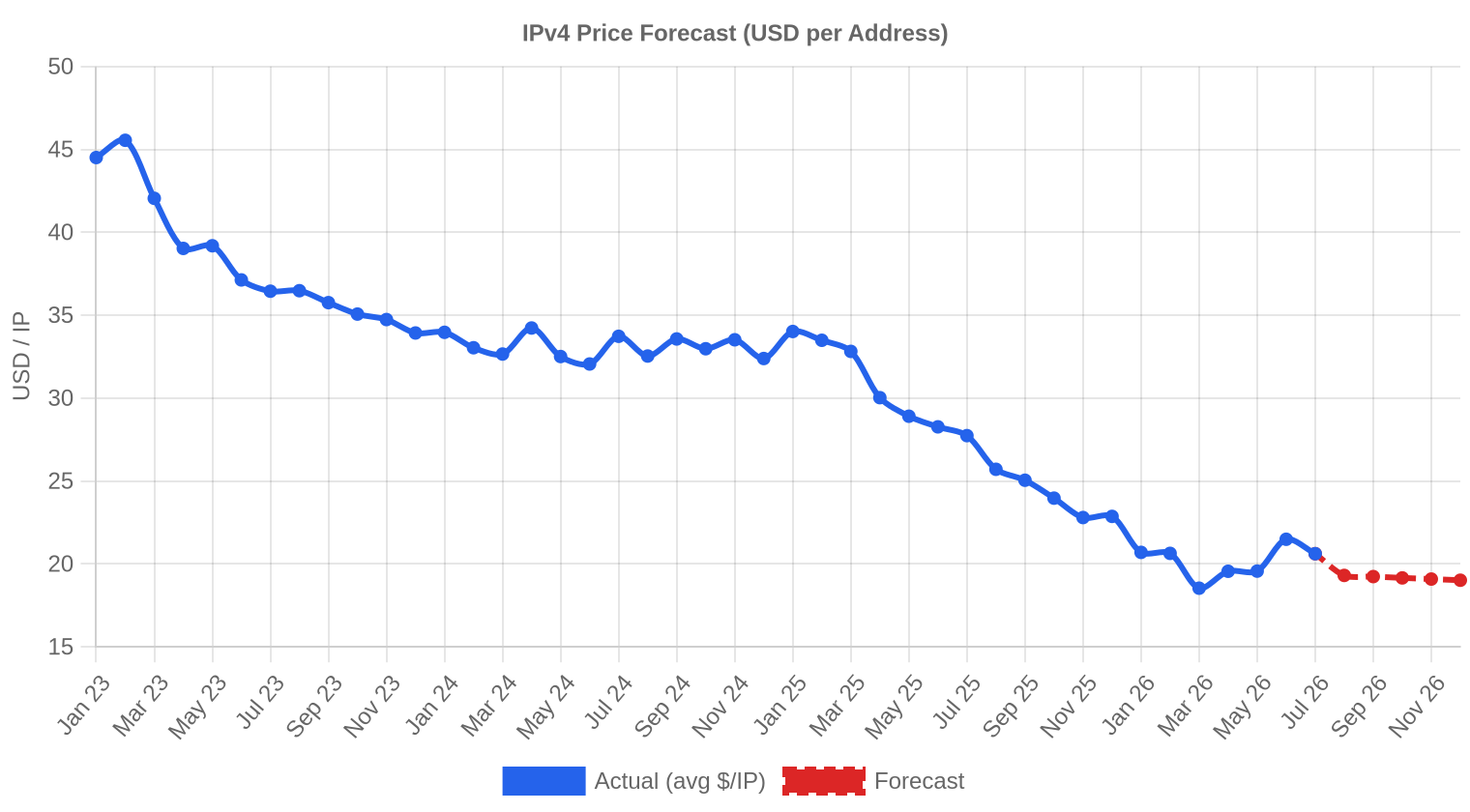
Forecasting each block-size band and RIR separately with our AI model:
The overall average price per IP is projected to reach $19.02 by December 2026, with a next-month estimate of $19.56 per IP.
- RIPE: projected at $19.00 per IP next month, trending toward $18.00 by December 2026.
- ARIN: projected at $21.00 per IP next month, trending toward $20.00 by December 2026.
- APNIC: projected at $23.00 per IP next month, trending toward $22.00 by December 2026.
- LACNIC: projected at $25.00 per IP next month, trending toward $24.00 by December 2026.
- AFRINIC: insufficient data for a reliable forecast.
Forecast by Block Size
| Block | Current $/IP | Next Month | Year-End | Confidence |
|---|---|---|---|---|
| /24 | $25.75 | $25.50 (-1.0%) | $25.00 (-2.9%) | medium |
| /23 | $20.00 | $19.75 (-1.3%) | $19.00 (-5.0%) | medium |
| /22 | $17.65 | $17.50 (-0.8%) | $17.00 (-3.7%) | medium |
| /21 | $17.00 | $16.75 (-1.5%) | $16.00 (-5.9%) | medium |
| /20 | $15.00 | $15.00 (0.0%) | $14.50 (-3.3%) | medium |
| /19 | $14.00 | $14.00 (0.0%) | $13.75 (-1.8%) | medium |
| /18-/16 | $12.50 | $12.50 (0.0%) | $12.00 (-4.0%) | low |
| /15-up | $10.00 | $10.00 (0.0%) | $9.50 (-5.0%) | low |
Editor's Take: Buy vs. Lease
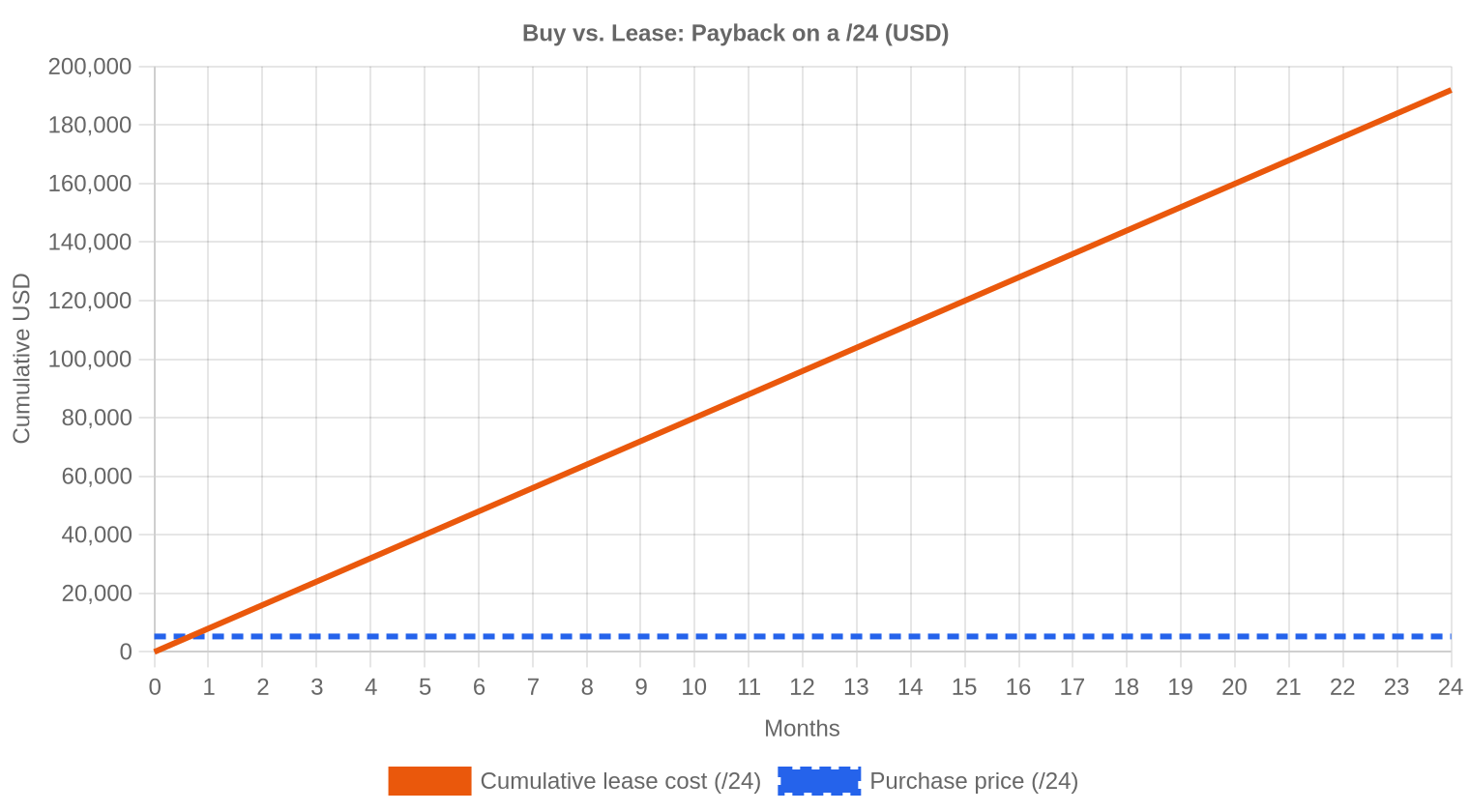
The buy-versus-lease math has never been this lopsided. At $20.62/IP to purchase and $31.25/month to lease a single address, the breakeven point sits at roughly 0.7 months — meaning a buyer recovers the purchase cost in equivalent lease savings in under three weeks. The implied annual yield for a block holder leasing at current rates is a theoretical 1,818%, though that figure assumes 100% utilization and ignores management overhead. Even at 30% utilization, lease yields dwarf any conventional fixed-income instrument. For anyone running a stable deployment that will need addresses for more than 90 days, buying is the only rational choice. The lease market exists for short-term campaigns and burst capacity — paying $8,000/month for a /24 you could own for $5,279 is a tax on indecision.| /24 Purchase price | $5,279 |
| /24 Lease price | $8,000 / mo |
| Payback period | 0.7 mo (0.1 yr) |
| Gross annual yield | 1,818.6% |
What This Means for You
Buyers: You're operating in the most favorable pricing environment since 2021. The 25.7% year-over-year decline gives you real leverage at the negotiating table. Don't let urgency override discipline — request blacklist reports, verify WHOIS cleanliness, and use escrow on every transaction.Sellers: If you've been sitting on inventory hoping for a bounce, the forecast through year-end offers no comfort. Blocks that could have fetched $27-28/IP twelve months ago are now clearing at $20-21. Accelerating your sales timeline — particularly for RIPE blocks subject to the 24-month rule — makes sense before further erosion.
Leasers: At $31.25/IP/month, leasing only pencils out for deployments under 30 days or situations where transfer timelines can't accommodate your go-live date. Anything beyond that, run the purchase numbers.
Block holders: If you're not actively using your allocation, leasing generates extraordinary yield at current rates. A /24 generating $8,000/month against a market value of $5,279 is a cash machine — but be aware that falling purchase prices will eventually compress lease rates too.
Browse verified IPv4 blocksSell IPv4 →
List your blocks with managed transferLease IPv4 →
Flexible short-term capacityLease Out IPv4 →
Turn idle blocks into recurring revenue
IPv4 Pricing by Block Size
The per-IP premium for /24 blocks remains significant. A clean /24 at the market median runs about $19.38/IP ($4,961 per block), but pristine blocks with established reputation clear north of $30/IP. Larger blocks — /20s and above — trade at meaningful discounts per IP, often in the $13-16 range, rewarding buyers who can absorb bigger allocations. The /16 tier, when blocks surface, typically clears at $10-14/IP, reflecting both the larger capital outlay and the thinner buyer pool at that scale.| Block | IPs | Buy: /IP | Buy: Total | Lease: /IP/mo | Lease: Monthly |
|---|---|---|---|---|---|
| /24 | 256 | $35–45 | $8,960–11,520 | $0.38–0.50 | $97–128 |
| /22 | 1,024 | $28–38 | $28,672–38,912 | $0.33–0.45 | $338–461 |
| /20 | 4,096 | $22–32 | $90,112–131,072 | $0.30–0.40 | $1,229–1,638 |
| /18 | 16,384 | $20–30 | $327,680–491,520 | $0.30–0.38 | $4,915–6,226 |
| /16 | 65,536 | $18–28 | $1,179,648–1,835,008 | $0.30–0.35 | $19,661–22,938 |
IPv4 Price History: 2011–2026
IPv4 addresses first traded at $4-5/IP in the years following IANA exhaustion in 2011. Prices climbed steadily through the mid-2010s, accelerating into the $40-50 range by 2022-2023 as cloud demand outstripped legacy reclamation. AWS's decision to charge $3.60/IP/year for public IPv4 addresses (effective February 2024) marked the inflection point — enterprise buyers suddenly had a reason to optimize holdings, and the resulting supply release has driven an 18-month decline. July 2026's $20.62 average represents roughly a 55% correction from peak levels.| Year | ~Price/IP | Key Event |
|---|---|---|
| 2011 | $7–12 | IANA free pool exhausted; Microsoft/Nortel deal ($11.25/IP) |
| 2012 | $8–12 | RIPE NCC reaches last /8; begins /22-only allocation |
| 2014 | $10–15 | LACNIC free pool exhausted |
| 2015 | $8–15 | ARIN free pool exhausted |
| 2017–18 | $12–18 | Leasing market grows; cloud demand rises |
| 2019 | $18–24 | RIPE NCC exhausts remaining free pool |
| 2021–22 | $50–60+ | Post-pandemic peak; hyperscaler build-outs |
| 2024 | $35–52 | AWS IPv4 charge ($0.005/IP/hr); large block correction |
| 2025–26 | $18–45 | Market bifurcation; /16s below $20 for first time since 2019 |
Market Structure: Who Is Buying & Selling
The buyer base has shifted materially. Two years ago, hyperscalers and large cloud providers dominated large-block purchases. Today, mid-market ISPs, hosting companies, and regional enterprises account for the bulk of transactions — 74 of July's 96 deals fell below $50,000. The sell side is increasingly populated by companies that accumulated blocks during the run-up and are now monetizing excess holdings as internal IPv6 migration reduces their need.IPv4 vs. Other Asset Classes
At current lease rates, IPv4 blocks generate yields that embarrass every traditional asset class. Even at conservative utilization assumptions, a leased /24 producing $96,000/year against a purchase price of $5,279 delivers returns that make triple-net real estate look pedestrian. The risk profile is different, of course — lease demand could soften, and the asset depreciates as IPv6 adoption inches forward — but on a pure cash-flow basis, few assets in the current rate environment offer comparable income against invested capital.| Asset Class | Typical Yield | Liquidity | Primary Risk |
|---|---|---|---|
| IPv4 | 1,818.6% | Moderate | IPv6 adoption, block quality |
| Commercial Real Estate | 5–8% | Low | Vacancy, rate cycle |
| Investment-Grade Bonds | 4–5% | High | Duration, credit risk |
| S&P 500 | ~1,3% | High | Market volatility |
| Money Market / T-Bills | ~4–5% | High | Rate cycle changes |
IPv6 Adoption & Why IPv4 Remains Essential
IPv6 adoption continues its glacial advance. Google's measurements show roughly 45% of traffic reaching its services over IPv6, but the enterprise world — particularly internal networks, legacy applications, and IoT deployments — remains heavily IPv4-dependent. Dual-stack will be the operational reality for at least another decade, which means IPv4 addresses retain functional value even as the protocol slowly cedes ground. The question isn't whether IPv4 dies; it's how long the tail is.AI & Cloud Infrastructure Demand
AI infrastructure buildouts are an increasingly visible source of IPv4 demand. Training clusters and inference farms require public-facing IPs for API endpoints, model serving, and data ingestion pipelines. The major AI labs and GPU cloud providers have been quiet acquirers over the past 12 months, typically purchasing /20 to /18 blocks through intermediaries. This demand layer partially offsets the softening from traditional enterprise buyers who are rationalizing their holdings.What Determines IPv4 Block Value
Block valuation depends on five factors, roughly in order of importance: blacklist cleanliness, RIR region, allocation age, prefix size, and transfer history. A RIPE /24 with a clean Spamhaus record and ten years of stable routing history commands 30-50% more than a recently allocated ARIN block of identical size with an unknown reputation profile. Buyers routinely pay premiums for blocks that have never touched spam or botnet infrastructure — the cost of remediating a dirty block in production far exceeds the purchase price differential.Sell vs. Lease: A Decision Framework
In a declining-price market, selling sooner beats selling later — every month of delay costs roughly 0.4% in asset value based on current trajectory. Leasing makes sense for holders who expect to need the addresses again within 2-3 years, or who can tolerate the operational overhead of tenant management. For pure financial holders with no operational use, selling now and redeploying capital elsewhere captures value before further erosion.| /24 Purchase price | $5,279 |
| /24 Lease price | $8,000 / mo |
| Payback period | 0.7 mo (0.1 yr) |
| Gross annual yield | 1,818.6% |
RIPE NCC 24-Month Transfer Restriction
RIPE's 24-month holding requirement continues to act as a supply-side friction. Blocks acquired after September 2019 cannot be transferred until two years post-allocation, which constrains the flow of recently purchased inventory back to market. This rule creates a structural lag in RIPE supply response — even as prices drop, sellers who acquired blocks in the $35-45 range during 2023-2024 face the choice of selling at a loss or waiting for a recovery that current data does not support.Deal Size Distribution
Average deal size fell to $55,929 from $74,033 in June — a 24.4% drop that reflects the market's tilt toward smaller transactions. Fully 74 of 96 deals (77%) came in under $50,000, totaling $1.17 million in aggregate. The mid-tier ($50K-$250K) accounted for 18 deals worth $2.28 million, while the three deals above $1 million contributed $4.05 million — meaning 3% of transactions drove 75% of dollar volume. That concentration risk means a single large buyer stepping away can materially shift monthly totals.Top Trading Countries
The US at 36 deals and the UK at 21 together represent 59% of transaction count — consistent with their outsized share of global hosting and cloud infrastructure. Canada's 9 deals reflect ongoing ISP consolidation and BEAD-adjacent broadband expansion. The European long tail (Ireland, Italy, Spain, Denmark, Poland, Finland) shows healthy distributed demand across the continent, with no single country beyond the UK dominating RIPE-region activity.BEAD Broadband Program Impact
The $42.45 billion BEAD program is entering its deployment phase, and ISPs building out last-mile broadband need IPv4 space for CPE management and subscriber pools. Most BEAD recipients are regional and rural providers who need /20 to /18 blocks — exactly the size range where supply is tightest. As BEAD-funded construction accelerates through 2027, this program alone could absorb meaningful inventory from the ARIN region and put a floor under mid-size block pricing.Hyperscaler IPv4 Holdings
Amazon, Microsoft, and Google collectively hold estimated IPv4 inventories exceeding 150 million addresses. Any significant release from these stockpiles would crater the market, but none of the three has shown interest in liquidating — the operational cost of migrating away from IPv4 internally dwarfs the proceeds from selling. Their strategy has been to optimize utilization rather than divest, which keeps this supply off the market and maintains structural scarcity at the mid-market level where most transactions occur.Macroeconomic Conditions & Market Impact
Enterprise IT budgets remain cautious through H2 2026. Higher-for-longer interest rates in the US and Europe are squeezing capital expenditures, which directly impacts large block purchases that represent six- and seven-figure outlays. The resulting demand compression is a meaningful contributor to the year-over-year price decline — buyers who might have pulled the trigger at $28/IP in 2025 are now discovering they can wait and pay $20.Model Update & Calibration
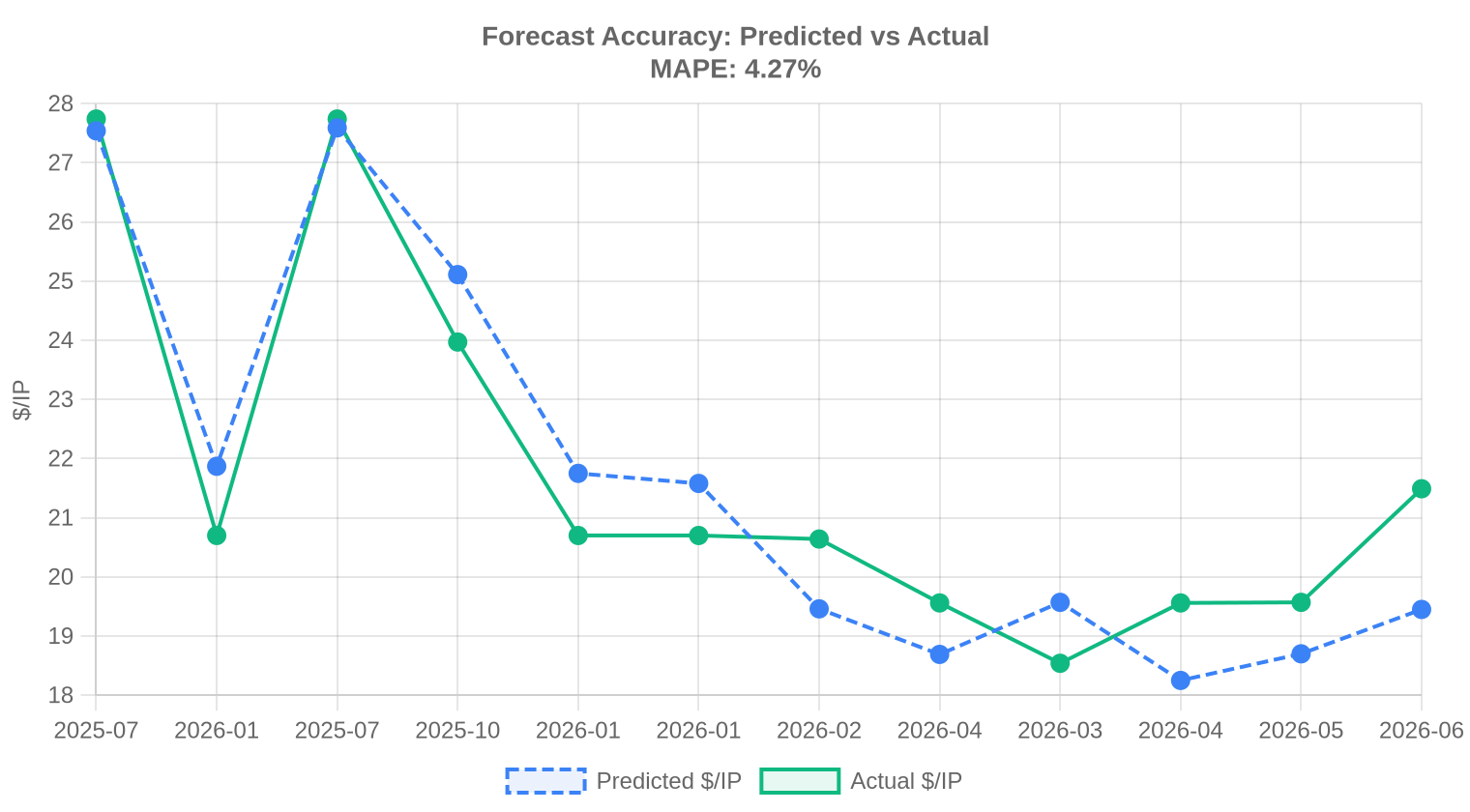
As part of our continuous improvement process, we backtested previous forecasts against realised prices and fine-tuned the model accordingly. Recent months now carry more influence than older data, and the confidence bands have been widened or narrowed based on how well they captured actual outcomes in the past. You can see the full backtest results in the table and chart below.
| Report Period | Target Month | Predicted | Actual | Deviation |
|---|---|---|---|---|
| 2026-01 | 2026-02 | $19 | $21 | -6% |
| 2026-Q1 | 2026-04 | $19 | $20 | -4% |
| 2026-02 | 2026-03 | $20 | $19 | +6% |
| 2026-03 | 2026-04 | $18 | $20 | -7% |
| 2026-04 | 2026-05 | $19 | $20 | -4% |
| 2026-05 | 2026-06 | $19 | $21 | -9% |
Methodology
Figures are based on completed IPv4Center marketplace transactions and RIR transfer statistics. Prices are in US dollars per IP address. Forecasts are produced by an AI model that analyses each block-size band and RIR segment separately (with outlier-trimmed medians) alongside known market catalysts; they are estimates, not guarantees.
Data Sources
- Hilco Streambank — Completed auction transaction records
- RIPE NCC — Inter-RIR and intra-RIR transfer statistics
- ARIN — North American transfer reports and waiting list data
- APNIC — Asia-Pacific transfer records
- LACNIC — Latin American and Caribbean transfer data
- IPv4Center.com — Proprietary marketplace transaction and lease pricing data
This report is generated automatically for informational purposes only and does not constitute financial advice.
Frequently Asked Questions
What is the average IPv4 price in July 2026?
The weighted average IPv4 price in July 2026 is $20.62 per address, with a median of $19.38/IP across 96 transactions.
How much does a /24 IPv4 block cost in July 2026?
At the market median of $19.38/IP, a /24 block (256 addresses) costs approximately $4,961. Clean, well-documented /24s with good reputation can trade up to $8,960 ($35/IP).
How much has IPv4 pricing dropped year-over-year?
Average IPv4 pricing fell 25.7% compared to July 2025, making this one of the sharpest annual declines in the market's history.
Which RIR region has the cheapest IPv4 addresses?
RIPE addresses are currently cheapest at $19.71/IP average with a median of $18/IP. ARIN averages $21.46/IP, and APNIC's single transaction priced at $25/IP.
Why are APNIC IPv4 blocks more expensive?
APNIC blocks command a premium ($25/IP in July) due to limited supply, regulatory complexity in the Asia-Pacific region, and strong demand from growing markets in Southeast Asia.
How many IPv4 addresses were traded in July 2026?
A total of 380,160 IPv4 addresses changed hands across 96 priced transactions, with a combined value of $5.37 million.
Is it better to buy or lease IPv4 addresses in July 2026?
Buying is overwhelmingly favorable. At $20.62/IP to purchase versus $31.25/IP per month to lease, the purchase price pays for itself in under one month of avoided lease costs.
What is the current IPv4 lease rate?
The going rate for IPv4 leasing is approximately $31.25 per IP per month, or $8,000/month for a /24 block, based on 170 sample observations.
How long does an IPv4 transfer take?
ARIN transfers typically complete in 2-4 weeks. RIPE transfers can take 2-6 weeks depending on documentation readiness. Both timelines assume clean paperwork and no disputes.
What is the IPv4 price forecast for the rest of 2026?
Our model projects $19.56/IP in August 2026 and $19.02/IP by December 2026, representing a continued gradual decline of approximately 8% from current levels.
What is the most commonly traded IPv4 block size?
/24 blocks (256 addresses) are the most frequently traded, accounting for 31 of 96 transactions in July 2026 — about one-third of all deals.
Which countries are most active in IPv4 trading?
The United States leads with 36 transactions, followed by the United Kingdom (21) and Canada (9). These three countries account for nearly 69% of all July 2026 deals.
What mistakes should be avoided when buying IPv4 addresses?
The most costly mistakes are skipping blacklist and reputation checks, failing to verify the seller's legal authority to transfer, and not using escrow. A block with a Spamhaus listing can take months to remediate and may never fully recover its routing reputation.
What are the risks of skipping blacklist verification?
Deploying a blacklisted block can result in email delivery failures, ad platform rejections, and CDN blocks. Remediation takes 30-90 days with no guarantee of full clearance. The $2-3/IP savings from skipping due diligence can easily cost thousands in lost productivity.
Why shouldn't you skip escrow when buying IPv4?
IPv4 transfers are irreversible once completed at the RIR. Without escrow, you risk paying for a block that never transfers, receiving a block with undisclosed encumbrances, or dealing with a seller who disappears. Escrow fees are typically 1-2% of deal value — trivial insurance against total loss.
What risks come with buying IPv4 from unverified sellers?
Unverified sellers may not hold clear title, may be selling blocks subject to lease agreements, or may lack proper organizational authorization. Always verify the seller's RIR membership status and request proof of allocation before proceeding.
Why is ARIN IPv4 pricing higher than RIPE?
ARIN blocks average $21.46/IP versus RIPE's $19.71/IP in July. ARIN's tighter supply, simpler transfer mechanics, and strong domestic US demand support the premium, though the gap has narrowed substantially from historical norms.
What is RIPE's 24-month holding rule?
RIPE requires that IPv4 blocks be held for 24 months before they can be transferred again. This constrains speculative flipping and creates a structural supply lag that affects pricing dynamics in the RIPE region.
How does AWS's IPv4 charge affect the market?
AWS's $3.60/year per public IPv4 address charge (effective February 2024) prompted enterprises to optimize their address usage, releasing surplus blocks back to market. This supply increase has been a major driver of the 25.7% year-over-year price decline.
What is the payback period for buying versus leasing IPv4?
At current rates ($20.62/IP purchase, $31.25/IP/month lease), the purchase pays for itself in approximately 0.7 months — less than three weeks. Any deployment lasting more than a month is cheaper to own.
How does the BEAD program affect IPv4 demand?
The $42.45 billion US BEAD broadband program is entering its deployment phase, and rural ISP buildouts require IPv4 space for subscriber management. This program could tighten supply for mid-size blocks (/20 to /18) in the ARIN region through 2027.
Are IPv4 addresses a good investment in 2026?
As a pure appreciation play, no — prices are declining. As a yield asset, potentially yes — lease rates of $31.25/IP/month against a $20.62/IP purchase price generate exceptional cash flow, though lease demand could soften alongside purchase prices.
How does IPv6 adoption affect IPv4 prices?
IPv6 handles roughly 45% of Google's traffic, but enterprise adoption lags far behind. Dual-stack will persist for at least another decade, which means IPv4 retains functional value. The gradual transition pressures prices downward but doesn't eliminate demand.
What drives IPv4 block valuation?
The five main factors are blacklist cleanliness, RIR region, allocation age, prefix size, and transfer history. A clean block with established routing history can command 30-50% more than a comparable block with an unknown reputation.
What is the average deal size in July 2026?
Average deal size fell to $55,929 from $74,033 in June, a 24.4% decline. 77% of deals were under $50,000, reflecting the market's shift toward smaller, more frequent transactions.
How many RIR transfers were recorded in July 2026?
RIRs recorded 294 total transfers in July 2026, with ARIN accounting for 182 and RIPE for 112. The gap between 294 total transfers and 96 priced transactions reflects internal reorganizations and non-market moves.
Should IPv4 holders sell or lease their blocks?
In a declining-price market, selling sooner captures more value — each month of delay costs roughly 0.4% in asset value. However, leasing generates extraordinary yield at current rates. Holders who expect to need the addresses again within 2-3 years should consider leasing; purely financial holders should sell.
What is the minimum IPv4 block size that can be transferred?
Most RIRs allow transfers of /24 blocks (256 addresses) as the smallest unit. Some ARIN transfers can be done for smaller allocations, but /24 is the practical minimum for routable, market-tradeable space.
How are AI companies affecting IPv4 demand?
AI labs and GPU cloud providers are acquiring /20 to /18 blocks for training clusters and inference farms. This demand partially offsets softening from traditional enterprise buyers and is expected to grow as AI infrastructure scales through 2027.
What is the cheapest IPv4 price recorded in July 2026?
The lowest recorded price was $10/IP on an ARIN block, likely a larger allocation where the buyer accepted cleanup or reputation risk. The highest was $35/IP for a RIPE block, presumably a clean /24 with strong routing history.