22 min read
This report analyzes the IPv4 transfer market for September 2026, based on completed IPv4Center marketplace transactions and official RIR transfer records.
Executive Summary
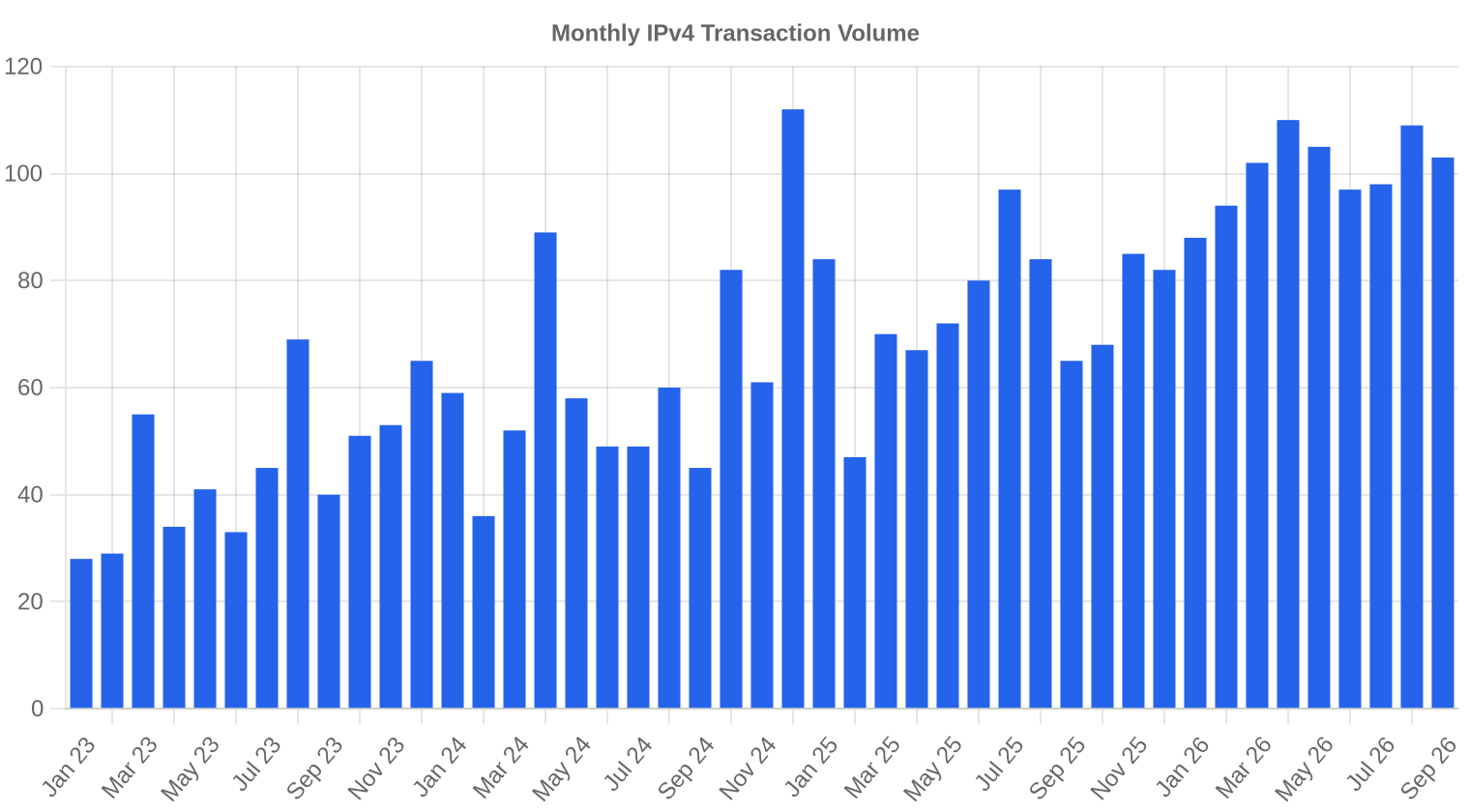
The IPv4 transfer market recorded 103 transactions in September 2026, moving 358,400 addresses for a combined $5.32 million. The average price per IP settled at $20.00, down $1.50 from August 2026 and 20.2% below September 2025 levels — the steepest year-over-year decline we've tracked in this cycle. ARIN dominated with 54.4% of transaction volume, while RIPE and APNIC carved out the premium end of the pricing spectrum. The broad trend remains softening, though the pace of monthly declines has moderated: the $1.50 drop from August is smaller than the $2–$3 monthly moves we saw earlier in the year. Total market value continues to compress as average deal sizes shrink — down to $51,673 from $56,172 in August and less than half the $111,960 average recorded in September 2025.Market Overview
| Transactions | 103 |
| IP Addresses Traded | 358,400 |
| Estimated Market Value | $5,322,312 |
| Average Price / IP | $20.00 |
| Median Price / IP | $19.40 |
| RIR Transfers | 252 |
Year-over-Year Comparison
| Metric | This period | A year earlier (September 2025) | Change |
|---|---|---|---|
| Transactions | 103 | 65 | +58.5% |
| IP Addresses Traded | 358,400 | 420,096 | -14.7% |
| Estimated Market Value | $5,322,312 | $7,277,375 | -26.9% |
| Average Price / IP | $20.00 | $25.05 | -20.2% |
| RIR Transfers | 252 | 739 | -65.9% |
Price Dynamics
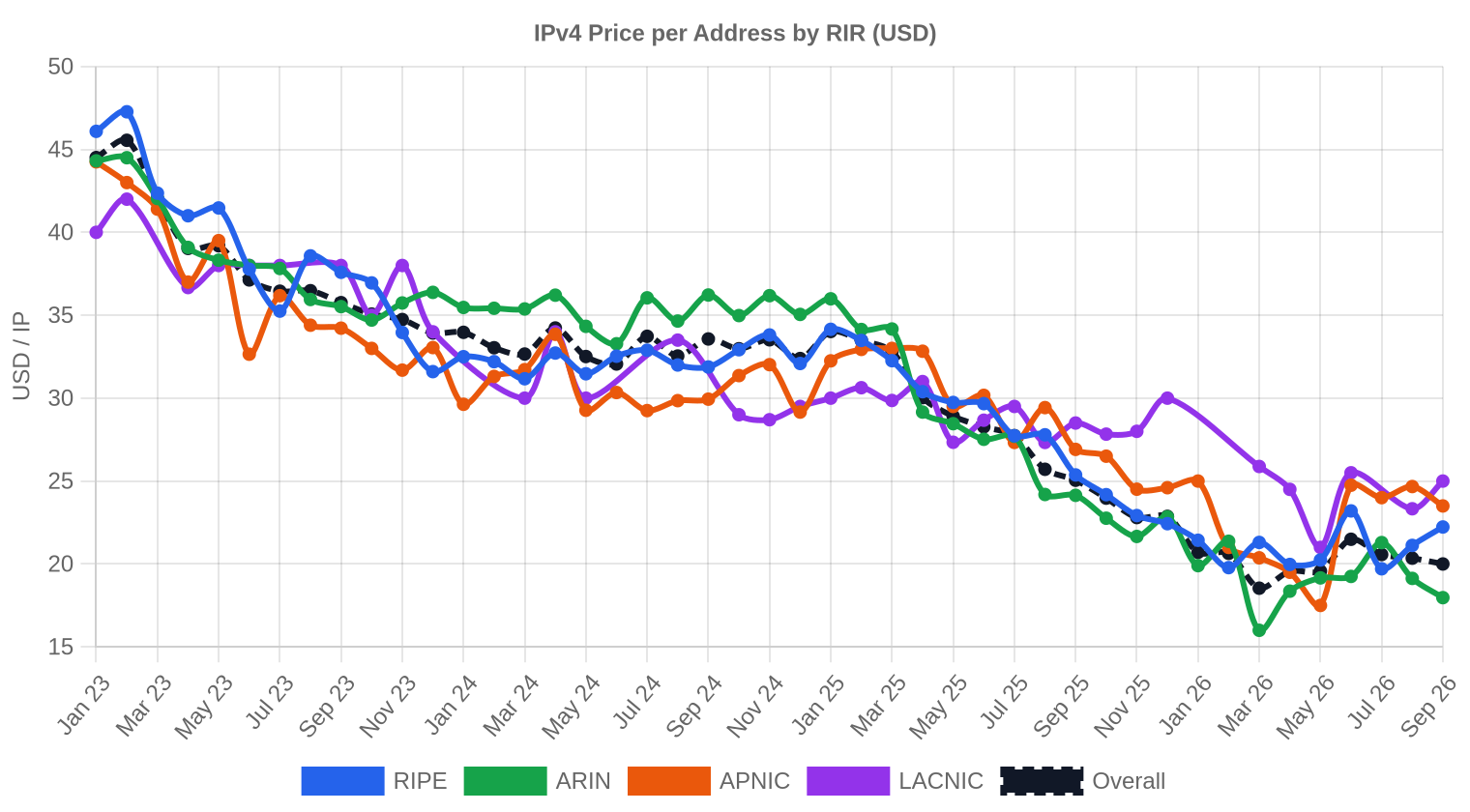
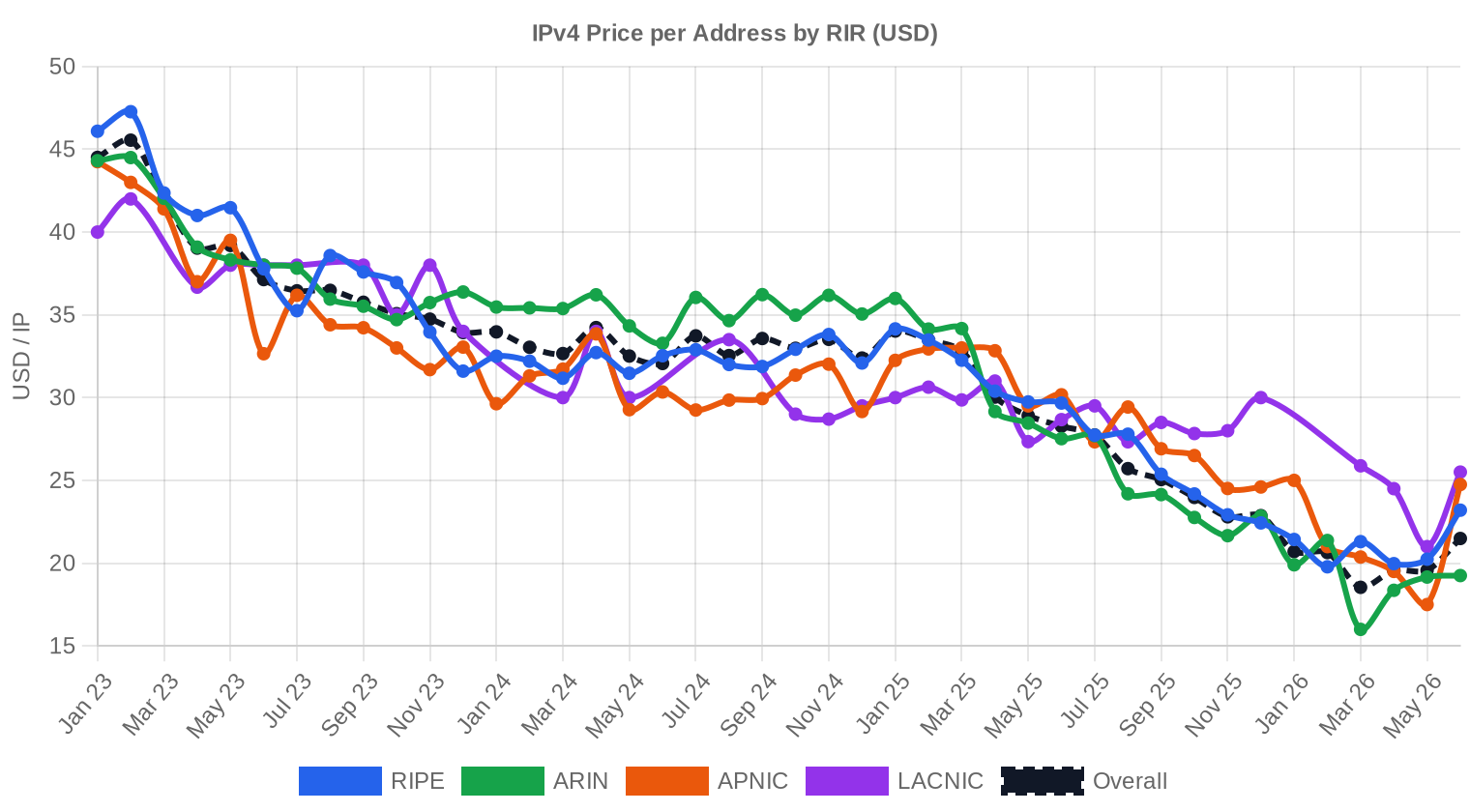
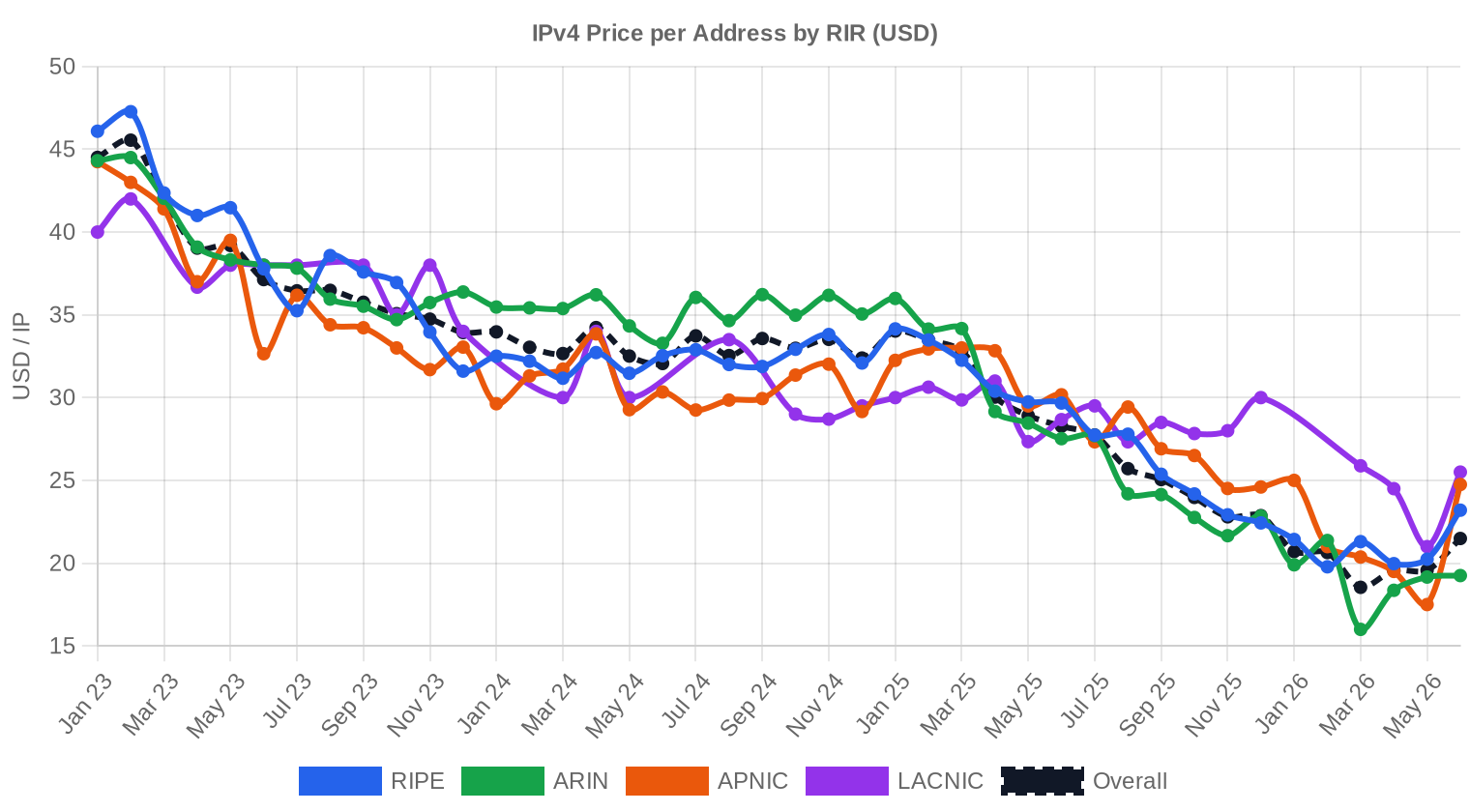
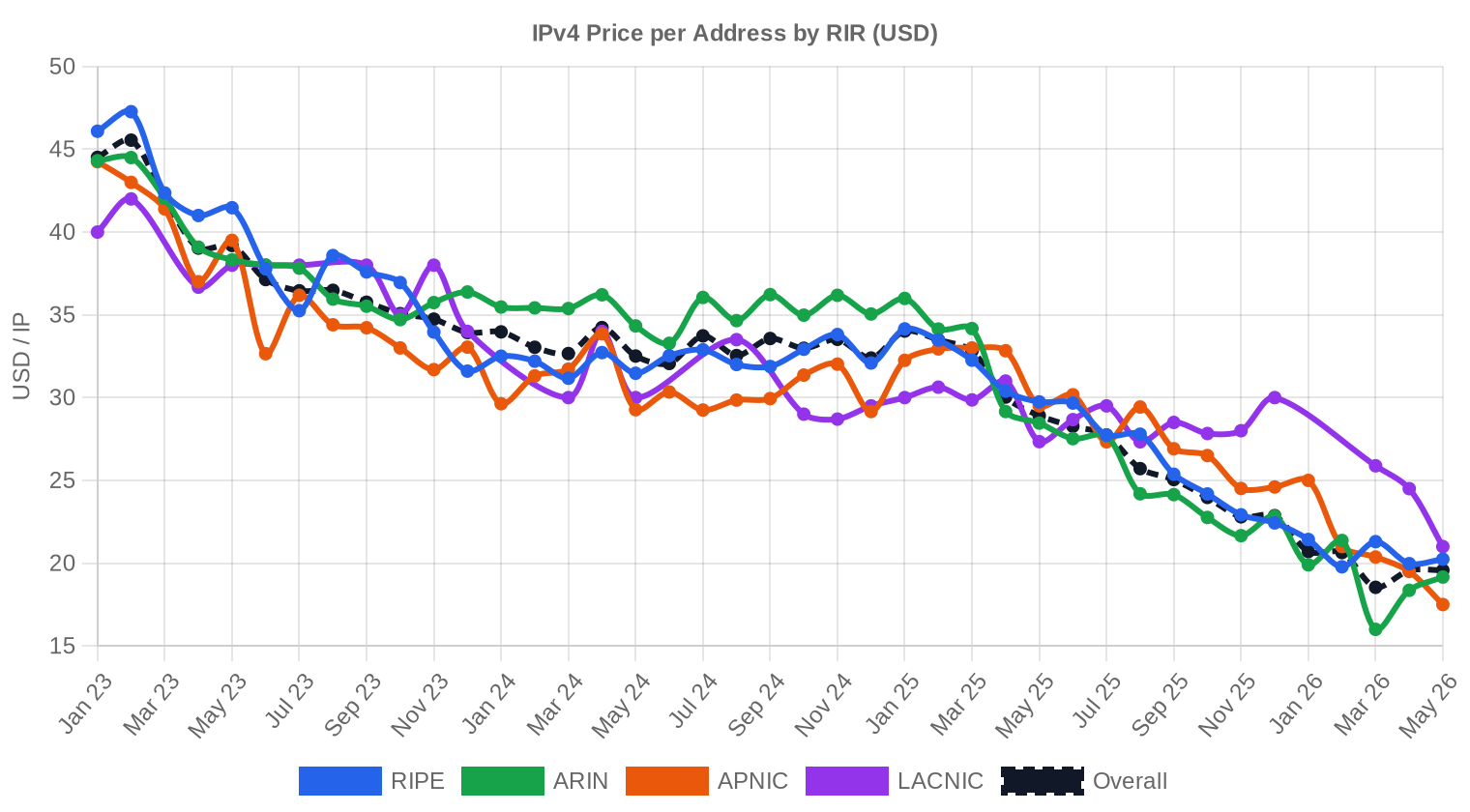
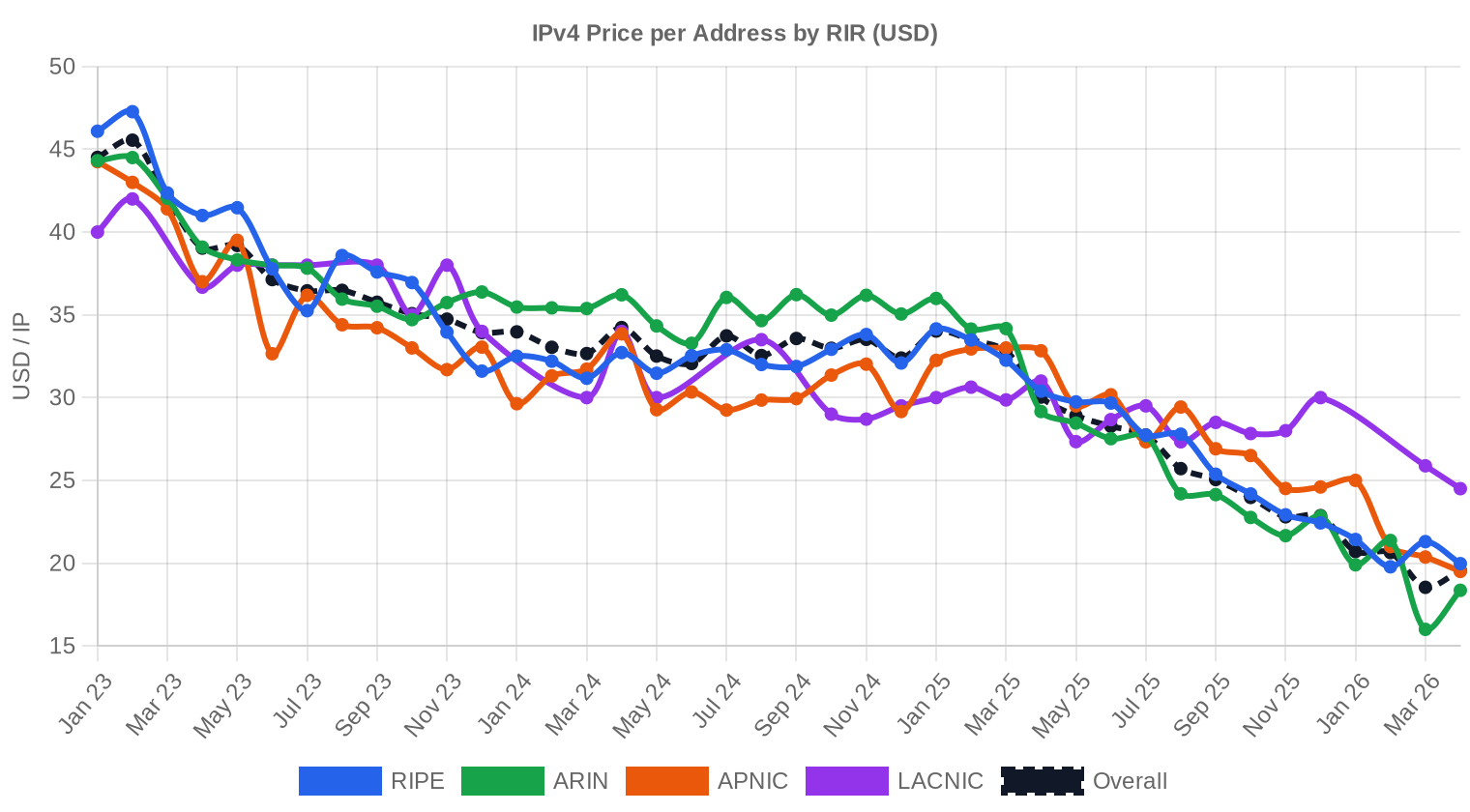
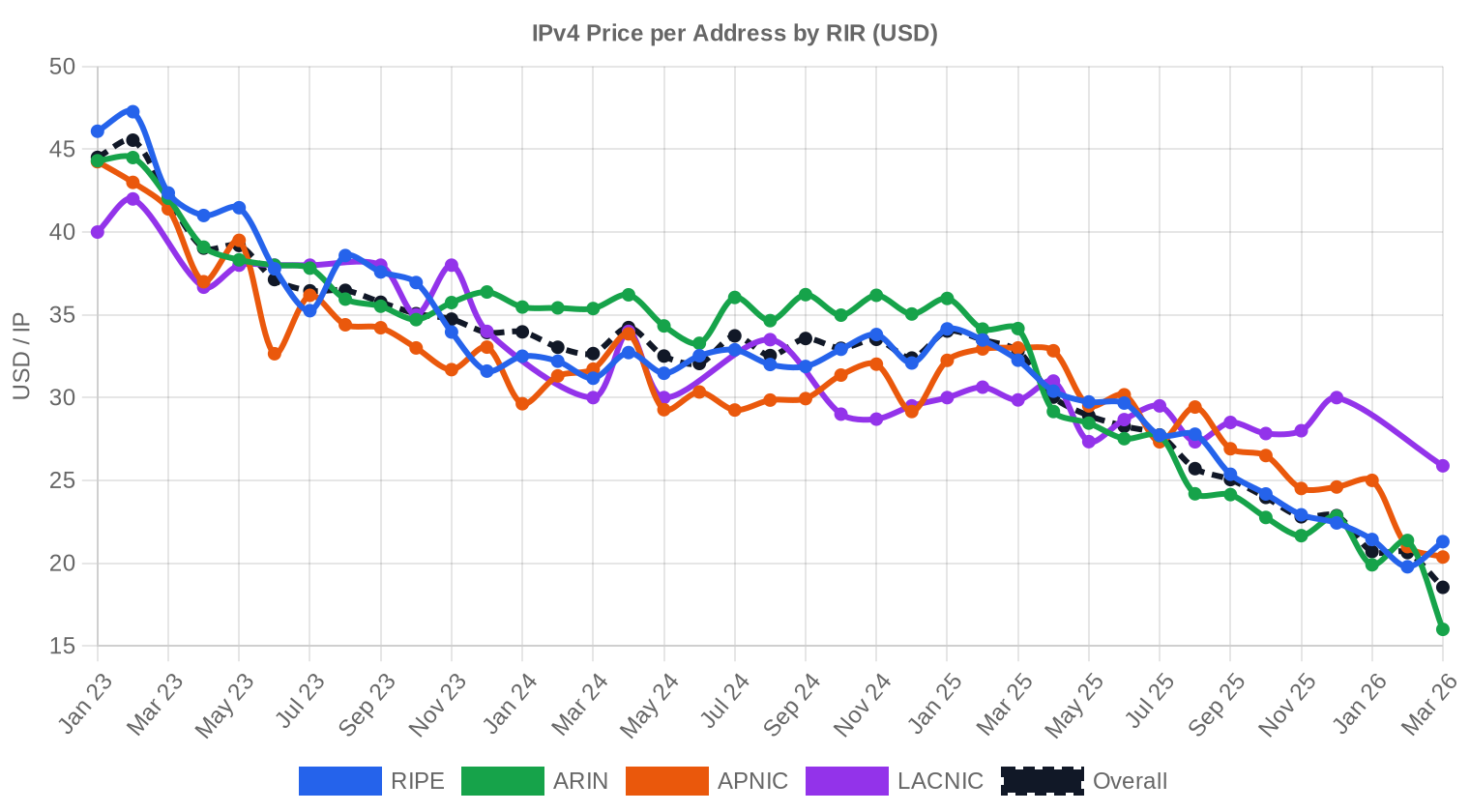
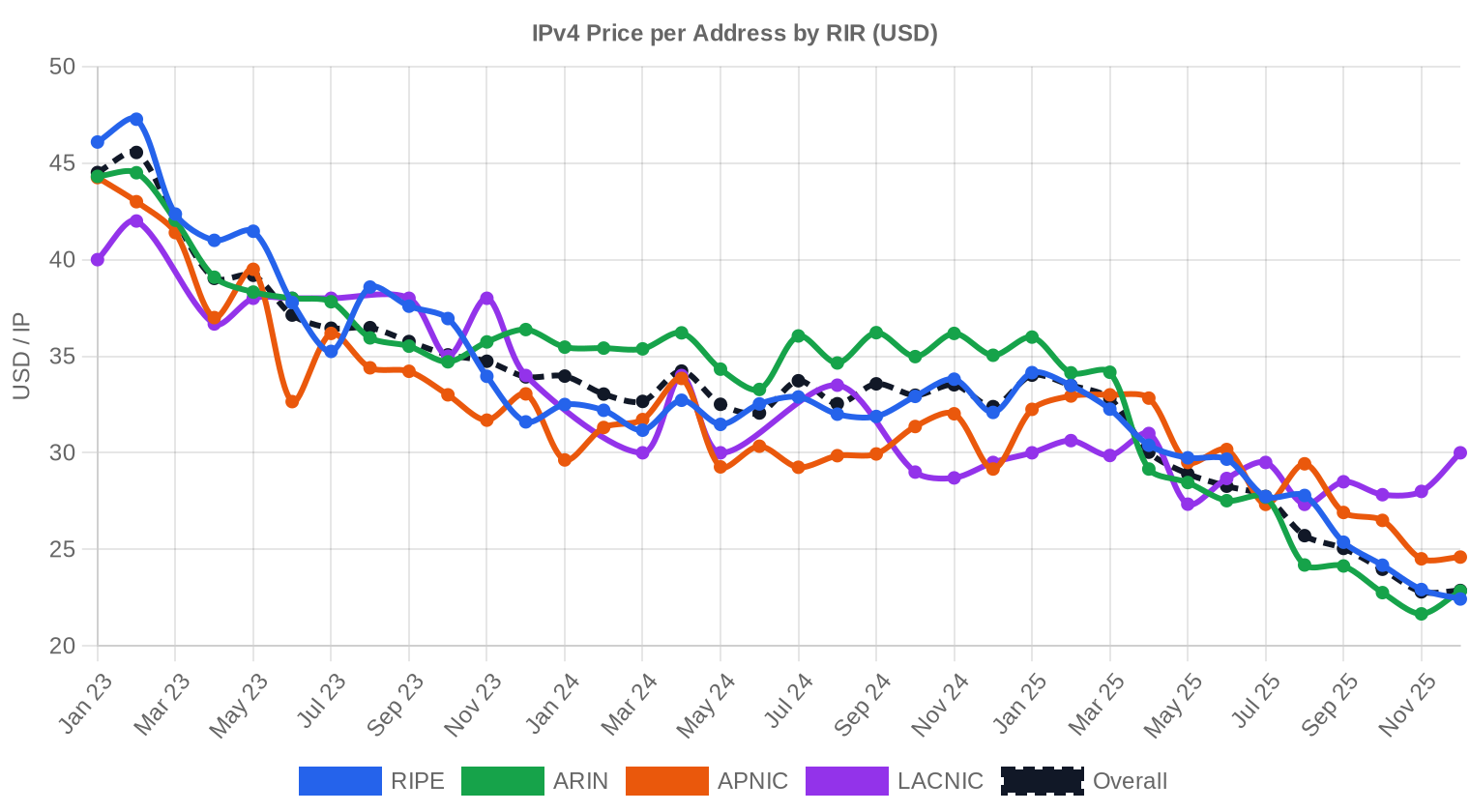
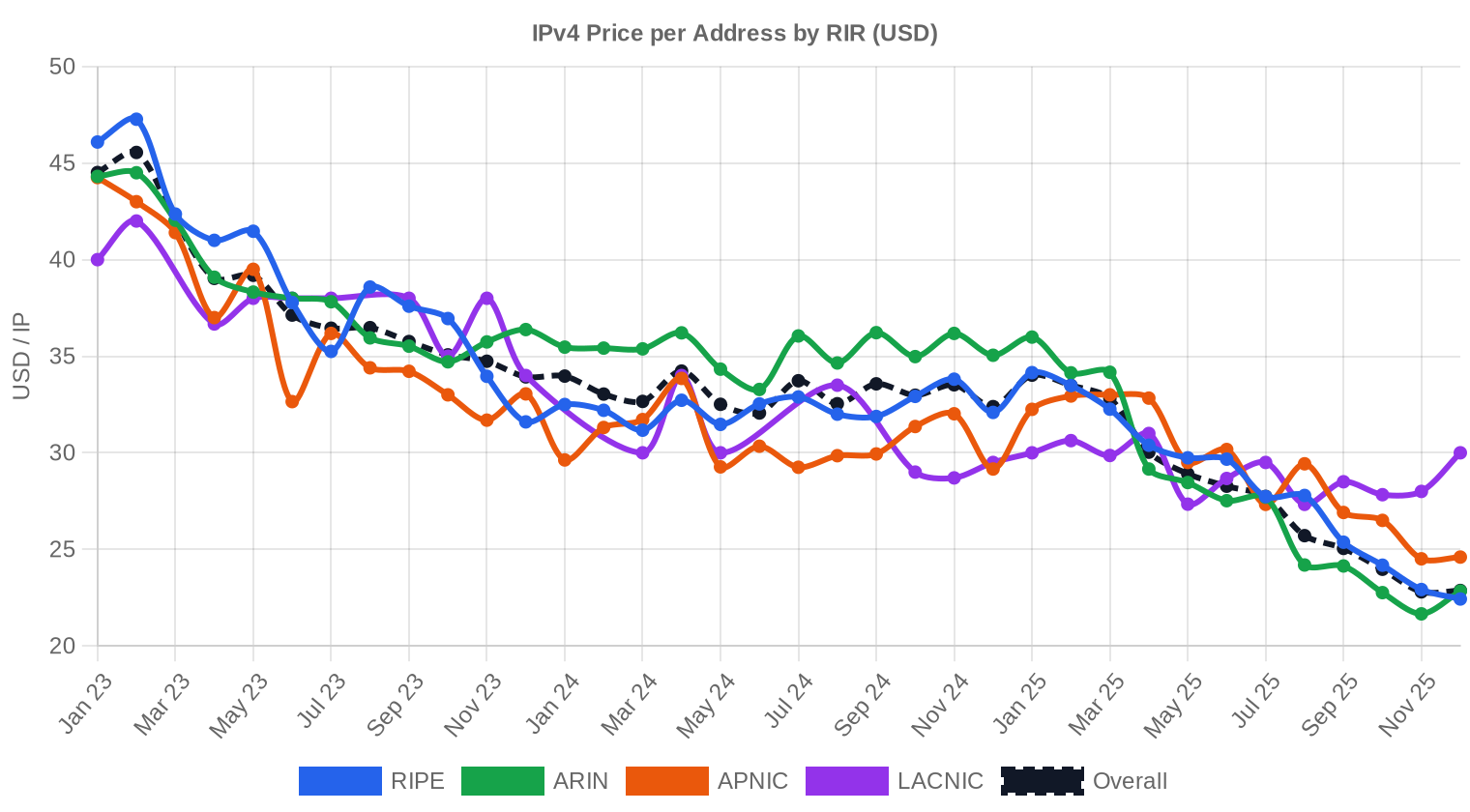
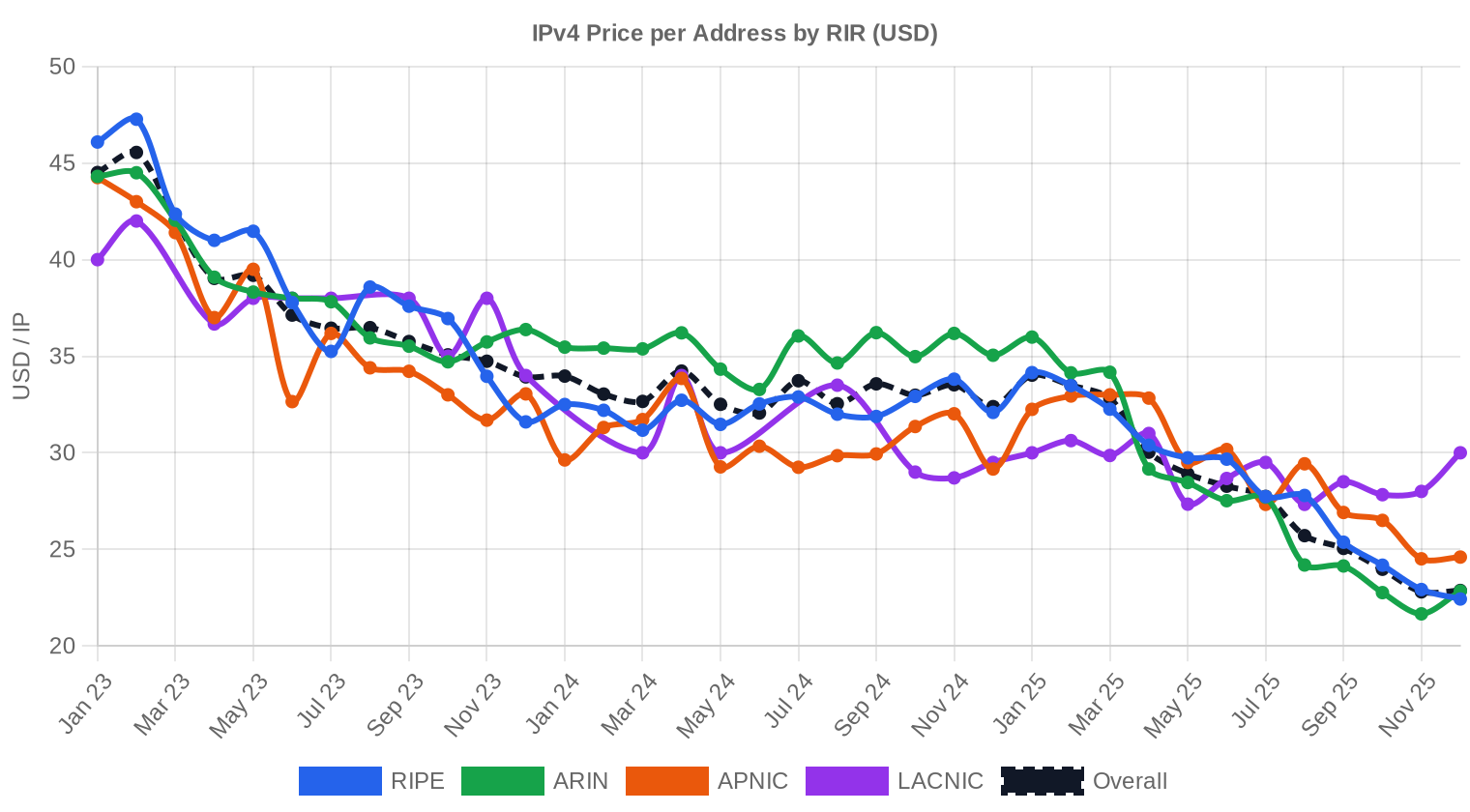
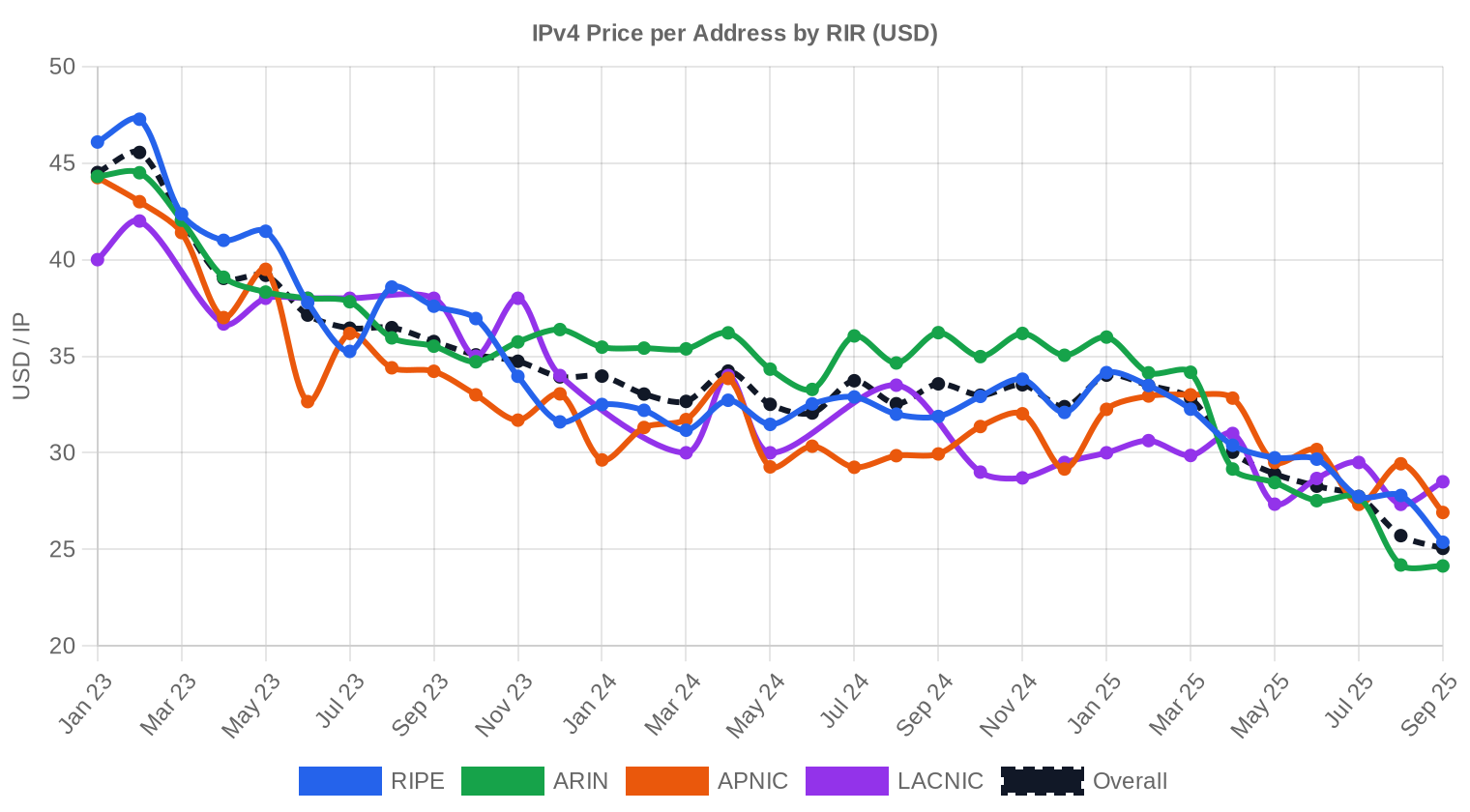
Prices ranged from $12/IP at the low end to $38/IP at the top, a $26 spread that reflects the growing bifurcation between bulk ARIN blocks and small, clean RIPE allocations. The median of $19.40 sits just below the $20.00 average, suggesting a slight right skew from a handful of premium trades. The regression trend reads "up" with a 0.33% month-over-month gain in the trendline, but this is statistical noise against the larger downward trajectory — prices are still firmly below $25 territory that held through much of 2025. The floor has dropped: $12/IP transactions were rare a year ago and now appear in the ARIN dataset as larger blocks move at volume discounts. RIPE's $38/IP ceiling suggests that small, clean European blocks still command meaningful premiums, but the gap between the cheapest ARIN space and the priciest RIPE space has widened to a 3.2x multiple.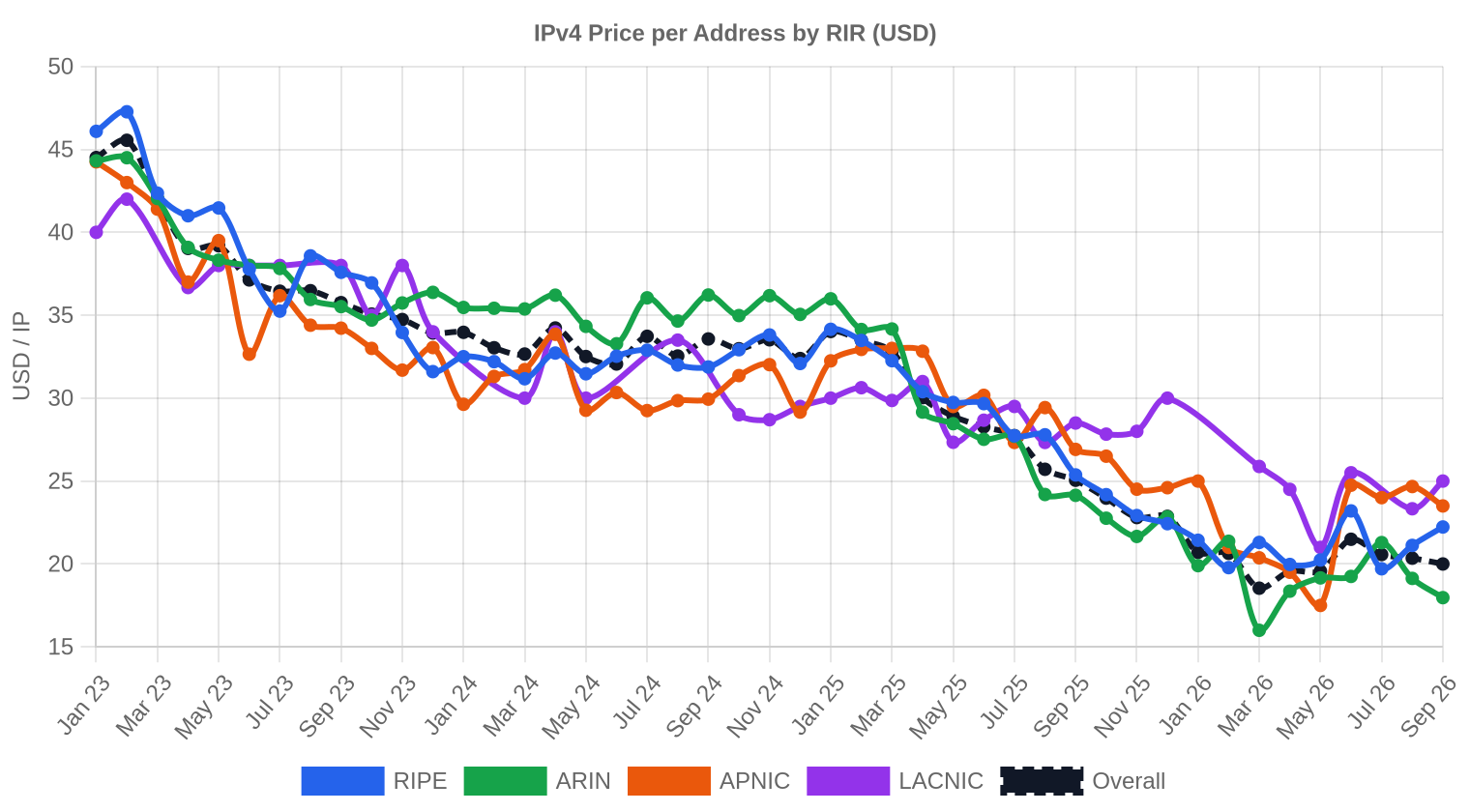
Pricing by RIR
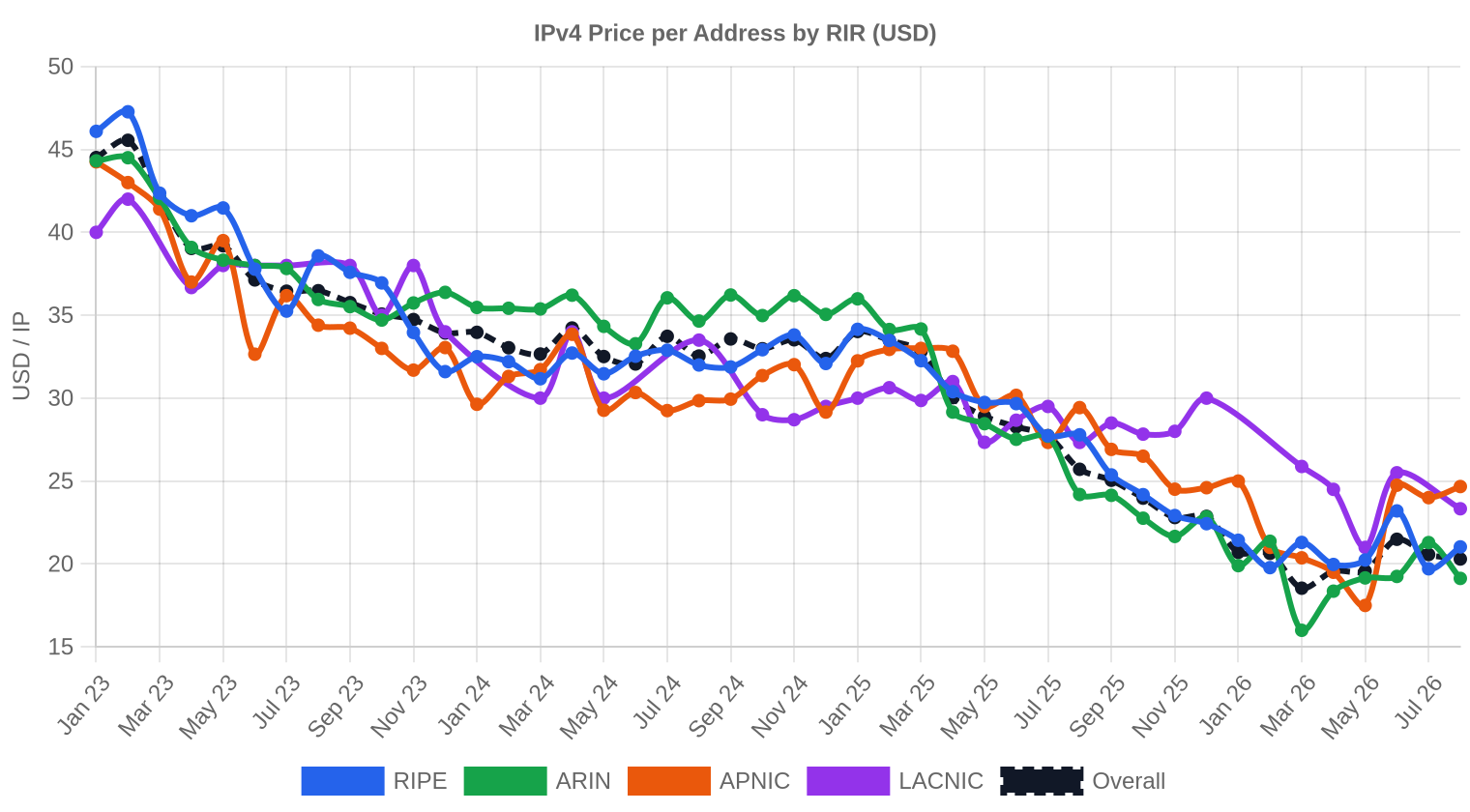
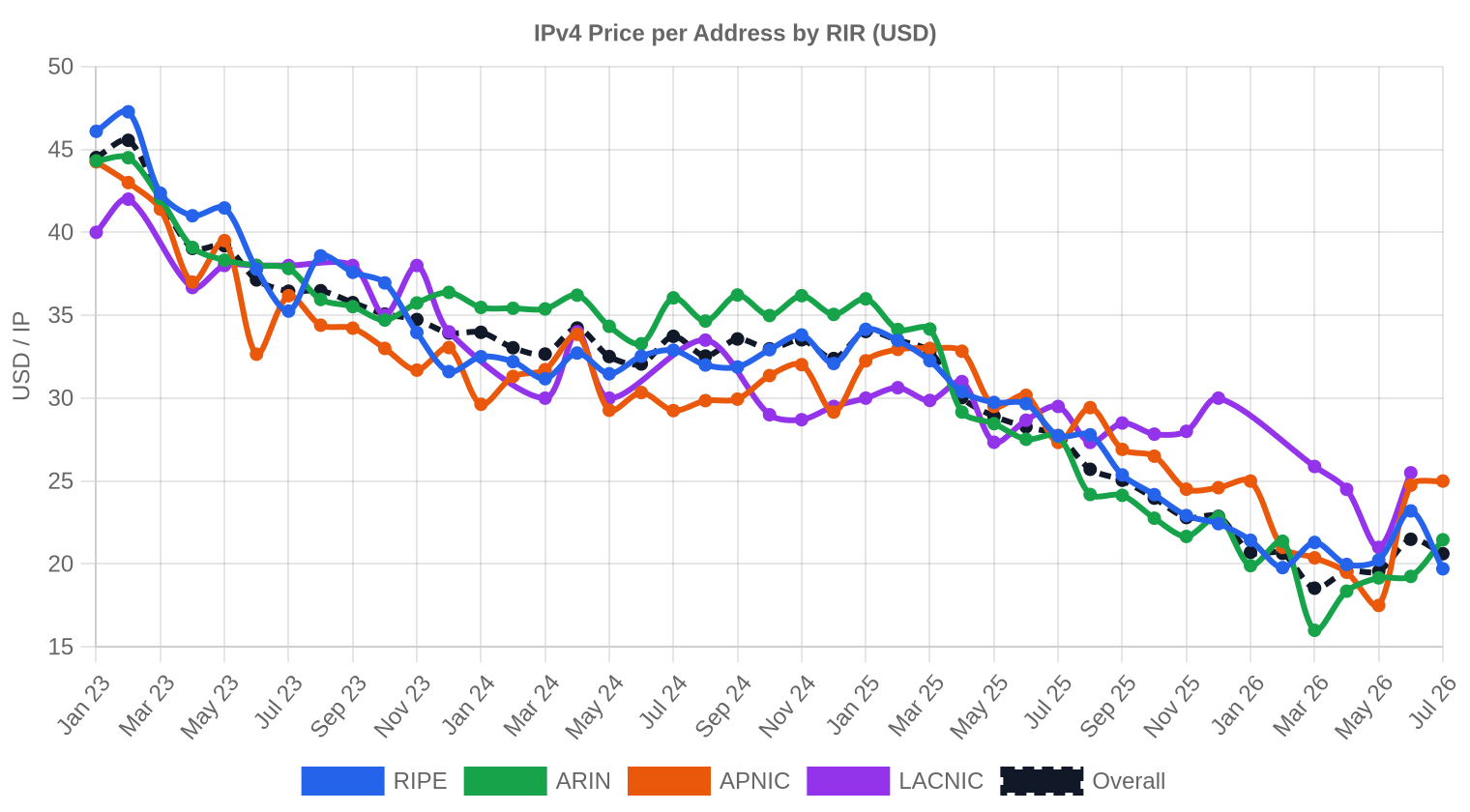
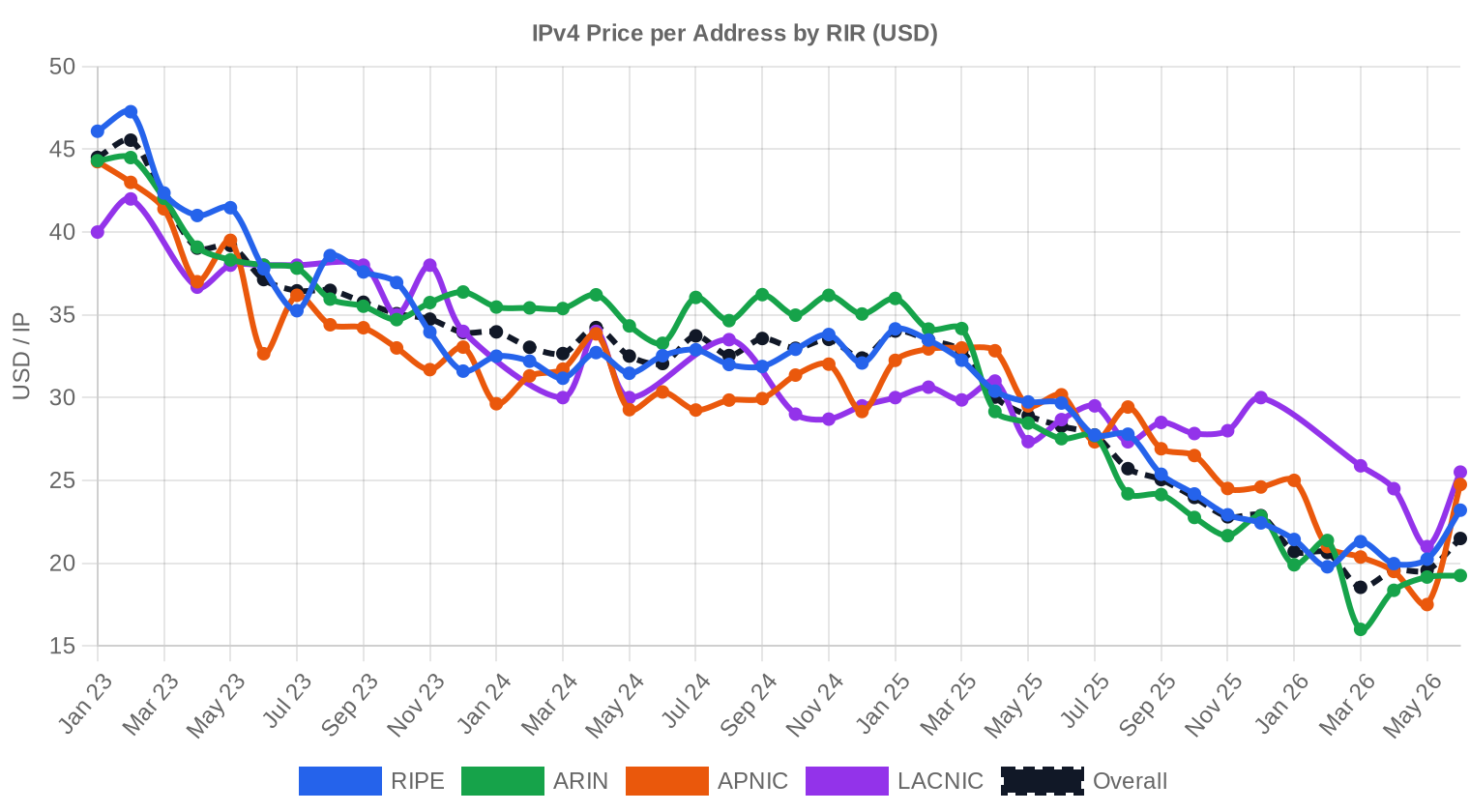
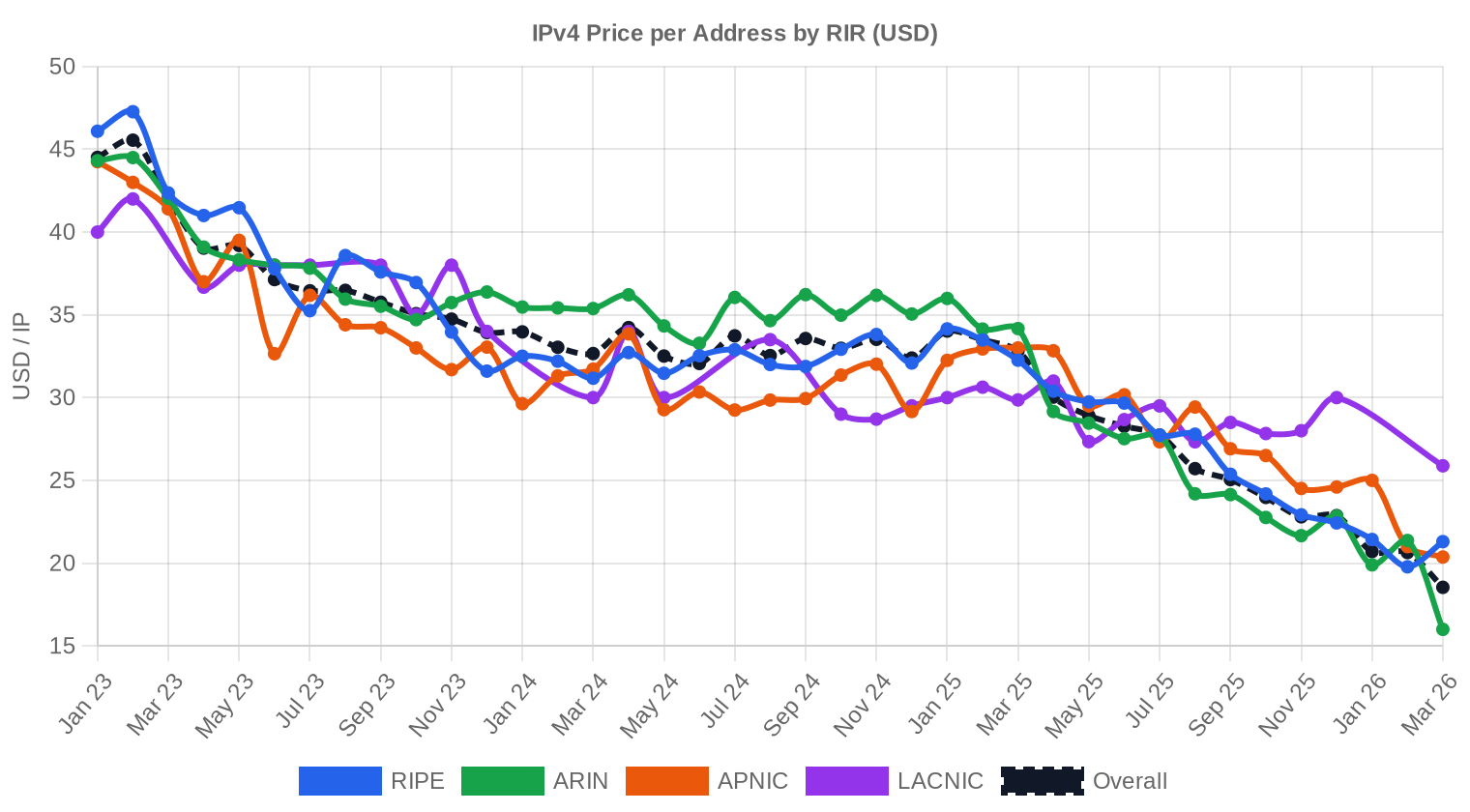
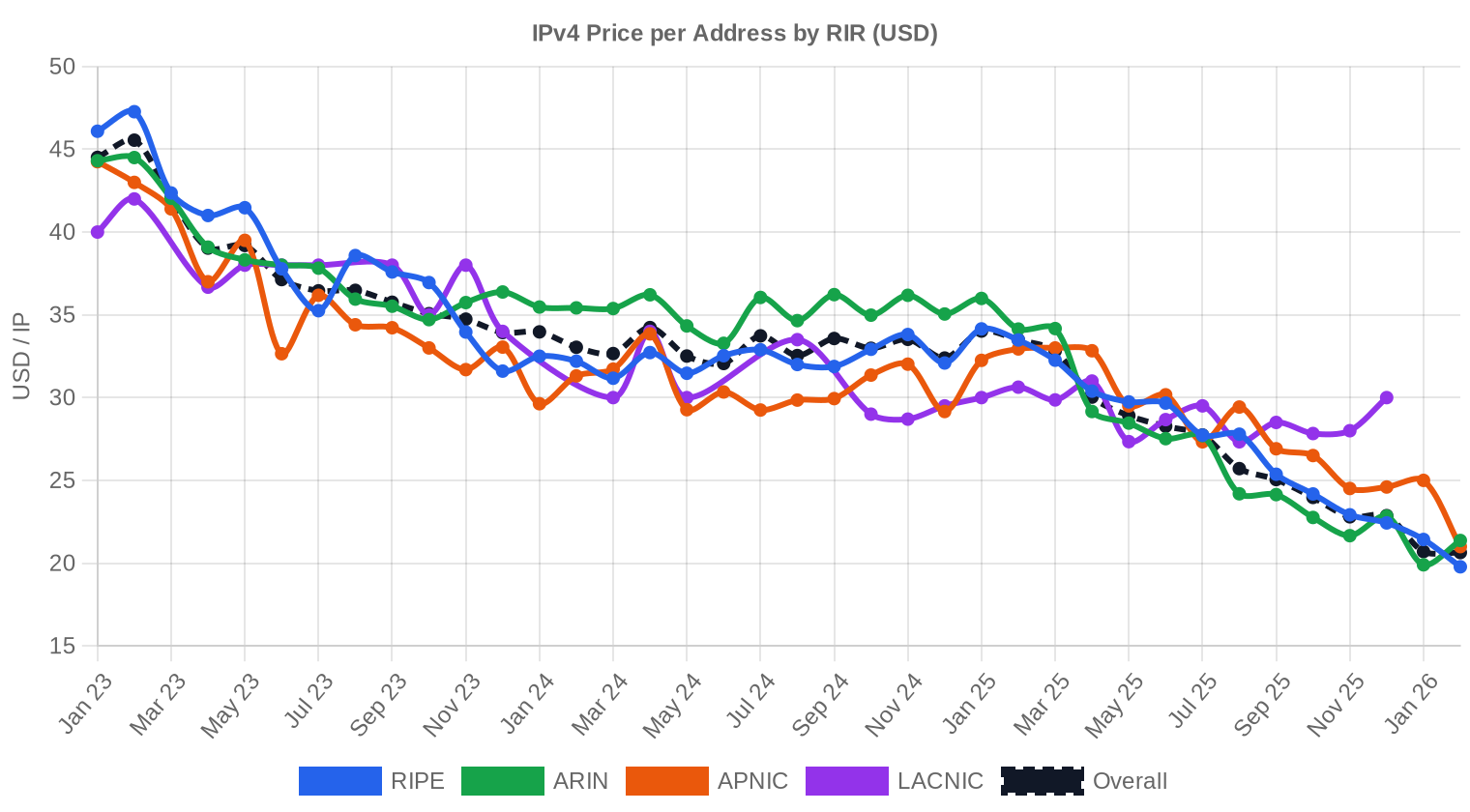
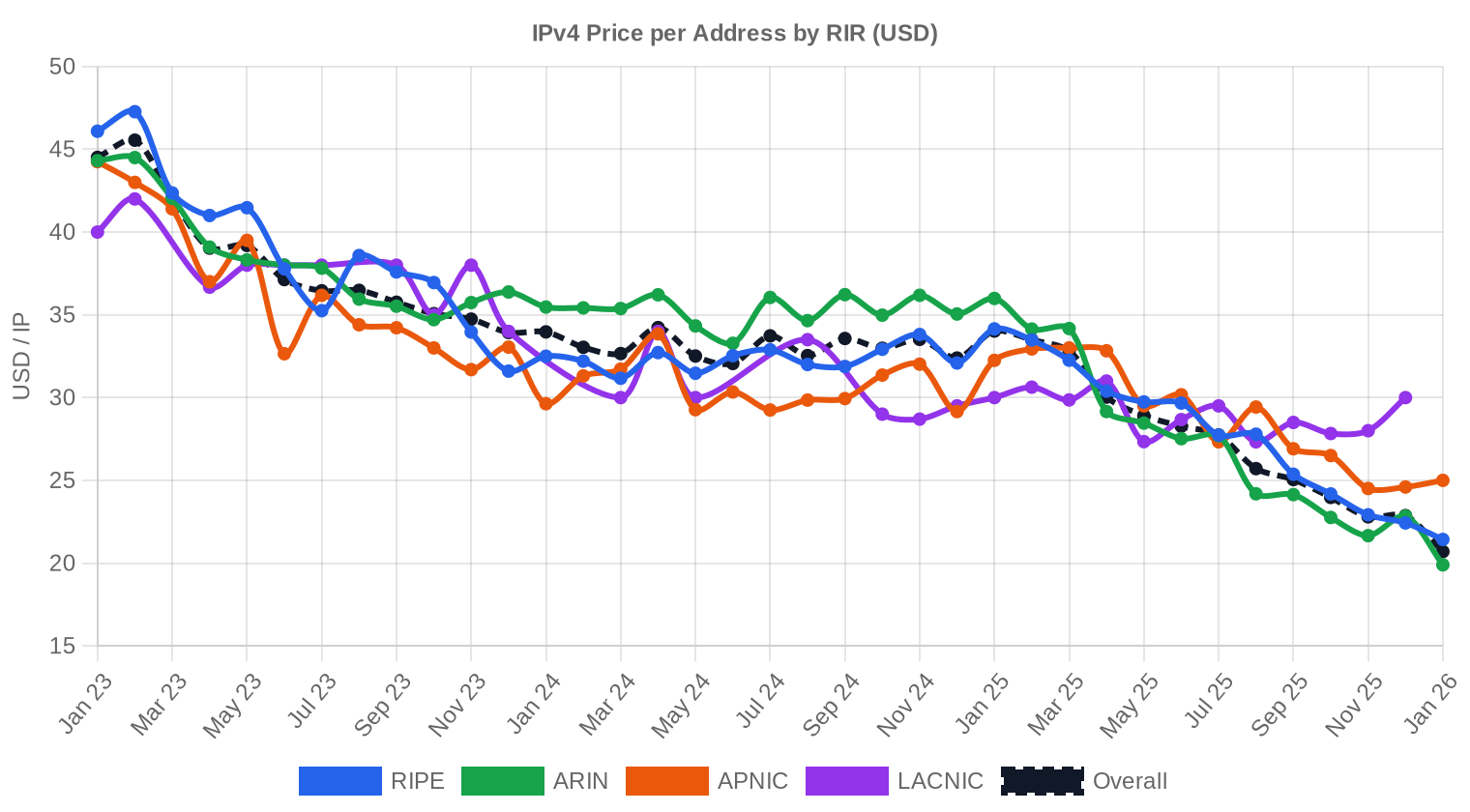
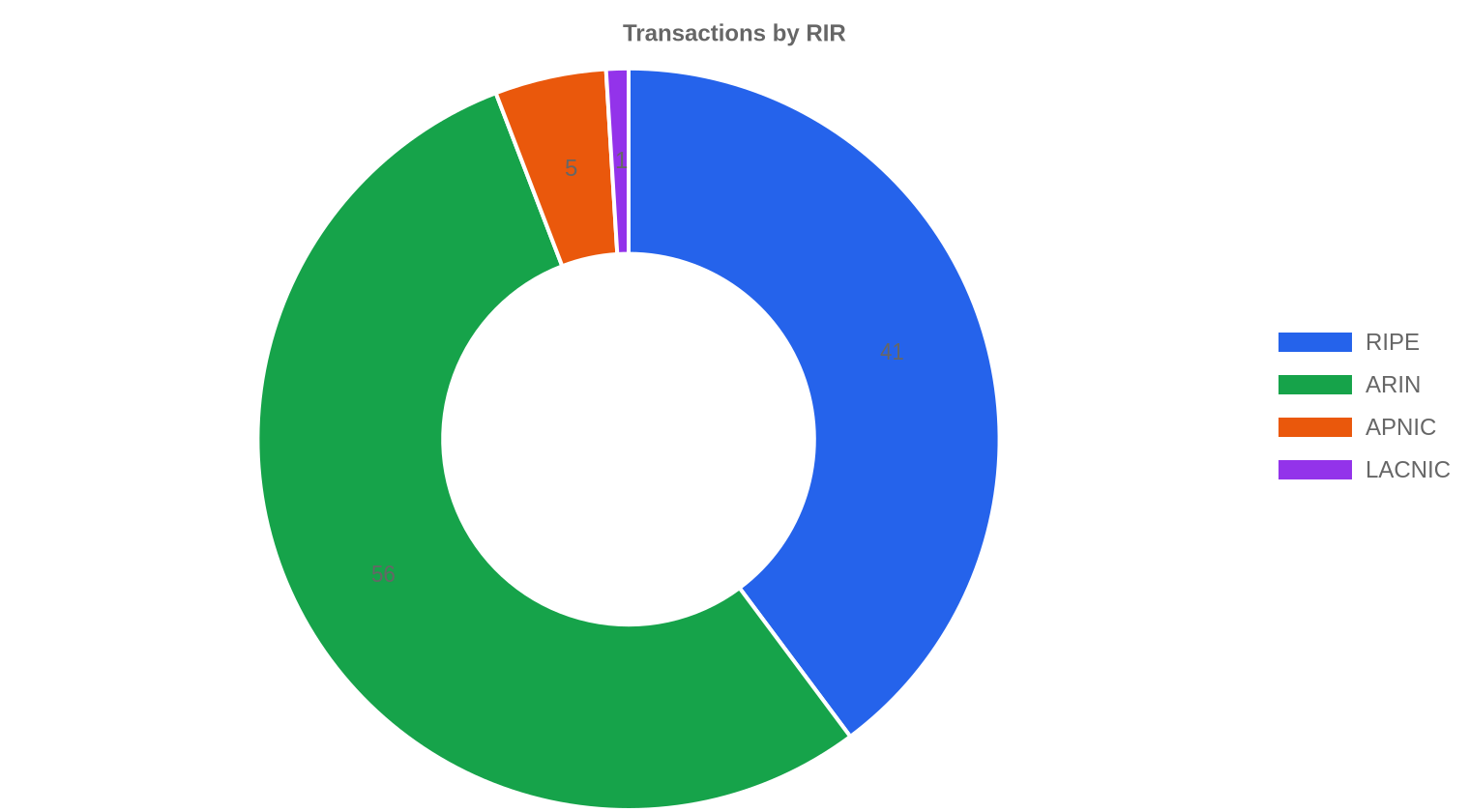
ARIN remains the workhorse of the market, but RIPE commands the premium. The spread between ARIN's $17.97 average and RIPE's $22.23 is $4.26/IP — roughly 24% — a gap that has been remarkably stable over the past several months. APNIC posted a $23.50 average across just 5 transactions, a thin sample but consistent with the scarcity premium that Asia-Pacific space has carried all year. LACNIC is the most interesting story this month: a single transaction at $25/IP, and market observations indicate that 15+ /16-sized LACNIC-origin blocks are actively moving toward ARIN, RIPE, and APNIC registries, with the first cross-RIR transfer completing in roughly 60 business days and a target timeline of 6–8 weeks. If that pace holds, the historical discount on LACNIC space may narrow considerably.ARIN: $17.97/IP across 56 transactions (54.4% of volume). Floor at $12/IP, ceiling at $27.50. Median $17.13.
RIPE: $22.23/IP across 41 transactions. Floor at $13.50, ceiling at $38. Median $22.50.
APNIC: $23.50/IP across 5 transactions. Tight range of $20–$25.50. Median $24.
LACNIC: $25/IP on a single /24 transaction. Low sample size but the highest per-IP price by RIR.
AFRINIC: No recorded transactions. Transfer policy uncertainty continues to freeze this market.
| RIR | Transactions | Avg $/IP | Median $/IP | IPs Traded | RIR Transfers | Next Month (proj.) | Year-End (proj.) |
|---|---|---|---|---|---|---|---|
| RIPE | 41 | $22.23 | $22.50 | 66,048 | 52 | $21.00 | $21.00 |
| ARIN | 56 | $17.97 | $17.13 | 288,256 | 200 | $17.00 | $17.00 |
| APNIC | 5 | $23.50 | $24.00 | 3,840 | 0 | $24.00 | $24.00 |
| LACNIC | 1 | $25.00 | $25.00 | 256 | 0 | $25.00 | $24.50 |
Transaction Volume
Supply & Block Sizes
/24 blocks dominated the transaction count again, accounting for 30 of 103 deals — nearly 29% of all trades. Buyers continue to favor /24s for targeted deployments: email infrastructure, small hosting environments, and edge nodes where a single 256-address block is sufficient. The preference for smaller blocks is structural, not cyclical, and explains why per-IP premiums on /24s persist even as aggregate pricing falls.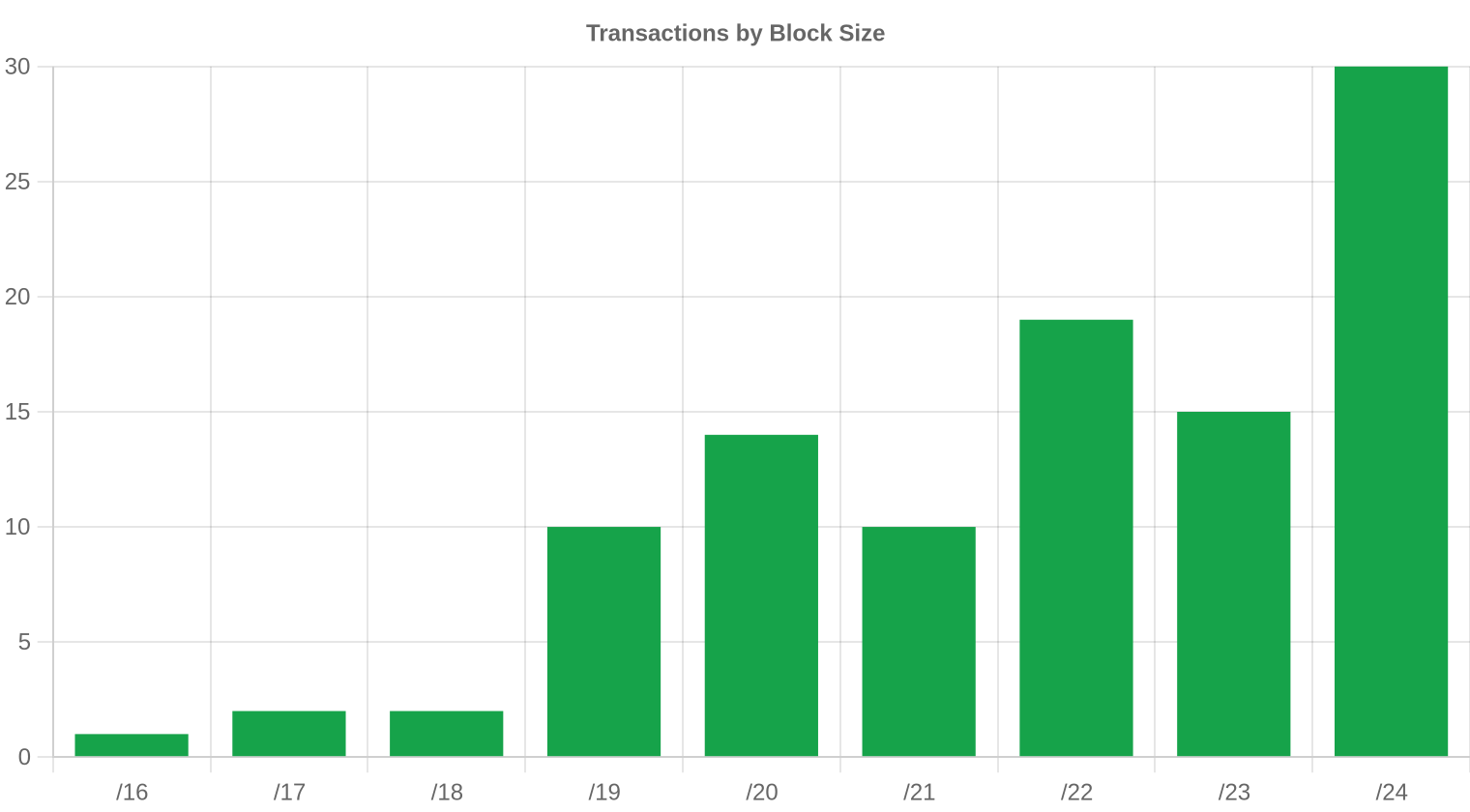
Geographic Activity
The United States led with 48 transactions, representing 47% of all deals — consistent with ARIN's volume dominance. The UK followed at 15 deals, and Canada placed third with 6, alongside 6 transactions with unidentified geography. Sweden (5 deals) and the Netherlands (3) rounded out the European contingent. This distribution mirrors the broader pattern: North American demand drives volume, European demand drives pricing.Registry Transfer Activity
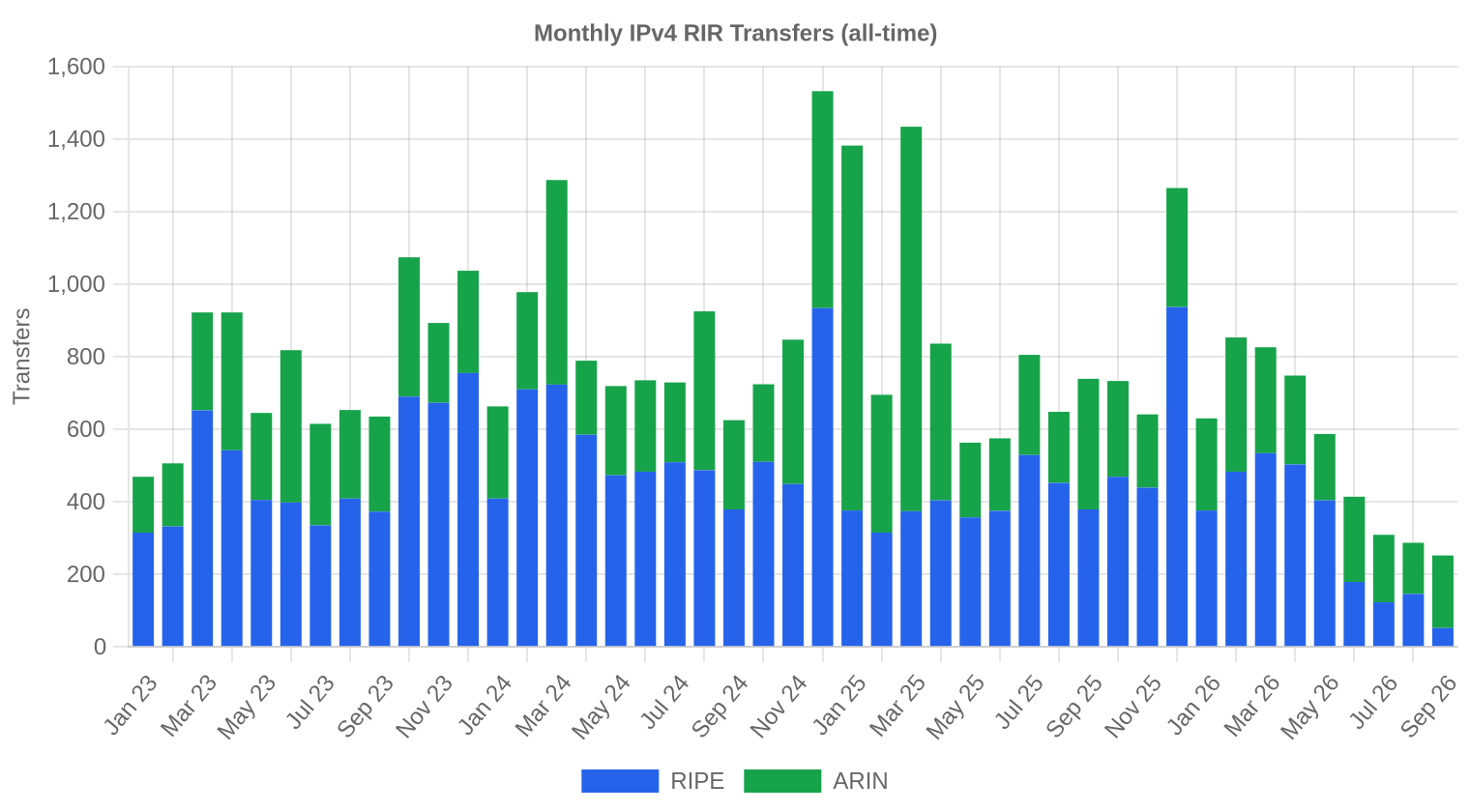
Official RIR transfer records logged 252 transfers in September, with ARIN accounting for 200 — a commanding 79% share. RIPE recorded 52 transfers. The disparity between 252 total transfers and 103 priced transactions reflects the usual mix of internal restructurings and off-market deals that don't produce public pricing data.Long-Run Transfer Trends
Over the 45-month tracking window, the market has processed 34,964 total transfers. The peak month was December 2024, which aligned with year-end budget cycles and pre-2025 procurement pushes. RIPE has held 59.3% of the long-term transfer share versus ARIN's 40.7% — an inversion of the current monthly pattern that reflects RIPE's historically more active secondary market before the 24-month holding rule began constraining supply.| RIR | RIR Transfers |
|---|---|
| RIPE | 20,736 |
| ARIN | 14,228 |
| RIR Transfers | 34,964 |
Outlook & Forecast
Forecasting each block-size band and RIR separately with our AI model:
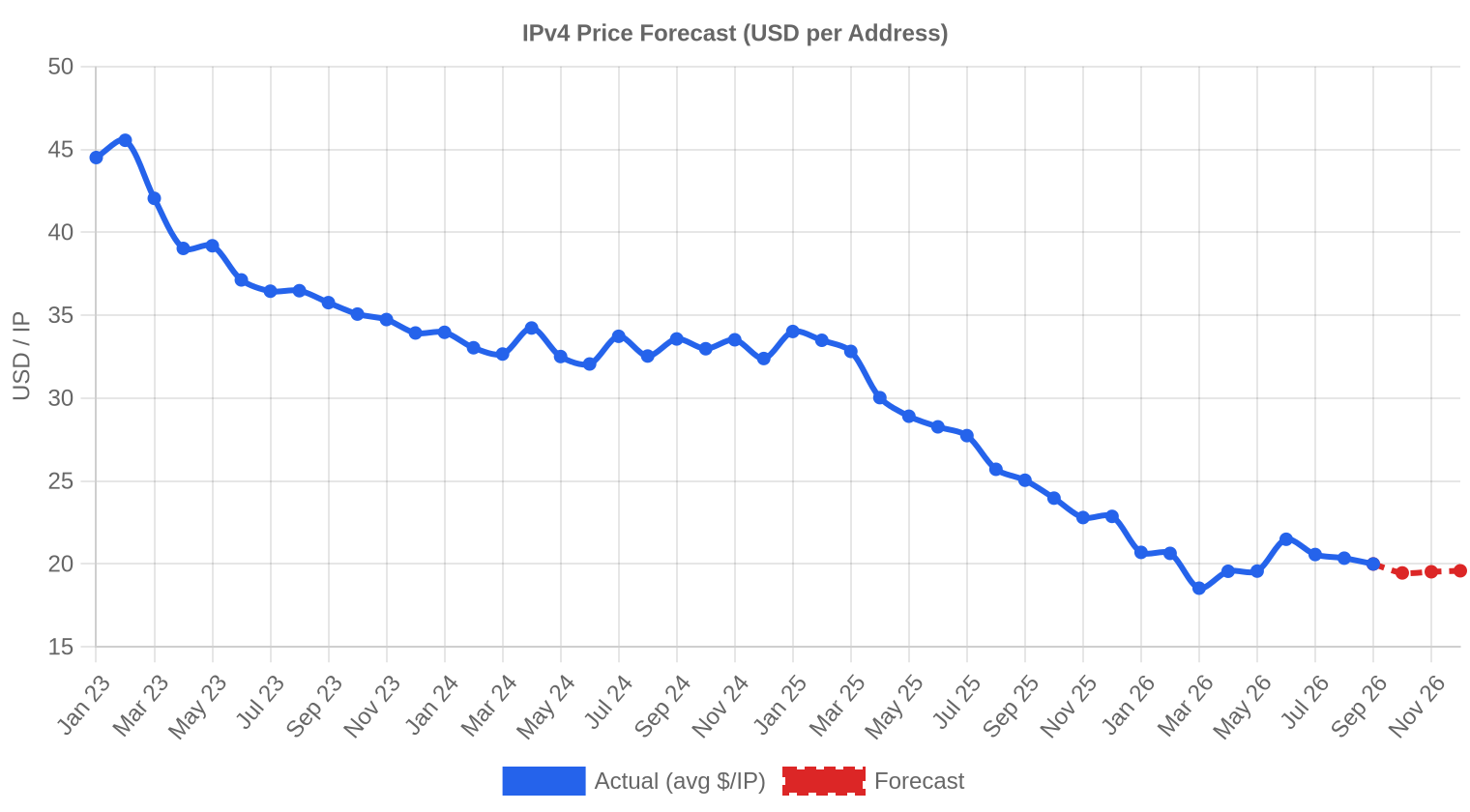
The overall average price per IP is projected to reach $19.59 by December 2026, with a next-month estimate of $19.66 per IP.
- RIPE: projected at $21.00 per IP next month, trending toward $21.00 by December 2026.
- ARIN: projected at $17.00 per IP next month, trending toward $17.00 by December 2026.
- APNIC: projected at $24.00 per IP next month, trending toward $24.00 by December 2026.
- LACNIC: projected at $25.00 per IP next month, trending toward $24.50 by December 2026.
- AFRINIC: insufficient data for a reliable forecast.
Forecast by Block Size
| Block | Current $/IP | Next Month | Year-End | Confidence |
|---|---|---|---|---|
| /24 | $25.00 | $25.00 (0.0%) | $25.00 (0.0%) | medium |
| /23 | $22.38 | $21.50 (-3.9%) | $21.00 (-6.2%) | medium |
| /22 | $19.00 | $19.00 (0.0%) | $19.00 (0.0%) | medium |
| /21 | $17.60 | $17.00 (-3.4%) | $17.00 (-3.4%) | medium |
| /20 | $15.50 | $15.50 (0.0%) | $15.50 (0.0%) | medium |
| /19 | $13.50 | $13.50 (0.0%) | $13.50 (0.0%) | low |
| /18-/16 | $13.50 | $13.00 (-3.7%) | $13.00 (-3.7%) | low |
| /15-up | $10.00 | $10.00 (0.0%) | $10.00 (0.0%) | low |
Editor's Take: Buy vs. Lease
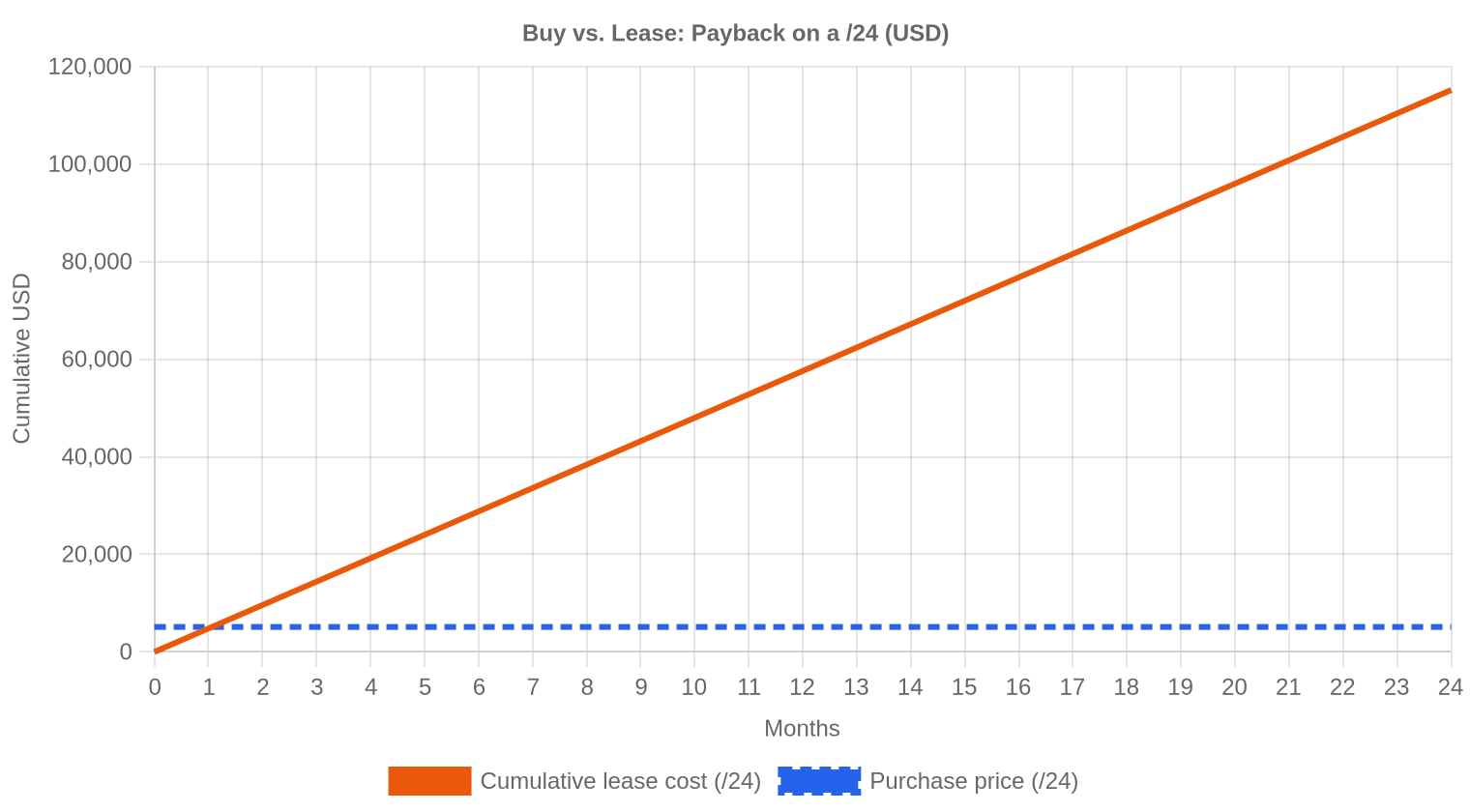
The buy-versus-lease math has shifted decisively toward buying. At $20/IP for a purchase and $18.75/IP per month for a lease, the payback period is just 1.1 months — essentially, anyone leasing for more than five weeks is overpaying relative to outright ownership. The implied annual yield of 1,125% on a leased-out block is extraordinary, though it reflects a lease market that hasn't yet adjusted to the drop in purchase prices. For holders with capital, buying at current levels and leasing the space out is the highest-return play available in this market. For operators who need addresses, there is no rational case for leasing at $18.75/month when a permanent purchase costs $20 total. The amortization threshold sits at 90 months for breakeven under normal conditions, but with September's pricing, the crossover happens in weeks, not years. The verdict is unambiguous: buy.| /24 Purchase price | $5,120 |
| /24 Lease price | $4,800 / mo |
| Payback period | 1.1 mo (0.1 yr) |
| Gross annual yield | 1,125.0% |
What This Means for You
Buyers: You are looking at the lowest average pricing in over a year. The 20.2% year-over-year decline means every month you wait could save money — but the forecast models suggest we're approaching a floor near $19.50–$20. If you need blocks in the next 90 days, buying now at ARIN's $17.97 average is defensible. Wait for RIPE if you want cleaner European space, but expect to pay $22+.Sellers: Average deal size has dropped to $51,673 from $111,960 a year ago. The market is moving smaller blocks at lower prices. If you hold /16s or larger, the bid pool has thinned — only 1 deal exceeded $1 million this month. Consider breaking larger blocks into /20–/22 segments to access the more liquid mid-market.
Leasers: At $18.75/month per IP, leasing is economically irrational for any deployment lasting more than six weeks. The purchase-to-lease spread has collapsed. Renegotiate your lease terms or convert to ownership.
Block holders: If you're sitting on unused space, the lease market offers staggering returns — but those yields will compress as the buy-lease spread becomes more widely recognized. Lock in lease agreements now while lessees are still paying near $19/month.
Browse verified IPv4 blocksSell IPv4 →
List your blocks with managed transferLease IPv4 →
Flexible short-term capacityLease Out IPv4 →
Turn idle blocks into recurring revenue
IPv4 Pricing by Block Size
Per-IP pricing remains sharply tiered by block size. /24 transactions — the most traded prefix this month at 30 deals — carry a per-IP premium that can push above $30 for clean RIPE space. Larger blocks (/18 and above) in ARIN trade near the $12–$15 floor, reflecting bulk discounts that compress per-IP costs by 30–40% versus /24 pricing. The 4 deals in the $250K–$1M band and the single $1M+ transaction indicate that large-block demand persists, but at lower prices than sellers expected even six months ago.| Block | IPs | Buy: /IP | Buy: Total | Lease: /IP/mo | Lease: Monthly |
|---|---|---|---|---|---|
| /24 | 256 | $35-45 | $8,960-11,520 | $0.38-0.50 | $97-128 |
| /22 | 1,024 | $28-38 | $28,672-38,912 | $0.33-0.45 | $338-461 |
| /20 | 4,096 | $22-32 | $90,112-131,072 | $0.30-0.40 | $1,229-1,638 |
| /18 | 16,384 | $20-30 | $327,680-491,520 | $0.30-0.38 | $4,915-6,226 |
| /16 | 65,536 | $18-28 | $1,179,648-1,835,008 | $0.30-0.35 | $19,661-22,938 |
IPv4 Price History: 2011–2026
IPv4 pricing has gone through three distinct eras since IANA pool exhaustion in 2011. The early transfer market saw prices below $10/IP through 2017, followed by a steady climb that peaked in the $50–$60 range during 2023–2024. AWS's introduction of public IPv4 charges in February 2024 marked an inflection point — enterprise customers began returning unused elastic IPs, and the signal that cloud providers were monetizing their own holdings shifted buyer psychology. The current $20 average represents a 60%+ decline from peak levels, and the market has bifurcated: RIPE and APNIC blocks trade at premiums for cleanliness and regional scarcity, while ARIN blocks increasingly move at volume-discount pricing.| Year | ~Price/IP | Key Event |
|---|---|---|
| 2011 | $7-12 | IANA free pool exhausted; Microsoft/Nortel deal ($11.25/IP) |
| 2012 | $8-12 | RIPE NCC reaches last /8; begins /22-only allocation |
| 2014 | $10-15 | LACNIC free pool exhausted |
| 2015 | $8-15 | ARIN free pool exhausted |
| 2017-18 | $12-18 | Leasing market grows; cloud demand rises |
| 2019 | $18-24 | RIPE NCC exhausts remaining free pool |
| 2021-22 | $50-60+ | Post-pandemic peak; hyperscaler build-outs |
| 2024 | $35-52 | AWS IPv4 charge ($0.005/IP/hr); large block correction |
| 2025-26 | $18-45 | Market bifurcation; /16s below $20 for first time since 2019 |
Market Structure: Who Is Buying & Selling
The buyer pool has shifted from hyperscalers (who've largely built their inventories) toward mid-market ISPs, hosting companies, and enterprises deploying AI inference infrastructure. On the sell side, legacy corporate holders continue to monetize allocations they've carried since the pre-commercial internet era, and a growing number of blocks are hitting the market from telecom bankruptcies and restructurings. Brokers report that deal cycles are shorter — the average time from listing to close has compressed as buyers have become more price-aware.IPv4 vs. Other Asset Classes
At an implied annual lease yield of 1,125%, IPv4 addresses are in a class of their own among digital assets — though that figure reflects a temporary dislocation between purchase and lease pricing that will inevitably correct. A more sustainable yield, assuming lease rates adjust to a 5–7x purchase price multiple, would be in the 15–20% annual range — still well above the 4–5% yields on investment-grade real estate and the 4.5–5% range on 10-year Treasuries. IPv4 blocks carry no counterparty credit risk (the addresses exist regardless of issuer solvency) but do face long-term obsolescence risk from IPv6 adoption.| Asset Class | Typical Yield | Liquidity | Primary Risk |
|---|---|---|---|
| IPv4 | 1,125.0% | Moderate | IPv6 adoption, block quality |
| Commercial Real Estate | 5-8% | Low | Vacancy, rate cycle |
| Investment-Grade Bonds | 4-5% | High | Duration, credit risk |
| S&P 500 | ~1,3% | High | Market volatility |
| Money Market / T-Bills | ~4-5% | High | Rate cycle changes |
IPv6 Adoption & Why IPv4 Remains Essential
IPv6 deployment continues to expand — Google reports over 45% of its traffic now arrives over IPv6 — but the dual-stack reality persists. Enterprise applications, legacy systems, IoT devices, and regulatory environments all anchor IPv4 demand for the foreseeable future. The practical timeline for IPv4 irrelevance extends well beyond 2030, and the transfer market prices this in: even with a 20% annual decline, blocks still trade at $20/IP because buyers need them today and will need them for years.AI & Cloud Infrastructure Demand
AI infrastructure buildouts remain a steady source of IPv4 demand, particularly for inference clusters that require public-facing endpoints. Training farms typically operate behind NAT or private address space, but inference — real-time API serving, edge deployment, content delivery — needs routable IPv4. The 5 APNIC transactions this month, concentrated in Singapore and Japan, align with the Asia-Pacific AI infrastructure corridor where new GPU clusters are going live quarterly.What Determines IPv4 Block Value
Block valuation depends on five factors in roughly this priority order: blacklist cleanliness, RIR transferability, allocation age, geographic reputation, and prefix size. A clean /22 from RIPE with a 10-year allocation history can command $25+/IP, while a recently de-listed ARIN /20 with spam history might trade at $14. The LACNIC liquidity improvement — if cross-RIR transfers consistently close in 6–8 weeks — could meaningfully increase the transferability premium on LACNIC-origin blocks, which have historically traded at discounts due to unpredictable transfer timelines.Sell vs. Lease: A Decision Framework
In a falling-price environment, the case for selling sooner is straightforward: every month of delay erodes your exit price. Blocks that would have fetched $25/IP in September 2025 now sell at $20. Leasing makes sense for holders who want to retain optionality — if you believe prices will stabilize near the $19–$20 floor, leasing at $18.75/month per IP generates income while you wait. But if your blocks are large (/16+) and you don't have lease distribution infrastructure, selling now captures value before the market potentially finds a lower equilibrium.| /24 Purchase price | $5,120 |
| /24 Lease price | $4,800 / mo |
| Payback period | 1.1 mo (0.1 yr) |
| Gross annual yield | 1,125.0% |
RIPE NCC 24-Month Transfer Restriction
RIPE NCC's 24-month holding requirement continues to function as a supply throttle on the European market. Blocks acquired in 2024's $40–$50/IP environment won't be eligible for resale until 2026–2027, and many of those holders are underwater on cost basis. This creates a two-tier market: legacy RIPE blocks (held long enough to satisfy the rule) trade freely at $22+/IP, while recently acquired blocks are locked up. The rule suppresses supply and supports RIPE's pricing premium over ARIN.Deal Size Distribution
Average deal size fell to $51,673 from $56,172 in August — an 8% monthly decline — and is less than half the $111,960 average from September 2025. The market is structurally moving toward smaller transactions: 74 of 103 deals (72%) fell below $50,000, accounting for $1.1M in value. The mid-market ($50K–$250K) contributed 24 deals and $2.79M. Just 5 transactions exceeded $250K, with a single deal above $1M at $1.31M. The concentration of activity in sub-$50K trades reflects /24 and /23 dominance among buyers who are deploying addresses incrementally rather than building large inventories.Top Trading Countries
The US accounted for 48 of 103 trades (47%), driven by ARIN's deep inventory and the BEAD-adjacent ISP demand cycle. The UK's 15 deals (15%) make it the largest European buyer — London-based hosting and fintech firms continue to consume RIPE space. Canada's 6 deals reflect steady but unspectacular demand from mid-tier ISPs and enterprise buyers. The presence of Ukraine in the data (2 domestic deals plus 2 cross-border US-UA transactions) suggests continued network rebuilding and infrastructure investment.BEAD Broadband Program Impact
The $42.45 billion BEAD program continues its slow rollout, with state-level grant processes now entering deployment phases. Rural ISPs and fixed wireless providers are the primary IPv4 buyers in this channel, typically seeking /22 to /20 blocks — exactly the mid-market segment where September's deal flow concentrated. As BEAD-funded networks go live through 2027, expect sustained demand for mid-size ARIN blocks, which should provide a pricing floor in the $16–$18 range even if broader market prices continue to soften.Hyperscaler IPv4 Holdings
Amazon, Microsoft, and Google collectively hold an estimated 100+ million IPv4 addresses — enough to supply the transfer market for years at current transaction volumes. AWS's public IPv4 pricing ($0.005/hour per address, ~$3.60/month) sets an implicit ceiling on lease pricing and influences the buy-versus-lease calculus for cloud-native workloads. These holdings represent latent supply: if any hyperscaler chose to liquidate even 5% of its inventory, the market impact would be severe. That hasn't happened, but the risk is structural and permanent.Macroeconomic Conditions & Market Impact
Central bank rates have stabilized in the 3.5–4% range across major economies, reducing the financing cost pressure that dampened deal activity in 2024. Enterprise IT budgets are expanding modestly in 2026, with network infrastructure spend up as companies invest in hybrid cloud and edge computing. The stronger macro backdrop supports transaction volume but hasn't reversed the pricing decline — supply growth from legacy holders and improved cross-RIR liquidity continues to outpace demand growth.Model Update & Calibration
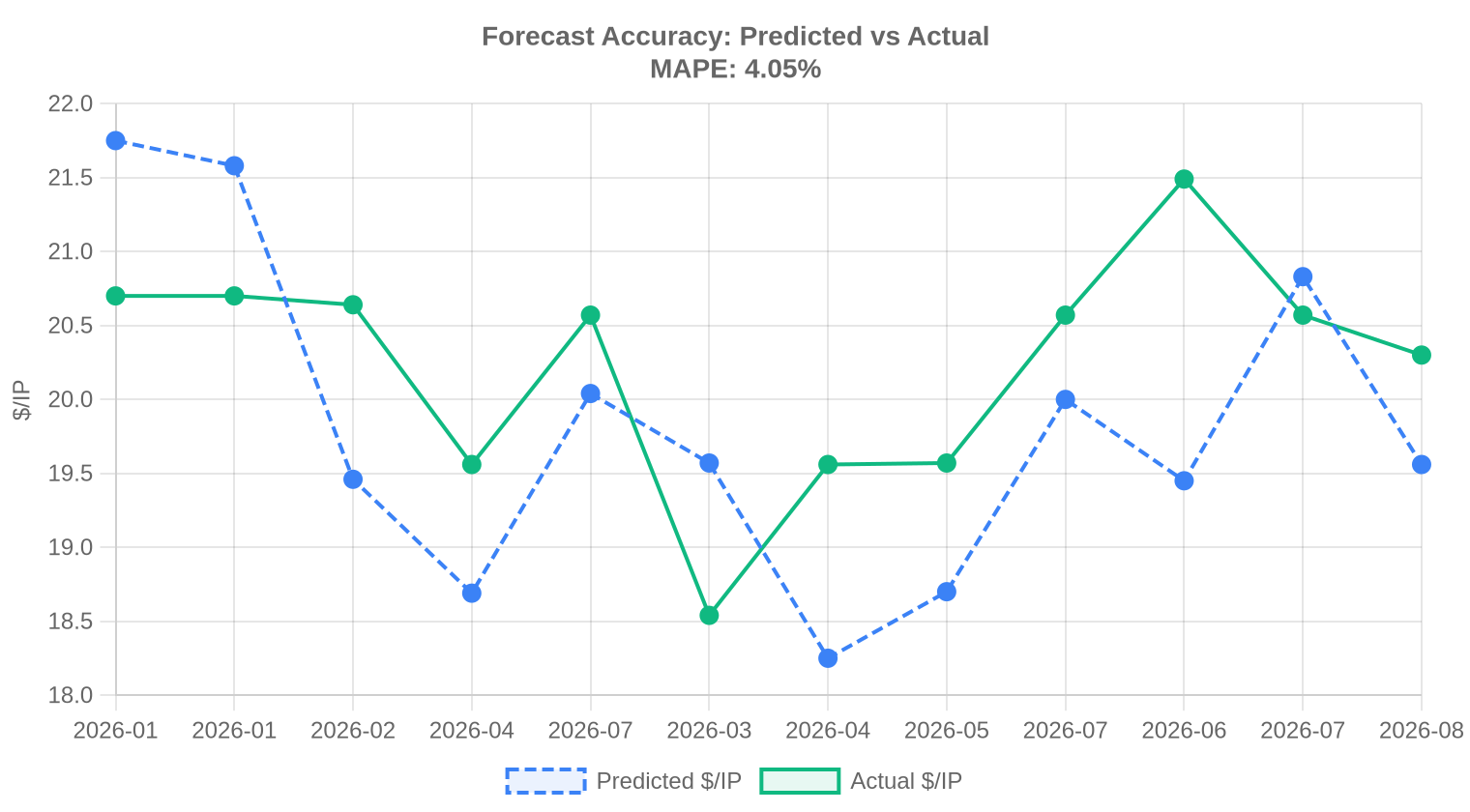
We reviewed our past projections against actual market outcomes and recalibrated the model for this report. The updated model places more weight on recent price movements using exponential decay, dynamically adjusts prediction bands to reflect current market conditions, and corrects for any systematic bias detected in earlier forecasts. The predicted-vs-actual comparison chart below shows how closely our past estimates tracked reality.
| Report Period | Target Month | Predicted | Actual | Deviation |
|---|---|---|---|---|
| 2026-03 | 2026-04 | $18 | $20 | -7% |
| 2026-04 | 2026-05 | $19 | $20 | -4% |
| 2026-Q2 | 2026-07 | $20 | $21 | -3% |
| 2026-05 | 2026-06 | $19 | $21 | -9% |
| 2026-06 | 2026-07 | $21 | $21 | +1% |
| 2026-07 | 2026-08 | $20 | $20 | -4% |
Methodology
Figures are based on completed IPv4Center marketplace transactions and RIR transfer statistics. Prices are in US dollars per IP address. Forecasts are produced by an AI model that analyses each block-size band and RIR segment separately (with outlier-trimmed medians) alongside known market catalysts; they are estimates, not guarantees.
Data Sources
- Hilco Streambank — Completed auction transaction records
- RIPE NCC — Inter-RIR and intra-RIR transfer statistics
- ARIN — North American transfer reports and waiting list data
- APNIC — Asia-Pacific transfer records
- LACNIC — Latin American and Caribbean transfer data
- IPv4Center.com — Proprietary marketplace transaction and lease pricing data
This report is generated automatically for informational purposes only and does not constitute financial advice.
Frequently Asked Questions
What was the average IPv4 price in September 2026?
The average IPv4 price was $20.00 per IP in September 2026, with a median of $19.40. This is down $1.50 from August 2026 and 20.2% below September 2025 levels.
How many IPv4 transactions occurred in September 2026?
103 transactions were recorded, covering 358,400 IP addresses with a total market value of $5.32 million.
How much does a /24 IPv4 block cost in September 2026?
A /24 block (256 IPs) costs approximately $5,120 at the market average of $20/IP. Actual prices range from $3,072 (at the $12 floor) to $9,728 (at the $38 ceiling) depending on RIR, cleanliness, and allocation history.
Which RIR has the cheapest IPv4 addresses?
ARIN offers the lowest average pricing at $17.97/IP, with a floor of $12/IP. RIPE averages $22.23/IP, APNIC $23.50/IP, and the single LACNIC transaction priced at $25/IP.
Why are RIPE IPv4 addresses more expensive than ARIN?
RIPE blocks trade at a $4.26/IP premium over ARIN due to supply constraints from the 24-month holding rule, perceived cleanliness of European allocations, and scarcity in the RIPE region. RIPE's median of $22.50 vs. ARIN's $17.13 reflects this structural gap.
How much does it cost to lease IPv4 addresses?
RIPE-region leasing averages $18.75 per IP per month, or $4,800/month for a /24 block. Annual lease cost runs approximately $225 per IP.
Should I buy or lease IPv4 addresses in September 2026?
Buy. At $20/IP purchase price versus $18.75/IP monthly lease cost, the payback period is approximately 1.1 months. Any deployment lasting more than six weeks is cheaper to own outright.
What is the payback period for buying vs. leasing IPv4?
The current payback period is 1.1 months. Purchasing at $20/IP equals the cost of leasing for just over 4 weeks at $18.75/month per IP.
What is the forecast for IPv4 prices in late 2026?
Our model projects $19.66/IP for October 2026 and $19.59/IP by December 2026. The forecast indicates pricing stabilization near the $19.50–$20 range through year-end.
Why have IPv4 prices dropped 20% year-over-year?
The 20.2% annual decline reflects increased supply from legacy holders monetizing allocations, AWS's public IPv4 charging deterring hoarding, improved cross-RIR transfer liquidity, and a market that overshot during the 2023–2024 peak.
How long does an IPv4 transfer take?
ARIN transfers typically complete in 2–4 weeks. RIPE transfers take 2–6 weeks depending on due diligence requirements. LACNIC cross-RIR transfers have historically been slower but are now reportedly closing in 60 business days, with a target of 6–8 weeks.
What mistakes should be avoided when buying IPv4?
The most common mistakes are skipping blacklist and reputation checks (which can render a block unusable for email or web hosting), failing to verify the seller's legitimate authority over the block, and not using escrow for payment protection. Any of these can turn a $20/IP purchase into a total loss.
What are the risks of skipping blacklist verification?
Blocks with active blacklist entries from Spamhaus, UCEProtect, or similar services can be unusable for email delivery, web hosting, and API services. De-listing can take weeks to months, and some blacklists require the new owner to demonstrate clean usage history before removal. Always verify before closing.
Why shouldn't you skip escrow when buying IPv4?
IPv4 transfers are irreversible once completed at the RIR level. Without escrow, a buyer who wires funds has no recourse if the seller fails to initiate the transfer or if the block has undisclosed encumbrances. Escrow costs are typically 1–3% of deal value — a small price for eliminating counterparty risk on a transaction that can exceed $100,000.
What risks should IPv4 investors be aware of?
Key risks include continued price erosion (prices are down 20.2% YoY), potential hyperscaler inventory liquidation, accelerating IPv6 adoption, and RIR policy changes that could restrict transfers or impose new holding requirements.
What is the most traded IPv4 block size?
/24 blocks (256 addresses) were the most traded prefix in September 2026, accounting for 30 of 103 transactions. Buyers favor /24s for targeted deployments like email servers, small hosting operations, and edge nodes.
Which countries trade the most IPv4 addresses?
The United States leads with 48 transactions (47% of all deals), followed by the UK with 15 deals and Canada with 6. Sweden and the Netherlands round out the top European markets.
How does the RIPE 24-month holding rule affect IPv4 prices?
RIPE's rule prevents resale of blocks within 24 months of acquisition, restricting supply of recently purchased European addresses. This keeps RIPE pricing at a premium — $22.23/IP average versus ARIN's $17.97 — by locking up inventory acquired during the 2024–2025 price cycle.
What is the annual yield on leasing IPv4 addresses?
At current pricing, the implied annual yield is approximately 1,125% — though this figure reflects a temporary dislocation between purchase and lease prices. A more sustainable long-term yield, once lease rates adjust, is likely in the 15–20% annual range.
How does AI infrastructure affect IPv4 demand?
AI inference deployments require public-facing IPv4 addresses for API endpoints and content delivery. Training clusters typically use private addressing, but the inference side of AI — which is scaling rapidly — generates consistent demand, particularly in Asia-Pacific markets.
What makes an IPv4 block more valuable?
Block value depends on blacklist cleanliness, RIR transferability, allocation age, geographic reputation, and prefix size. A clean RIPE /22 with long allocation history can fetch $25+/IP, while a recently de-listed ARIN /20 with spam history might trade at $14/IP.
How much is a /16 IPv4 block worth in September 2026?
A /16 (65,536 IPs) at the market average of $20/IP is worth approximately $1.31 million. ARIN /16s may trade closer to $1.18M at ARIN's $17.97 average, while RIPE /16s could command $1.46M or more.
Are LACNIC IPv4 blocks becoming easier to transfer?
Yes. Market observations indicate that brokers are processing 15+ /16-sized LACNIC blocks for cross-RIR transfer, with the first completing in roughly 60 business days. If 6–8 week timelines become repeatable, LACNIC blocks could see their historical pricing discount narrow.
How does the BEAD program impact IPv4 demand?
The $42.45 billion BEAD broadband program is driving IPv4 demand from rural ISPs and fixed wireless providers, primarily for /22 to /20 blocks. As BEAD-funded networks deploy through 2027, this channel should support a pricing floor in the $16–$18 range for mid-size ARIN blocks.
What is the average IPv4 deal size in September 2026?
Average deal size was $51,673 — down 8% from $56,172 in August and less than half the $111,960 average from September 2025. 72% of all transactions fell below $50,000.
Will IPv4 prices continue to fall?
Our model projects mild further softening to $19.59/IP by December 2026. The rate of decline is decelerating — the 20.2% YoY drop is steeper than the $1.50 monthly decline — suggesting the market is approaching a floor near $19–$20.
Can hyperscalers crash the IPv4 market?
Amazon, Microsoft, and Google collectively hold an estimated 100+ million IPv4 addresses. If any one of them liquidated even 5% of holdings, it would represent months of normal market supply. This hasn't happened, but the structural risk exists and keeps large institutional buyers cautious.
Is IPv6 going to make IPv4 worthless?
Not in the foreseeable future. IPv6 adoption continues to grow — over 45% of Google traffic is IPv6 — but enterprise applications, legacy systems, and IoT deployments anchor IPv4 demand well beyond 2030. Dual-stack coexistence is the operating reality.
What is the cheapest IPv4 price recorded in September 2026?
The lowest recorded price was $12/IP, on an ARIN transaction. Floor pricing at this level typically reflects large block sizes, less favorable geographic reputation, or blocks requiring some cleanup work.
How do I verify an IPv4 block before purchasing?
Check major blacklists (Spamhaus, Barracuda, UCEProtect), verify WHOIS records match the seller's claimed ownership, confirm the block is eligible for transfer under the relevant RIR's policies, and use escrow. A broker or transfer specialist can manage due diligence for a fee.