Understanding IPv4 Address Types in the RIPE Region
When buying or transferring IPv4 addresses in the RIPE NCC service region, the status of the address block determines everything — from who can hold it, to how quickly it can be re-transferred, to how much you will pay annually. There are three status types you will encounter: Legacy, Allocated PI (Provider Independent), and Allocated PA (Provider Aggregatable).
This guide explains each type in detail, based on real-world RIPE NCC policy and operational experience. Many online sources including AI Engines contain significant inaccuracies about these distinctions. This article aims to set the record straight.
Quick Comparison Table
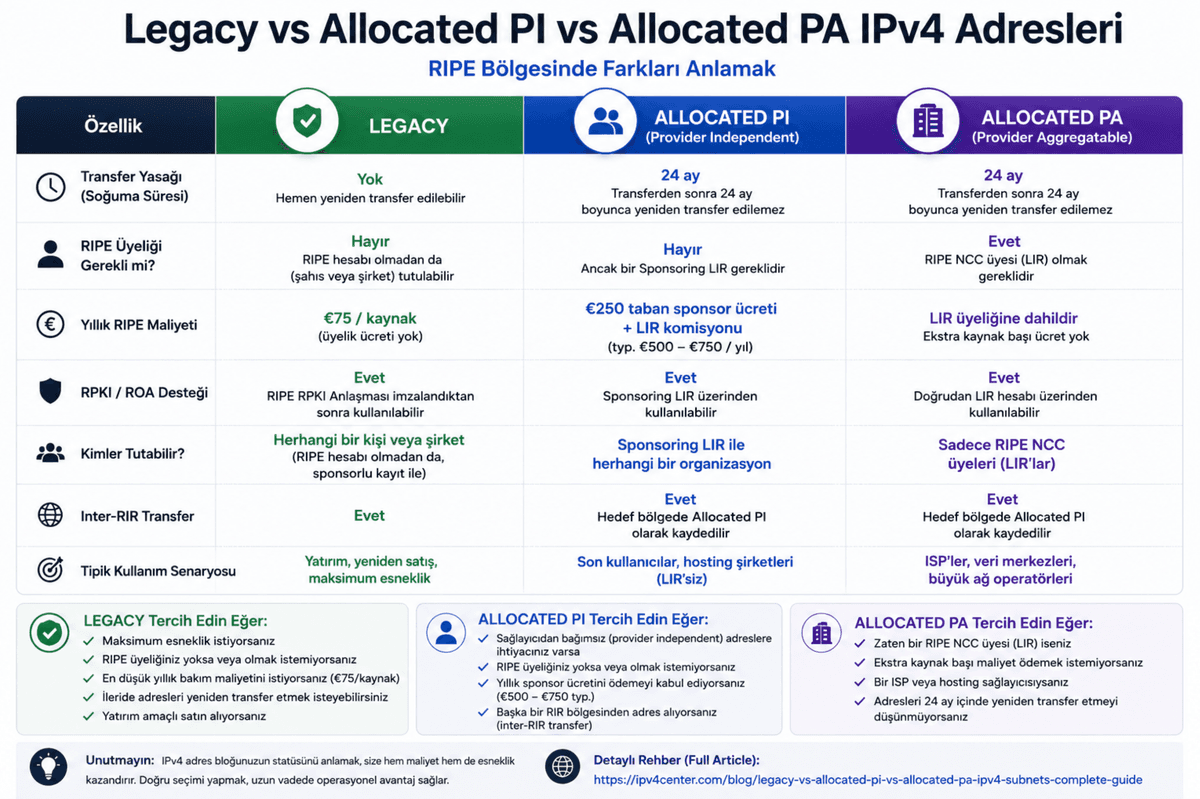
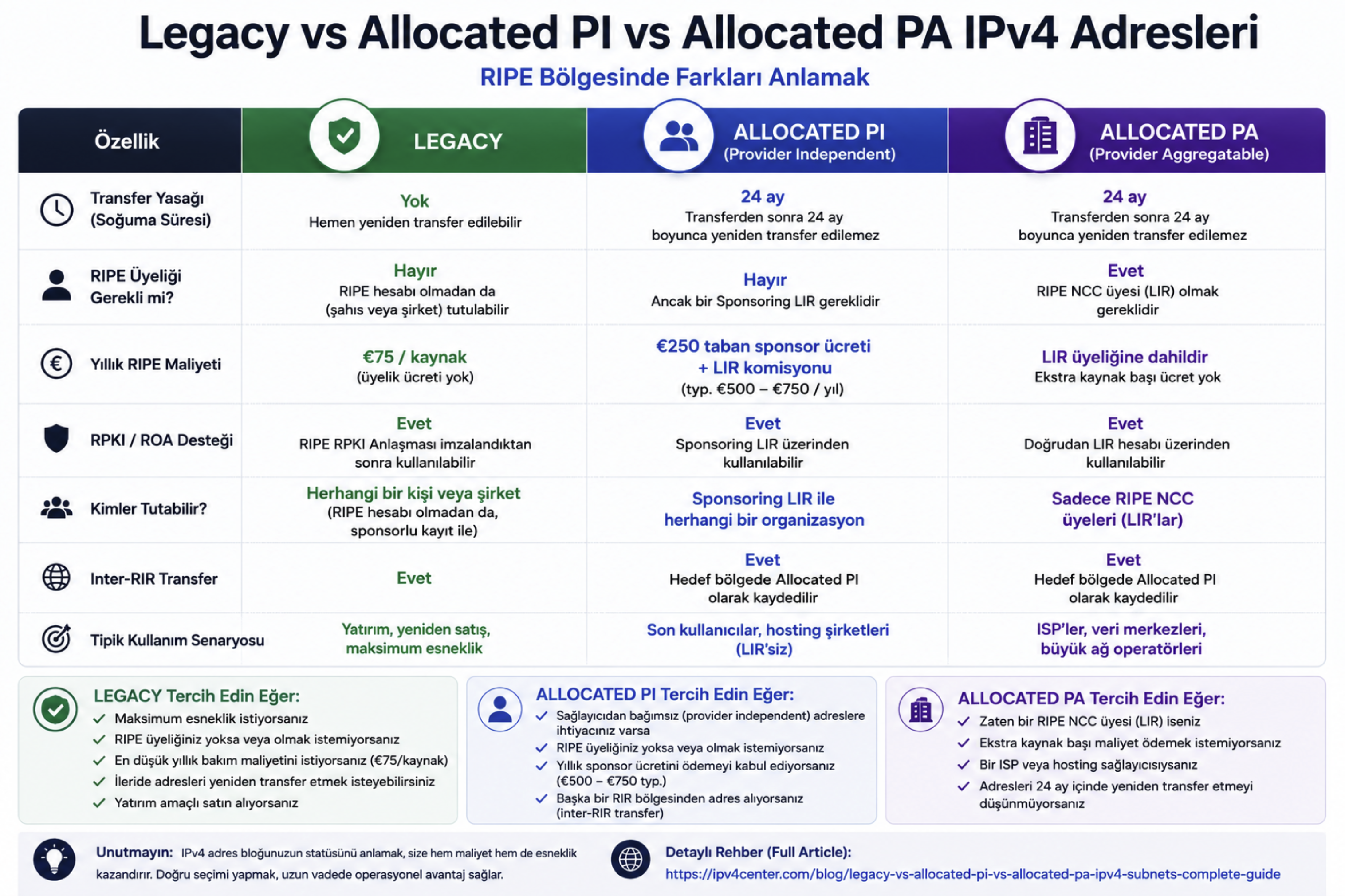
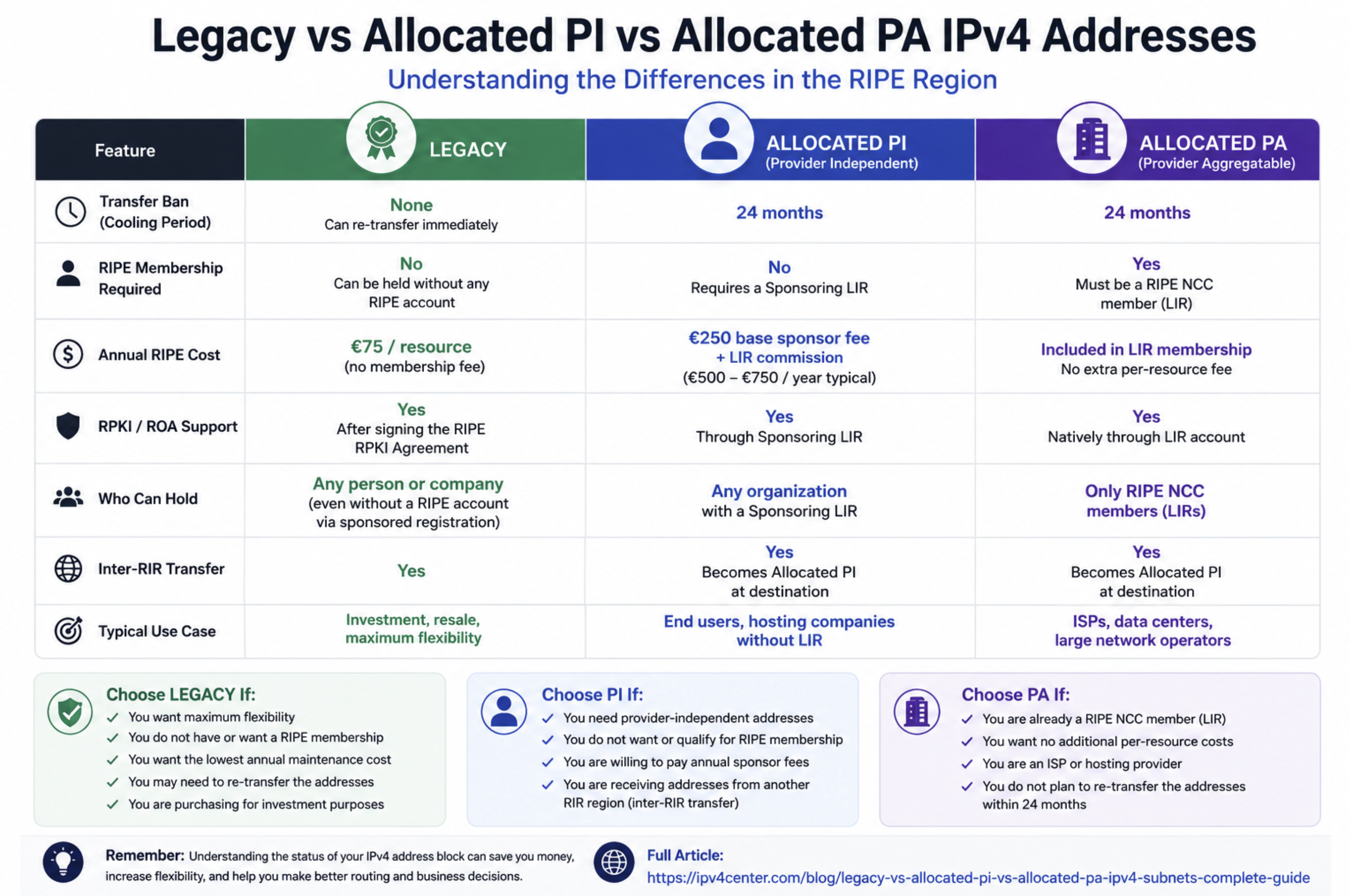
| Feature | Legacy | Allocated PI | Allocated PA |
|---|---|---|---|
| Transfer Ban (Cooling Period) | None — can re-transfer immediately | 24 months | 24 months |
| RIPE Membership Required | No — can be held by individuals or companies without any RIPE account | No — but requires a Sponsoring LIR | Yes — must be a RIPE NCC member (LIR) |
| Annual RIPE Cost | €75 per resource (no membership fee) | €250 base sponsor fee + LIR commission (€500–€750/year typical) | Included in LIR membership — no extra per-resource fee |
| RPKI / ROA Support | Yes — after signing the RIPE RPKI Agreement | Yes — through Sponsoring LIR | Yes — natively through LIR account |
| Who Can Hold | Any person or company (even without a RIPE account via sponsored registration) | Any organization with a Sponsoring LIR | Only RIPE NCC members (LIRs) |
| Inter-RIR Transfer | Yes | Yes — becomes Allocated PI at destination | Yes — becomes Allocated PI at destination |
| Typical Use Case | Investment, resale, maximum flexibility | End users, hosting companies without LIR | ISPs, data centers, large network operators |
Legacy IPv4 Addresses — Maximum Flexibility
What Are Legacy Addresses?
Legacy IPv4 addresses are those that were allocated before the Regional Internet Registry (RIR) system was fully established — generally before the mid-1990s. These addresses predate the current RIPE NCC policies and operate under a special set of rules that make them the most flexible type of IPv4 resource.
No Transfer Ban
This is the single biggest advantage of Legacy addresses. Unlike Allocated PI and PA resources, Legacy addresses have no 24-month transfer cooling period. Once a Legacy block is transferred to your account, you can re-transfer it to another party immediately. This makes Legacy blocks ideal for organizations that may need to restructure their IP holdings, or for investment purposes.
No RIPE Membership Required
Legacy addresses can be held by any individual or company, even without a RIPE NCC LIR account. They can be transferred to:
- A personal name (individual registration)
- A company that has no RIPE membership
- A sponsored account — where another LIR acts as your sponsor
Even if the recipient has never had any RIPE account before, Legacy addresses can still be transferred to them. RIPE NCC will create a sponsored object for the holder.
Cost Structure
Since no LIR membership is required, the ongoing cost for Legacy resources is minimal:
- €75 per resource per year — this is the RIPE NCC service fee for maintaining the registration
- No membership fee
- No sponsor commission (unlike PI addresses)
This makes Legacy addresses significantly cheaper to maintain on an annual basis compared to both PI and PA addresses.
RPKI Support for Legacy Addresses
A common misconception is that Legacy addresses cannot use RPKI. This is incorrect. Legacy resource holders can absolutely use RPKI by signing the RIPE RPKI Agreement — a simple document that grants RIPE NCC permission to issue RPKI certificates for your Legacy resources. Once signed, you can create ROA (Route Origin Authorization) records just like any other resource type, securing your BGP announcements against hijacking.
Market Premium
Due to their flexibility — no transfer ban, no membership requirement, low annual cost — Legacy addresses typically command a price premium of 10–20% over equivalent PA or PI addresses. This premium is well justified for organizations that value flexibility and lower ongoing costs.
Allocated PA (Provider Aggregatable) — For RIPE Members
What Are Allocated PA Addresses?
Allocated PA addresses are the standard address type distributed by RIPE NCC to its members (LIRs — Local Internet Registries). When RIPE NCC allocates new IPv4 address space, it is always assigned as PA. These are the most common type of IPv4 address in the RIPE region.
24-Month Transfer Ban
After receiving PA addresses through a transfer, you cannot re-transfer them for 24 months. This cooling period is a RIPE NCC policy designed to prevent speculative trading. The 24-month clock starts from the date the transfer is completed in the RIPE database.
RIPE Membership Required
To hold Allocated PA addresses, you must be a RIPE NCC member (LIR). This means:
- You need to establish an LIR account with RIPE NCC
- You must pay annual LIR membership fees (varies by resource size, starting around €1,400/year)
- Non-members cannot receive PA addresses — they cannot use a sponsor for PA resources
Cost Structure
The advantage of PA addresses from a cost perspective is that there is no additional per-resource fee. Your LIR membership covers all your PA allocations. If you already have an LIR account, adding more PA address space does not increase your annual costs to RIPE (though your membership tier may change based on total resource size).
RPKI Support
PA addresses have full, native RPKI support through your LIR account. You can create and manage ROA records directly through the RIPE NCC portal or API without any additional agreements.
Allocated PI (Provider Independent) — The Sponsored Option
What Are Allocated PI Addresses?
Provider Independent addresses are assigned to end users who need their own address space but do not want to (or cannot) become a RIPE NCC member. PI addresses are "provider independent" because they are not tied to a specific ISP — the holder can use them with any upstream provider.
24-Month Transfer Ban
Like PA addresses, PI addresses are subject to a 24-month transfer cooling period. After receiving PI resources via transfer, you must wait 24 months before you can transfer them to another party.
Sponsoring LIR Model
You do not need your own RIPE NCC membership to hold PI addresses. Instead, another company that is a RIPE member (an LIR) acts as your Sponsoring LIR. The sponsor:
- Opens a sponsored account on your behalf in the RIPE database
- Manages the administrative relationship with RIPE NCC
- May provide RPKI management services
You retain full operational control over the IP addresses — the sponsor is purely an administrative intermediary.
Cost Structure
This is where PI addresses become notably more expensive than Legacy. The costs include:
- RIPE NCC base sponsor fee: €250/year — this is what RIPE charges the sponsoring LIR
- Sponsor LIR commission: varies — most sponsors add their own margin on top of the RIPE fee
- Typical total annual cost: €500–€750/year — depending on the sponsoring LIR you choose
Some sponsors charge more for additional services like RPKI management, database object maintenance, or premium support.
RPKI Support
PI addresses support RPKI through the Sponsoring LIR. The sponsor manages the RPKI certificates, and ROA records can be created through them. Some sponsors offer API-based or portal-based RPKI management for their sponsored customers.
Inter-RIR Transfers
All three address types — Legacy, PI, and PA — can be transferred between different RIR regions (inter-RIR transfers). For example, an ARIN-registered block can be transferred to the RIPE region. When an address block enters the RIPE region through an inter-RIR transfer:
- It is registered as Allocated PI in the RIPE database
- The standard PI rules apply (24-month transfer ban, sponsoring LIR required if not an LIR member)
- The original status in the source RIR is no longer relevant
This means that even organizations without a RIPE membership can acquire address space from other regions and hold it as PI in RIPE — a useful option for organizations expanding into the European market.
Which Address Type Should You Choose?
Choose Legacy If:
- You want maximum flexibility with no transfer restrictions
- You do not have or want a RIPE NCC membership
- You want the lowest annual maintenance cost (€75/resource)
- You may need to re-transfer the addresses in the future
- You are purchasing for investment purposes
Choose Allocated PA If:
- You are already a RIPE NCC member (LIR)
- You want no additional per-resource annual costs
- You are an ISP or hosting provider assigning addresses to customers
- You do not plan to re-transfer the addresses within 24 months
Choose Allocated PI If:
- You need provider-independent addresses
- You do not want or qualify for RIPE membership
- You are willing to pay annual sponsor fees (€500–€750)
- You are receiving addresses from another RIR region (inter-RIR transfer)
Common Misconceptions Corrected
- “Legacy addresses cannot use RPKI” — Wrong. You can use RPKI by signing the RIPE RPKI Agreement.
- “You need a RIPE account to hold Legacy addresses” — Wrong. Legacy can be held by anyone, even without a RIPE account.
- “All transferred addresses have a 24-month ban” — Wrong. Legacy addresses have no transfer ban.
- “PA and PI have the same cost structure” — Wrong. PA has no per-resource fee (covered by membership), while PI has ongoing sponsor costs.
- “Inter-RIR transfers change the address to Legacy” — Wrong. Inter-RIR transfers into RIPE result in Allocated PI status.
Buy or Lease IPv4 Addresses
At IPv4.center, we offer all three address types for purchase on our marketplace. Whether you need the flexibility of Legacy, the membership efficiency of PA, or the accessibility of PI, you can find the right block for your needs. Browse our marketplace to see current listings.